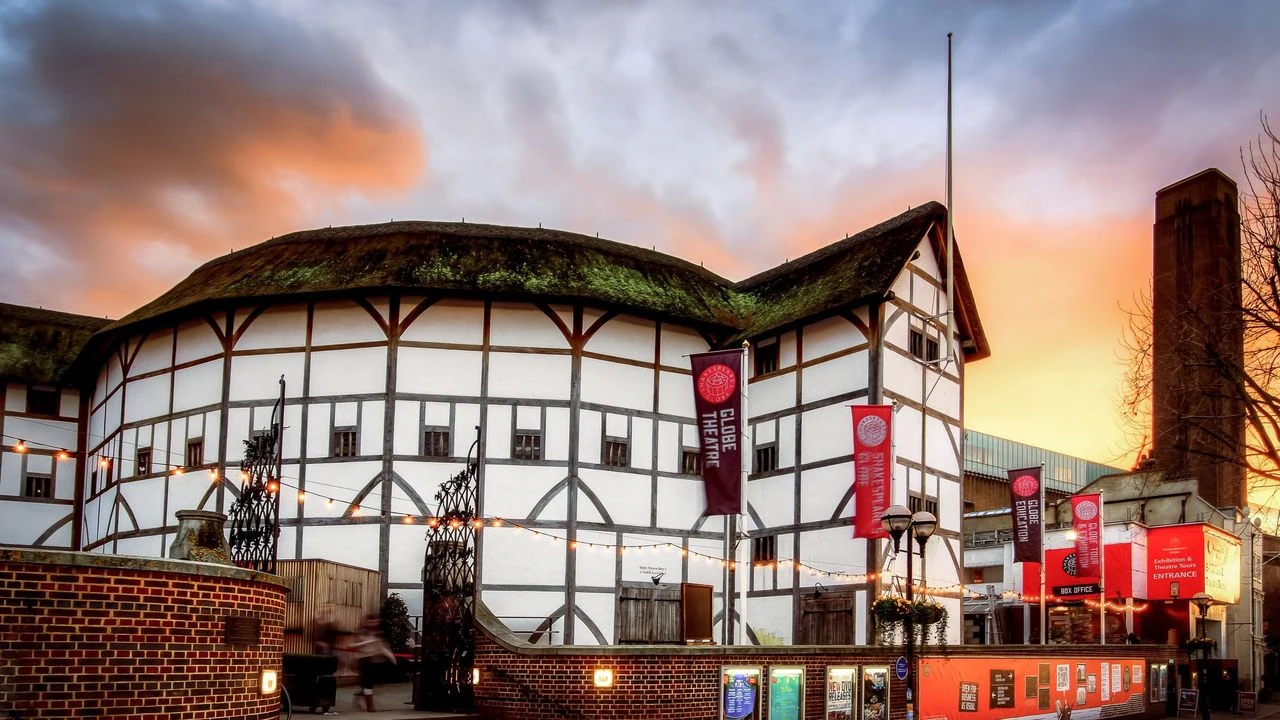
The Globe Theatre is not one building but two, separated by centuries and by a short walk across Southwark. The first opened in 1599 as the playhouse of Shakespeare’s company, the Lord Chamberlain’s Men. It burnt down during a performance in 1613, was rebuilt the following year and was eventually demolished after London’s theatres were closed. The modern Shakespeare’s Globe, opened in 1997, is an academic reconstruction about 750 feet from the original site. Together, the buildings’ histories tell a story of commercial theatre, changing city life and the continuing effort to stage Shakespeare in London.
A playhouse built from another theatre
The Globe’s timber came from an earlier London playhouse, The Theatre, which had been built in Shoreditch in 1576. Its owner, James Burbage, had leased the land, but a dispute arose when the lease expired and the landlord, Giles Allen, claimed the building. On 28 December 1598, while Allen was away, carpenter Peter Street and members of the acting company dismantled The Theatre beam by beam. They stored the timbers near Bridewell, then transported them across the Thames the following spring to Southwark.
The new playhouse was not simply The Theatre reassembled. It was larger, and its construction cost £700. The chosen plot lay south of Maiden Lane, near the river and an established district of entertainment, but the ground was marshy and liable to flooding at high tide. Builders raised it with a bank of earth reinforced by timber. The Globe was probably complete by the summer of 1599. Its precise opening date is uncertain: a performance of Julius Caesar witnessed by the Swiss visitor Thomas Platter on 21 September is one possible candidate, while the first securely recorded performance was Ben Jonson’s Every Man out of His Humour later that year.
The theatre belonged to actors who were also shareholders in the Lord Chamberlain’s Men. Richard Burbage and his brother Cuthbert each held a quarter; Shakespeare, John Heminges, Augustine Phillips and Thomas Pope initially held smaller shares. The proportions changed as new shareholders joined, and Shakespeare’s share declined over time. The arrangement linked the work on stage to the business of running the playhouse: actors were not only performers but investors in the company and its venue.
An open-air theatre and its audiences
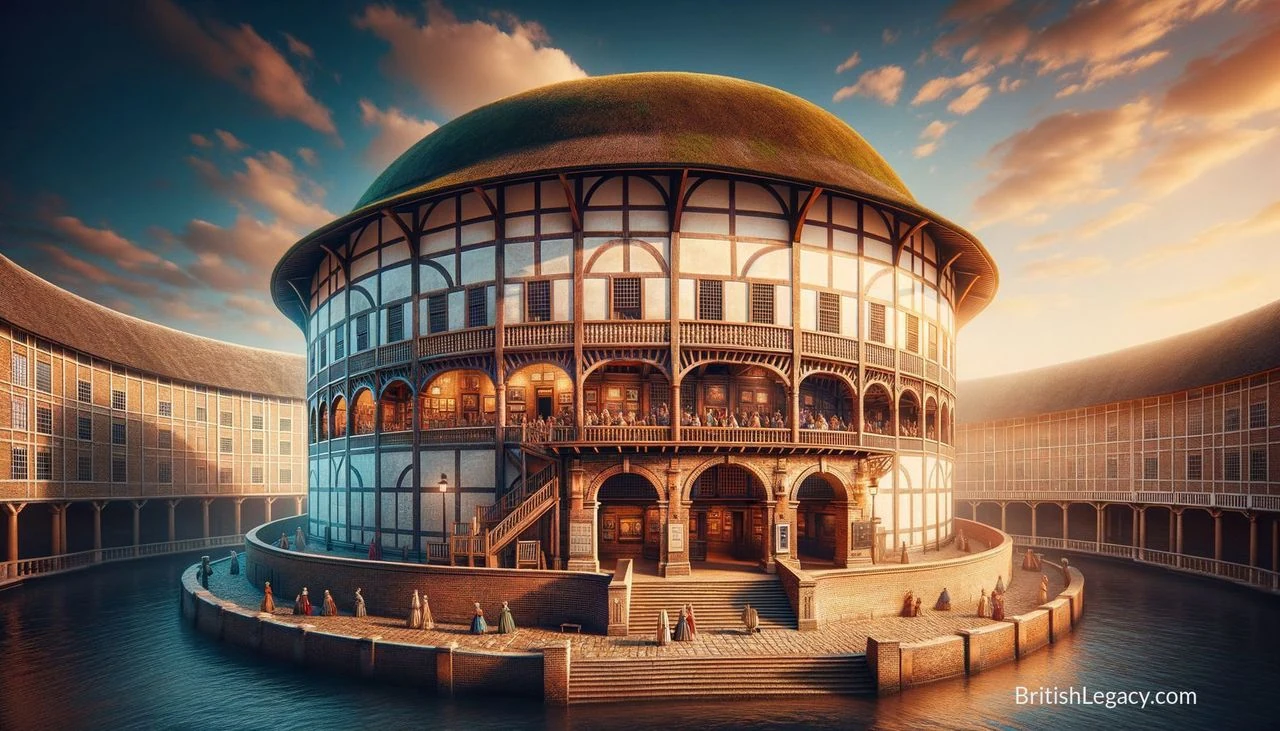
The Globe’s exact dimensions are not known. Scholarly estimates describe a three-storey, open-air amphitheatre roughly 100 feet in diameter, able to hold as many as 3,000 people. Although often pictured as round, excavations in 1988–89 suggested a polygon with 20 sides. The surviving evidence therefore gives a useful sense of its scale without making every detail of its shape certain.
A stage projected into the open yard, placing standing spectators on three sides of the performance. These spectators, known as groundlings, paid a penny to stand on the earthen floor. More expensive seats rose in tiers around them. The platform measured about 43 feet wide and 27 feet deep, stood roughly five feet above the ground and had a trapdoor connecting it with the space below. Behind it were doors leading to the tiring house, where actors dressed and waited to enter. A balcony above the doors could serve scenes that required an upper level, while musicians could also perform there.
A roof covered the back part of the stage. Its underside, known as the heavens, was painted with clouds and had a trapdoor through which performers could descend by rope and harness. The stage was positioned in the south-east corner so that it would be in shade during summer afternoon performances. Archaeological traces and historical images have helped researchers reconstruct these features, but some details remain disputed. The Globe’s theatrical design was thus shaped by both practical conditions and the evidence later generations have been able to recover.
Fire, rebuilding and closure
On 29 June 1613, a theatrical cannon fired during a performance of Shakespeare’s Henry VIII set the Globe’s thatch and wooden structure alight. The fire destroyed the building. One surviving account says that no one was hurt apart from a man whose burning breeches were put out with a bottle of ale. The theatre was rebuilt the following year at a reported cost of £1,400, this time with a tiled roof.
The second Globe continued until the closures imposed during the First English Civil War. The Long Parliament ordered London’s theatres to close in September 1642. The Globe was later pulled down, probably in 1644–45, to make way for tenements. The commonly repeated precise date of 15 April 1644 is not supported by a reliable document. The theatre’s story therefore includes two distinct endings: the fire that destroyed the first building and the later demolition of its replacement after public performance had been prohibited.
The Globe was associated with Shakespeare, but it was not a stage for his work alone. Early works by Ben Jonson, Thomas Dekker and John Fletcher were also performed there. Its place in London theatre history rests on the company and range of writers it brought together, as well as its lasting connection with Shakespeare.
Reconstruction near the original site
The modern theatre opened in 1997 as Shakespeare’s Globe, with a production of Henry V. The project grew from the vision of American actor and director Sam Wanamaker. Its location is about 230 metres from the original playhouse, rather than on the same plot. That distinction matters: the reconstruction is not a restored Elizabethan building but an informed interpretation based on evidence for both the 1599 and 1614 Globes.
Archaeologists uncovered a small portion of the original foundations in 1989 beneath a car park behind Anchor Terrace on Park Street. The site lies mostly beneath the listed terrace, limiting further excavation. The exposed foundations indicate a 20-sided shape, and their outline is now marked at ground level. This discovery gave the modern project physical evidence to work with, alongside images and historical records, but it could not resolve every question about the original design.
The modern Globe has also presented Shakespeare alongside works by contemporary playwrights and has been described as a venue for education through workshops and lectures. Performances and educational activity can introduce audiences to the conditions of early modern theatre as well as to the plays themselves. Claims that modern spectators experience precisely the same acoustic and visual conditions as the original audience should be treated cautiously: the reconstruction is an approximation, not an exact survival of the 1599 building.
Why the Globe Theatre deserves a place in British Legacy
The Globe deserves a place in British Legacy because its history brings together a distinctly London story of making, performance and adaptation. The first playhouse was built from timbers salvaged from The Theatre in Shoreditch, transported across the Thames and assembled on a difficult Southwark site. Its stage, yard and tiers of seats accommodated a large public, while its ownership by actors connected theatrical performance with the practical business of running a company. Shakespeare’s association is central, but the Globe also hosted work by other writers, including Ben Jonson, Thomas Dekker and John Fletcher. Remembering the playhouse in this fuller context makes it part of a wider history of English theatre rather than simply a shrine to one writer.
The modern reconstruction extends that history without pretending to be the original. It opened near the old site, draws on archaeological and documentary evidence, and makes the study and performance of early modern drama visible in contemporary London. Its value lies partly in what it can show about theatrical space: the relationship between stage and audience, the practical arrangements behind a performance and the way a playhouse sits within the city around it. The Globe’s successive buildings also show how cultural inheritance depends on interpretation. The original burned, its successor was demolished, and the present theatre was built from the evidence that remained. That is a specific British legacy: not an unbroken monument, but a continuing effort to understand and renew a significant part of London’s theatrical past.
Sources
Globe Theatre (revision 1372182986)
Adapted in part from Globe Theatre by Wikipedia contributors, under CC BY-SA 4.0. Text has been edited and combined with the existing article; this adapted text is shared under the same licence. Contributor history.