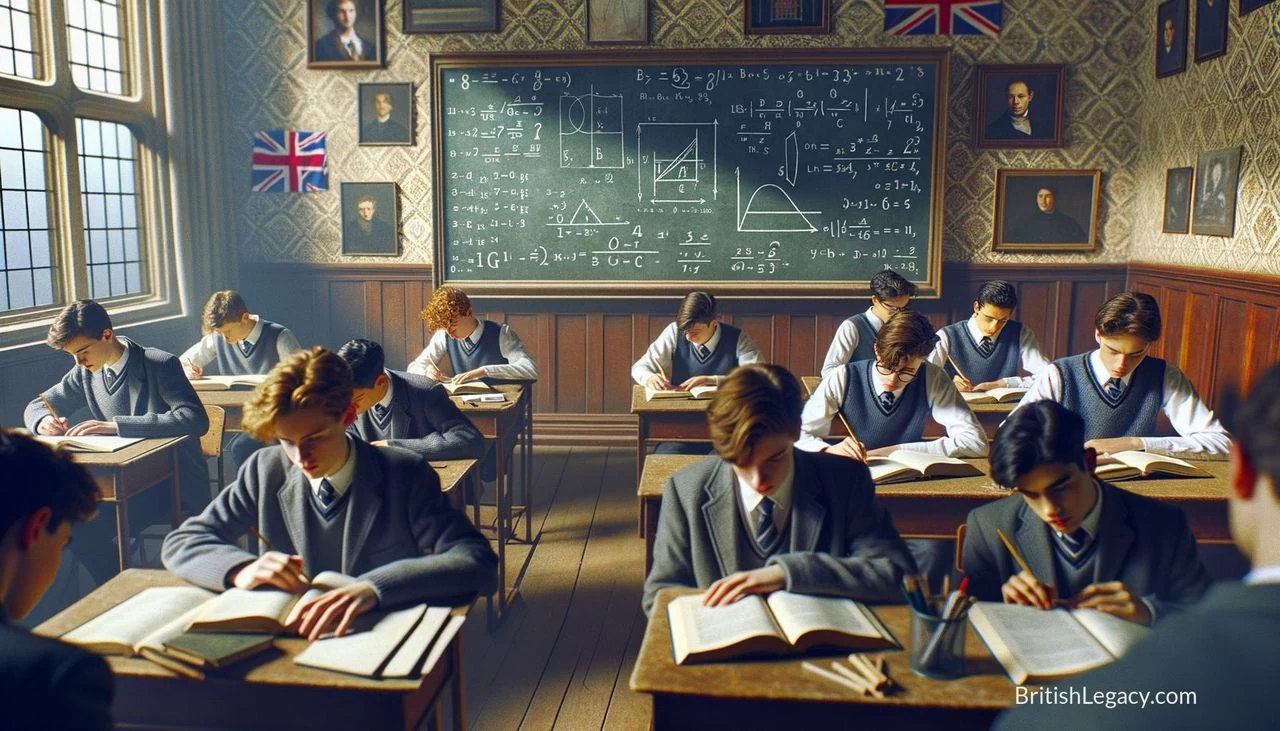
In Alan Bennett’s The History Boys, a group of bright pupils at a fictional Sheffield grammar school prepare for university entrance examinations while their teachers argue, in very different ways, over what education is for. The play moves between examination tactics and learning for its own sake, with humour and adolescent desire complicating the lessons. First staged at the National Theatre in London in 2004, it became a major British stage production, travelling to Broadway and returning to theatres in Britain and abroad.
A school in Sheffield, and three competing teachers
The play is set in the mid-to-late 1980s at Cutlers’ Grammar School, a fictional boys’ school in Sheffield. Its history pupils are working towards entrance examinations for Oxford and Cambridge. The headmaster wants the school to improve its standing in academic league tables, and recruits Irwin, a supply teacher, to coach the boys. His approach is calculated and exam-focused: he encourages them to shape their answers for effect as well as substance.
Irwin’s methods contrast with those of Hector, an eccentric English and general studies teacher who values knowledge beyond its usefulness in an examination. His lessons range across poetry, film and performance, and resist the idea that education should be measured only by results. Mrs Dorothy Lintott, the school’s history teacher, offers a third presence in the classroom. Her practical teaching sits alongside the contest between Hector’s expansive ideal and Irwin’s hard-edged coaching.
The pupils are unruly, funny and various. Posner, the youngest, is gay and Jewish, and his feelings for Dakin are part of the play’s treatment of desire and identity. Dakin is also the object of Irwin’s affection. The boys’ different personalities—among them Rudge’s athleticism, Scripps’s piano playing and Timms’s jokes—make the group more than a single portrait of academic ambition. Their friendships and exchanges give the classroom its comedy, while the adult characters’ conduct complicates any easy distinction between teaching and personal influence.
Education, ambition and boundaries
The play’s central dispute is not simply between a good teacher and a bad one. Hector’s commitment to learning for its own sake offers the boys a way to think beyond examinations, but his methods are unconventional and his relationship with them raises questions of professional boundaries. Irwin’s coaching can help pupils present themselves effectively, yet it also treats education as a route to measurable success. The headmaster’s ambitions give that pressure an institutional shape: the boys’ results matter to the school as well as to their futures.
By placing those arguments in a grammar school during the 1980s, Bennett connects the classroom to wider debates about education and its purposes. The play asks what is lost when learning is reduced to economic or academic utility, without pretending that examinations and university places are unimportant to the pupils. Its account of adolescence also brings sexuality into the school setting. Posner’s experience is shaped by the limits of acceptance around him, while the teachers’ own desires and conduct expose the unequal responsibilities of adults and pupils.
Comedy is not an escape from these tensions. It lets the characters display their wit and self-invention, but also draws attention to the performance involved in both classroom teaching and examination success. Irwin’s coaching encourages the boys to make an impression; Hector’s lessons ask them to absorb words and ideas that may have no immediate practical payoff. The play’s questions persist because neither approach can be reduced to a simple formula for a good education.
From the Lyttelton to Broadway and beyond
The History Boys opened at the Lyttelton Theatre, part of the National Theatre in London, on 18 May 2004. Nicholas Hytner directed the original production, whose cast included Richard Griffiths as Hector, Frances de la Tour as Mrs Lintott and Stephen Campbell Moore as Irwin. James Corden, Dominic Cooper, Russell Tovey, Sacha Dhawan, Samuel Barnett, Jamie Parker and Andrew Knott were among the original pupil cast. The production played to sell-out audiences, and its limited run was extended. It returned to the Lyttelton in November 2005, with changes to the cast, before touring.
The National Theatre production travelled to Hong Kong, Wellington and Sydney in 2006. The same production made its Broadway debut at the Broadhurst Theatre on 23 April that year. Its Broadway run was extended after the play’s success at American theatre awards. In London, it later played at Wyndham’s Theatre from January to April 2007, then returned there for another run from December 2007 to April 2008. UK and Ireland tours took the work to regional theatres, while a separate production by West Yorkshire Playhouse and Theatre Royal Bath toured in 2010 and was revived the following year.
The play received the 2005 Laurence Olivier Award for Best New Play. At the 2006 Tony Awards, it won Best Play, Best Performance by a Leading Actor for Richard Griffiths, Best Performance by a Featured Actress for Frances de la Tour, Best Direction for Nicholas Hytner, and awards for scenic and lighting design. Griffiths and Hytner also received Olivier Awards, while Samuel Barnett was nominated for an Olivier. The Broadway production’s reception extended beyond the Tonys: it won the New York Drama Critics’ Circle Award for Best Play and received awards from the Drama Desk and Outer Critics Circle.
Hytner directed a film adaptation, released in the United States in October 2006 and in the United Kingdom the following month, featuring the original stage cast. The work also travelled in other forms: productions included a Catalan adaptation in Barcelona and an Italian adaptation in Milan, as well as amateur and regional stagings in several countries. In 2013, members of the original cast reunited for the National Theatre’s 50th-anniversary celebration, performing the French lesson scene. Alan Bennett took the role of Hector in place of Griffiths, who had died earlier that year.
Why The History Boys deserves a place in British Legacy
The History Boys belongs in British Legacy because it makes a distinctly British educational setting the ground for questions that reach beyond the school gates. Its fictional Sheffield grammar school, Oxford and Cambridge entrance examinations, and anxious headmaster give the story a specific institutional world. Within it, Bennett tests two influential ideas about schooling: that knowledge has value in itself, and that education must also prepare pupils to succeed in a competitive system. The play gives neither argument the last word. Its humour and its disagreements make the costs and attractions of both approaches visible.
Its legacy is also recorded in the life of the production. The National Theatre staging drew audiences in London, toured internationally and reached Broadway, where it won major awards; later UK tours, overseas adaptations and a film carried the play to audiences beyond its first company. That reach matters not as a claim that the work speaks for every school or every pupil, but as evidence that its characters and questions travelled. The play joins the British theatrical tradition of using comedy to examine institutions and public values, while keeping its attention on particular teachers and boys. Its continuing value lies in the combination: a recognisable classroom, sharply distinct voices and an unsettled argument about what learning is for.
Sources
Adapted in part from The History Boys by Wikipedia contributors, under CC BY-SA 4.0. Text has been edited and combined with the existing article; this adapted text is shared under the same licence. Contributor history.