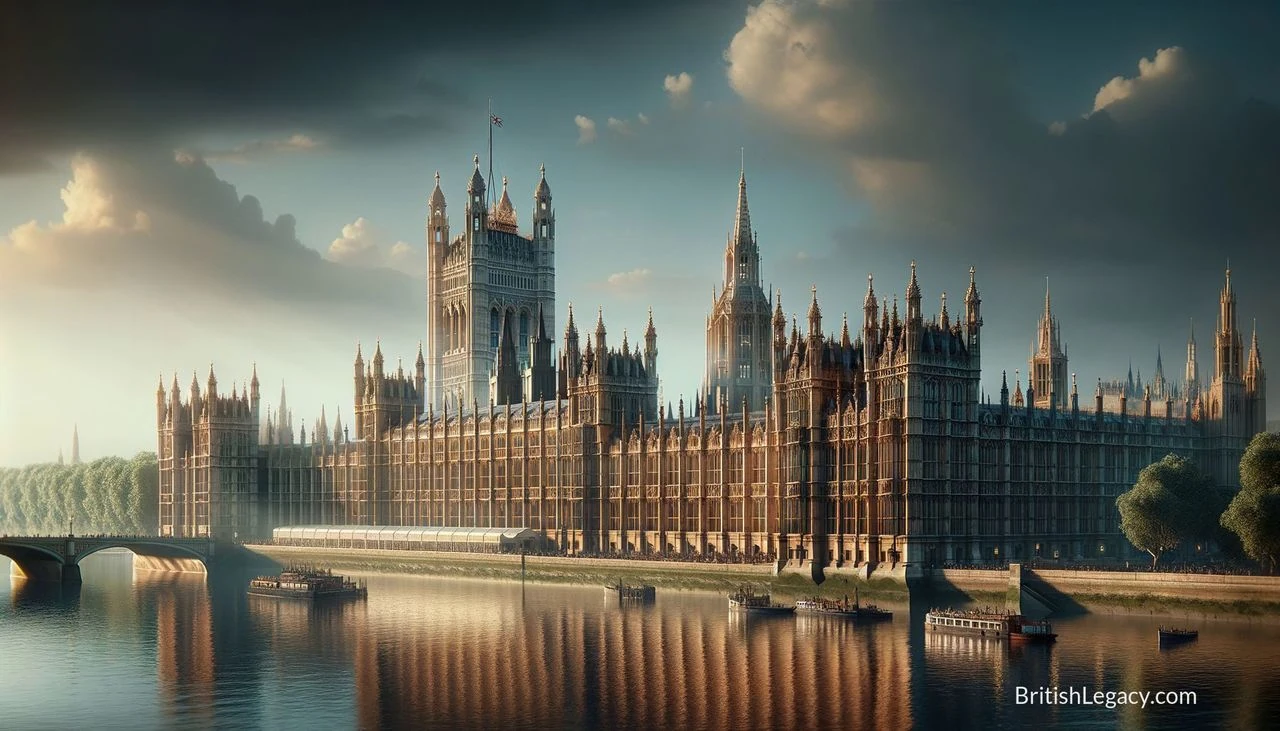
On the northern bank of the Thames in Westminster, the Palace of Westminster is both a familiar London landmark and the seat of the UK Parliament. Often called the Houses of Parliament, it is home to the House of Commons and the House of Lords. Its present form combines a site with medieval roots, surviving older buildings and a Gothic Revival complex shaped by reconstruction after the fire of 1834.
From royal residence to Parliament
The palace site began as a royal residence in the Middle Ages, during the reign of Edward the Confessor. Its association with royal life changed under Henry VIII, who considered the nearby Palace of Whitehall more suitable for royal functions. Westminster then became increasingly associated with parliamentary sessions and government. The building’s history is therefore not a simple change from one purpose to another: the royal origins of the site remain part of the story of a place that became a centre of parliamentary activity.
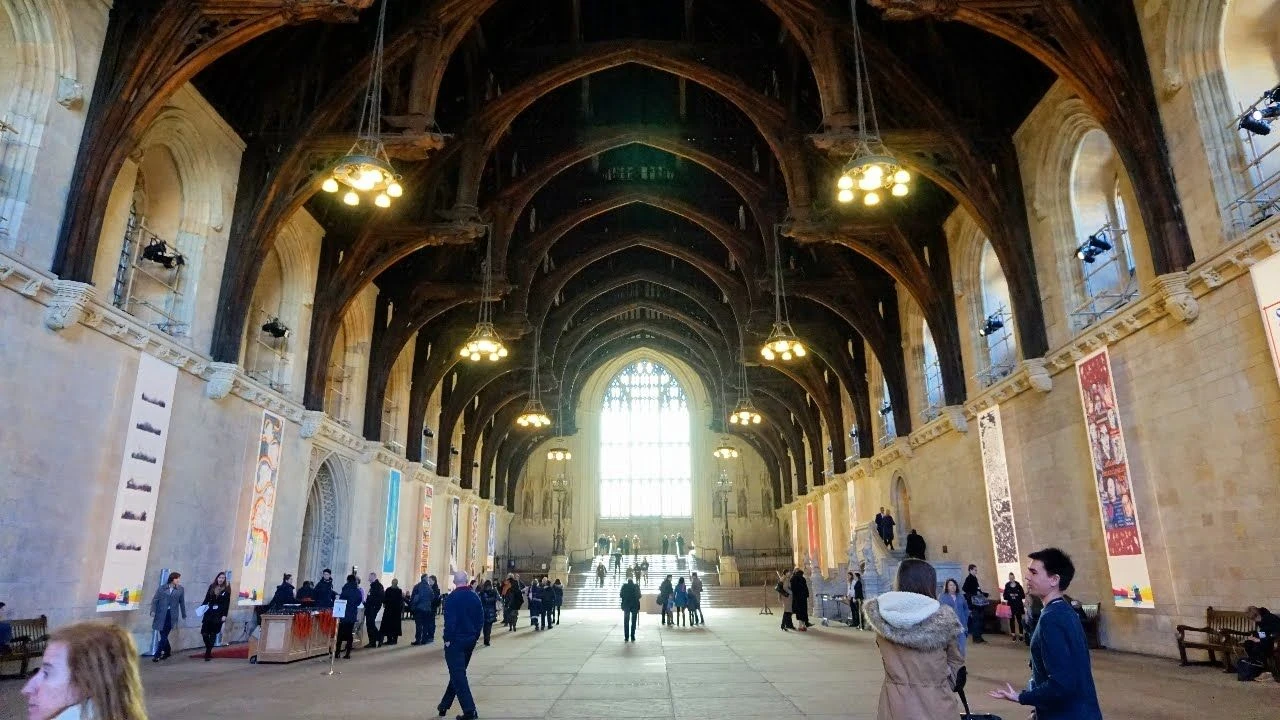
A major turning point came in 1834, when fire destroyed most of the medieval palace. Westminster Hall, the Jewel Tower, the Undercroft Chapel and the cloisters were among the parts that survived. These remains sit alongside the rebuilding that followed, making the palace a complex with both older elements and a much later architectural identity.
Sir Charles Barry led the reconstruction, with Augustus Pugin responsible for decorative work. Their design gave the palace its Gothic Revival character. The result was not simply a replacement for what had been lost: the rebuilt structure gave parliamentary activity a monumental architectural setting, while the surviving medieval buildings kept visible links to the earlier site. The fire and rebuilding thus mark a clear break in the palace’s physical history, but not a complete erasure of its past.
Architecture and the work of Parliament
The palace’s façade, ornate detailing and towers have made it one of London’s most recognisable landmarks. Its most familiar tower is the Elizabeth Tower. Big Ben is the name of the great bell, rather than the tower itself, though the names are often confused. The clock tower and bell have helped make the building’s outline recognisable well beyond Westminster.
Inside, the Central Lobby provides access to both parliamentary chambers. The House of Commons meets in a chamber furnished in green; the House of Lords meets in one associated with red and gold. The two rooms give the UK Parliament’s bicameral structure a distinct physical form. They are not simply features within an historic building: they are where the two houses conduct their parliamentary business.
The palace’s importance consequently rests on continued use as well as its architecture. Members of Parliament debate and legislate there, and the Commons and Lords bring two different chambers together within one complex. The building is also associated with the long development of parliamentary government and with changes in political participation, including the Representation of the People Act. These broad historical connections belong alongside the more immediate fact of Parliament continuing to meet within its walls.
A landmark recognised beyond Westminster
The Palace of Westminster is part of a UNESCO World Heritage Site and is among the most recognisable features of London’s riverside. Its Gothic Revival outline, Elizabeth Tower and great bell have given it a prominent place in the city’s image. Visitors are drawn to a building that remains both an architectural landmark and a setting for current parliamentary work.
The British parliamentary system has influenced other governments, although the extent and specific examples of that influence are not detailed here. The palace’s international recognition is evident in the association between its distinctive architecture and Parliament. Its name and image can stand for British political life, but the building is more than a symbol: it remains a place where the Commons and Lords meet and conduct their work.
Why the Palace of Westminster deserves a place in British Legacy
The Palace of Westminster deserves a place in British Legacy because its history brings together the changing uses of a single site. A royal residence associated with Edward the Confessor became a focus for parliamentary sessions after royal functions shifted towards Whitehall. The fire of 1834 destroyed much of the medieval palace, but Westminster Hall, the Jewel Tower, the Undercroft Chapel and the cloisters survived. Barry and Pugin’s reconstruction gave the complex its Gothic Revival character, creating a landmark whose architecture reflects both loss and renewal.
Its legacy is not confined to its appearance. The Commons and Lords continue to meet in the palace, making it a working setting for debate and legislation as well as a defining part of London’s riverside. The Central Lobby connects the two chambers, while the Elizabeth Tower and its bell have become instantly recognisable features. Together, the building’s medieval roots, nineteenth-century rebuilding and continuing parliamentary role explain its specific place in British public life. Remembering the palace means recognising both a distinctive architectural inheritance and an institution that remains in use.