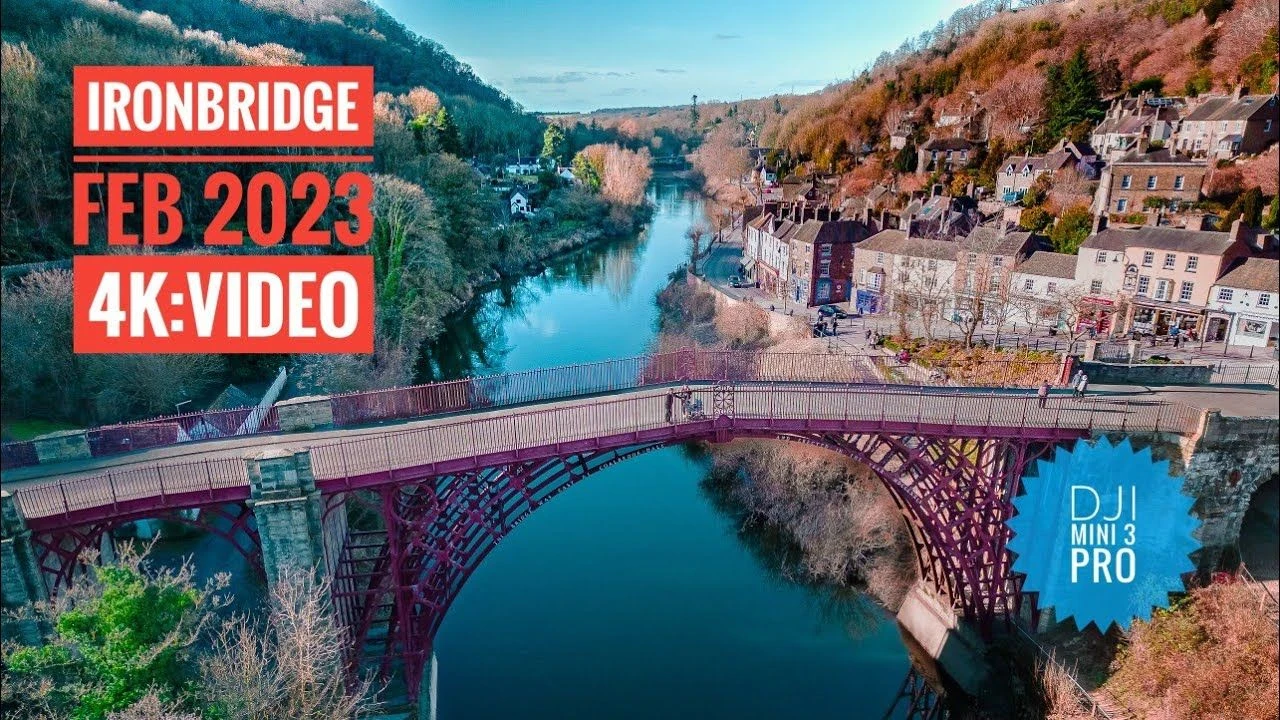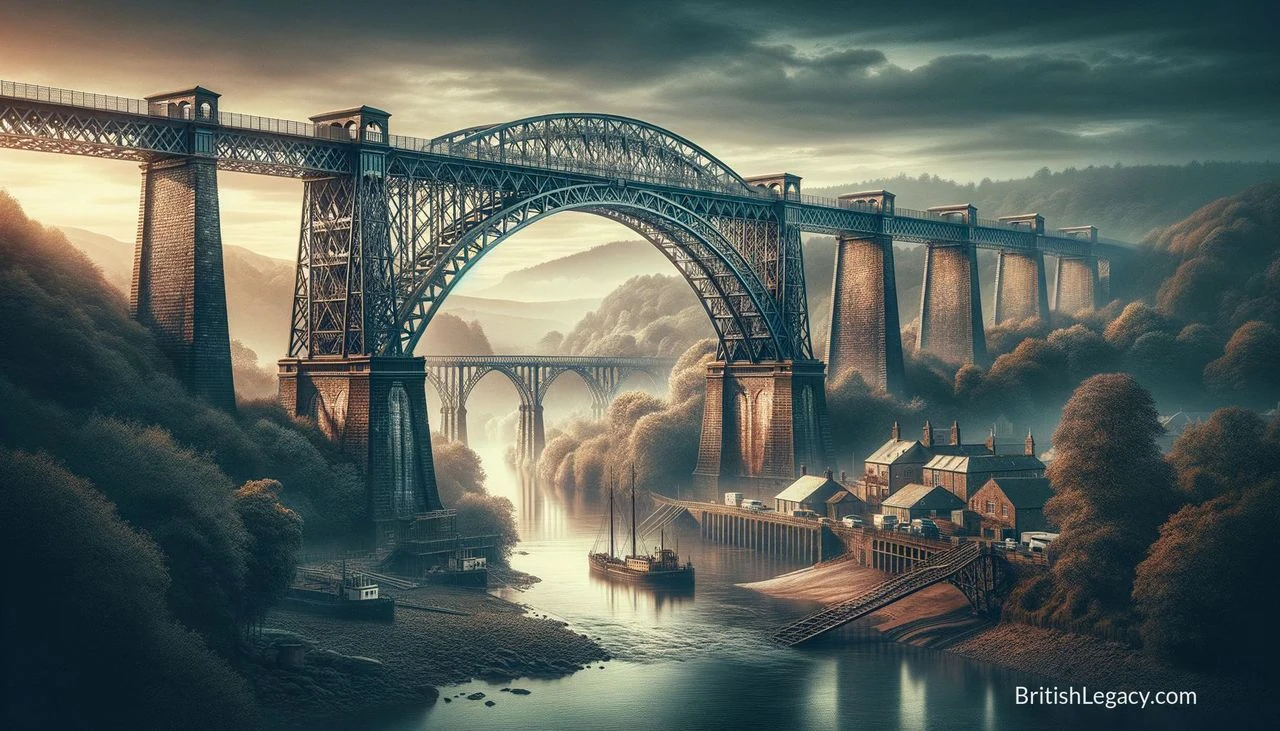
At Ironbridge Gorge, the River Severn once separated neighbouring industrial communities as well as carrying the boats that served them. The Iron Bridge addressed both problems with a bold single-span crossing: its cast-iron arch left the river navigable below while connecting Broseley, Madeley and Coalbrookdale. Opened in 1781, it was the world’s first major bridge made of cast iron. Its importance lies not in being the first iron bridge of any kind, but in demonstrating that cast iron could be used on this scale for a working river crossing.
A gorge shaped by industry
The gorge’s steep sides made a bridge difficult to build, but the resources near its surface helped make the surrounding district an important industrial centre. Coal, iron ore, fire clay and limestone could be mined locally, while the Severn offered a route for moving goods. Abraham Darby I had smelted local iron ore using coke made from Coalbrookdale coal in 1709. By the later eighteenth century, the river was both a trading route and an obstacle to movement between the industrial parishes of Broseley and Madeley. The nearest bridge was at Buildwas, about two miles away.
A crossing at Ironbridge Gorge needed to accommodate boat traffic and span difficult ground. The banks were steep and unstable, and roads on the two sides did not meet at a natural crossing point. A single high arch offered a way to keep a navigable channel open beneath the bridge. The location also had high approaches on either side and relatively solid ground, although the gorge’s instability would remain a challenge for the structure’s long-term upkeep.
From proposal to construction
Architect Thomas Farnolls Pritchard proposed a cast-iron bridge in a letter to local ironmaster John Wilkinson in 1773. Pritchard had designed wooden and stone bridges as well as decorative and funerary work. His proposal was for a material whose use in a bridge on this scale remained uncertain. An iron bridge had partly been built at Lyon in 1755 before the project was abandoned, while a smaller wrought-iron footbridge had been erected at Kirklees in 1769. The Iron Bridge was therefore a first of particular consequence: the first major bridge in the world made from cast iron.
After funds were raised by subscription, Abraham Darby III, an ironmaster at Coalbrookdale and grandson of Abraham Darby I, was appointed treasurer. He was later commissioned to cast and build the bridge. The trustees considered other materials and sought alternative plans before agreeing to proceed with Pritchard’s design. Pritchard died in December 1777, about a month after construction had begun, so he did not live to see his design completed.
The masonry and abutments were built between 1777 and 1778. The ironwork was assembled in 1779, and the bridge first spanned the river on 2 July that year. It opened to traffic on 1 January 1781. Five sectional cast-iron ribs form its main arch, which spans 100 feet 6 inches, or about 30.6 metres. The structure used 378 long tons and 10 hundredweight of iron—about 384.6 tonnes—and comprises almost 1,700 individual components. These were cast to fit their particular positions rather than made to standard dimensions. The heaviest pieces weighed more than five tonnes.
Cast iron, carpentry and the river
The bridge’s form draws on carpentry: its cast-iron members use interlocking details including mortise-and-tenon joints and dovetails. The ribs create a truss arch, with interlocking rings between them. This combination of familiar construction logic and a new material made the bridge a practical experiment as well as a striking crossing. Its outer ribs carry an inscription recording that it was cast at Coalbrookdale and erected in 1779.
Cast iron is strong in compression but more brittle and less suited to tension and bending than wrought iron or steel. That distinction matters to the bridge’s history: its achievement was not proof that cast iron was ideal for every structural use, but evidence that it could work successfully in a carefully designed arch. The open form also proved valuable during floods. In February 1795, the Iron Bridge survived a major Severn flood that swept away nearby bridges.
The bridge’s success encouraged further use of cast iron in bridge building. Later examples included the Wearmouth Bridge, built between 1793 and 1796, and the rebuilt Coalport Bridge. Thomas Telford’s replacement bridge at Buildwas, also built after the 1795 flood, had a longer span while using less than half the iron. The Iron Bridge was part of a developing engineering tradition, not the final word in bridge design. Wrought iron later became a preferred structural material, and steel-making advances brought further change.
Repairs, closure and conservation
Keeping the bridge secure was a recurring task. Movement in the gorge and pressure on the abutments prompted repairs in the 1780s and 1790s. Further work followed in the nineteenth century, including the replacement of stone land arches with timber and, later, cast iron. The structure survived, but its reputation for strength did not spare it from cracking, movement and repeated repair.
As road traffic increased, concerns grew about the weight of vehicles and the bridge’s condition. A weight limit was imposed, but the trustees closed it to vehicles from 18 June 1934. Pedestrians continued to pay tolls until 1950, when the bridge passed into public ownership. Proposals to demolish or relocate it were raised in the decades that followed, but a conservation programme instead repaired its foundations between 1972 and 1975. Work included a concrete inverted arch beneath the river to counter movement of the abutments, lighter road surfacing and repairs to the stonework. The tollhouse was also restored as an information centre.
A further major conservation project began in 2017 after surveys identified stresses in the ironwork, historic ground movement and damage associated with a nineteenth-century earthquake. The work included repairs to the ribs, arches, stonework and decking. Forensic analysis led to the bridge’s red-brown colour being restored, replacing the blue-grey finish used before the project. It reopened on 6 December 2018.
A landmark within a wider heritage landscape
The town of Ironbridge developed at the northern end of the crossing and took its name from it. The bridge, the settlement and the surrounding gorge are now part of the Ironbridge Gorge World Heritage Site, established in 1986. The bridge is also a Grade I listed building and a scheduled monument. These designations recognise more than an isolated engineering object: they place the crossing within a landscape whose natural resources, industry and transport shaped its development.
The structure has also been represented and studied beyond its own setting. Artists came to the Coalbrookdale area to record its industrial landscape; a drawing of the bridge by William Williams was commissioned by Darby in 1780, and an engraving by Michael Angelo Rooker circulated widely. A watercolour by Elias Martin, showing the bridge under construction in 1779, was discovered in a Stockholm museum in 1997. That image helped inform a half-size reconstruction of part of the bridge, built for research connected with the BBC programme Timewatch.
Why The Iron Bridge deserves a place in British Legacy
The Iron Bridge deserves a place in British Legacy because it marks a specific engineering change: the successful use of cast iron in a major bridge. Its builders had to respond to the demands of the Severn, the difficult ground of the gorge and uncertainty about whether the material could serve a structure of this kind. The result linked industrial communities while preserving space for river traffic below. Its significance is clearer when stated precisely. It was not the first iron bridge of any kind, but the first major cast-iron bridge, and its success encouraged the material’s use in later bridges.
Its legacy also includes the continuing work required to keep an experimental structure standing. Repairs, closure to vehicles and major conservation projects have all formed part of its history. The bridge now belongs to a World Heritage landscape that connects engineering with the region’s coal, iron and transport networks. That setting helps explain why the crossing mattered: it was made possible by local industrial expertise, answered a practical need in a working gorge and became a model for later engineers to consider and improve. Preserved as a pedestrian crossing and historic structure, it offers a tangible record of how new materials, local resources and difficult problems met in eighteenth-century Shropshire.
Sources
The Iron Bridge — Wikipedia revision 1373531328
Adapted in part from The Iron Bridge by Wikipedia contributors, under CC BY-SA 4.0. Text has been edited and combined with the existing article; this adapted text is shared under the same licence. Contributor history.