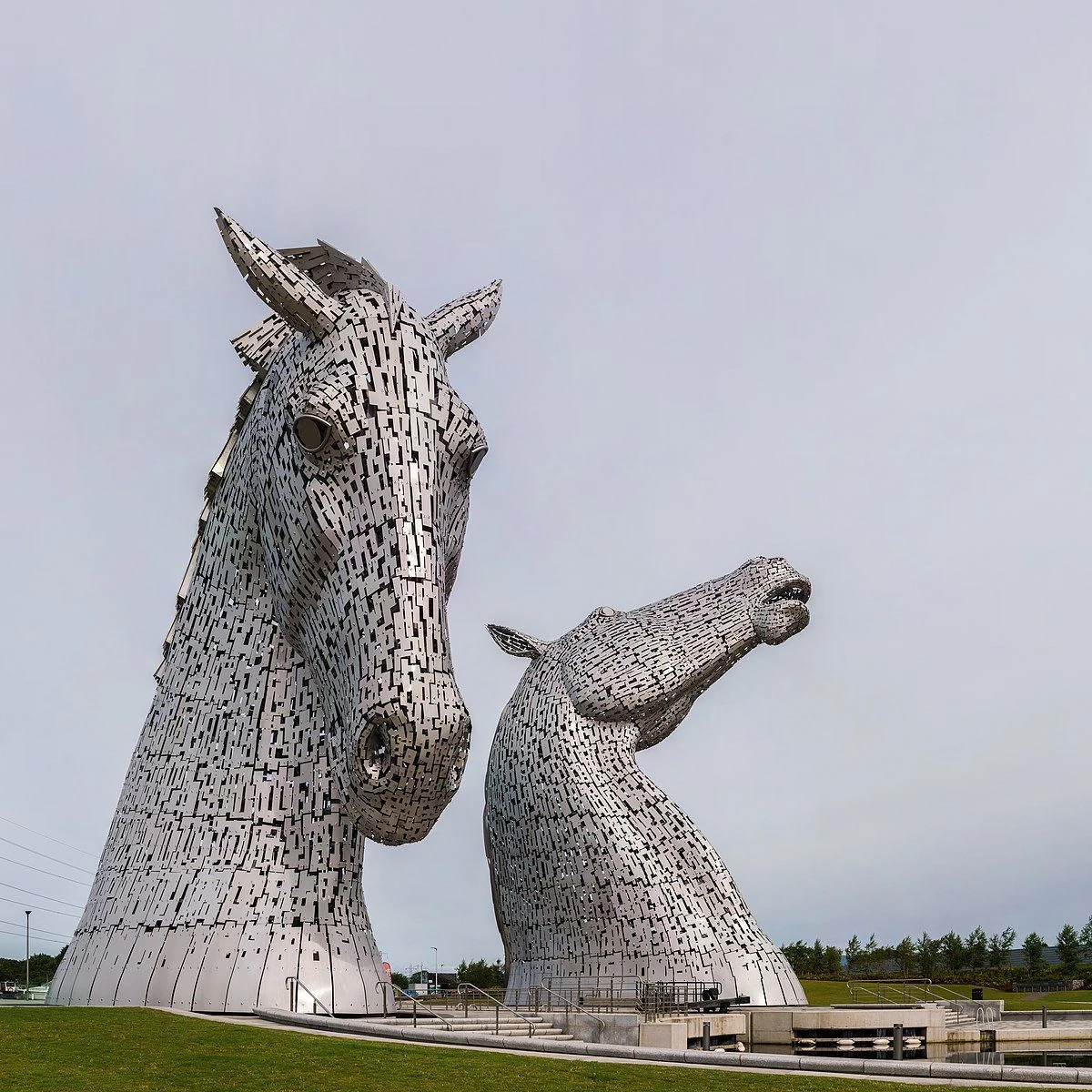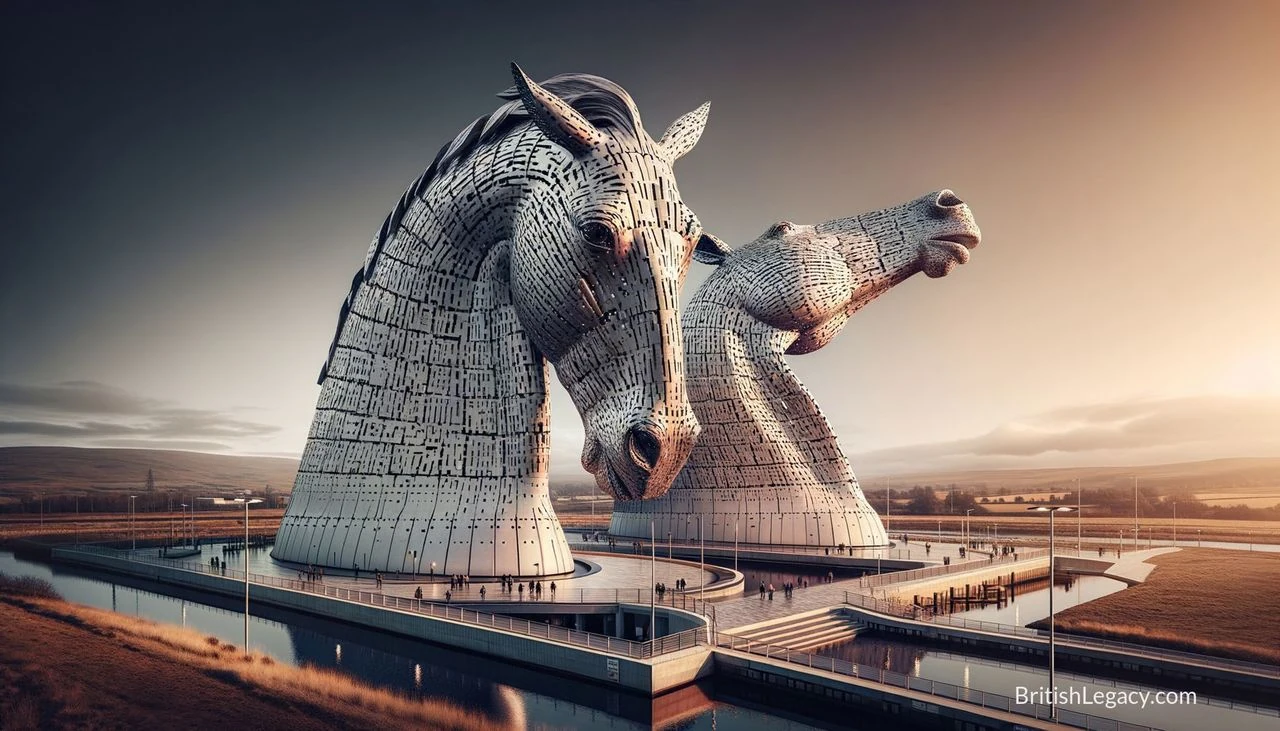
At the eastern end of the Forth and Clyde Canal, two steel horse-heads rise 30 metres above the landscape between Falkirk and Grangemouth. The Kelpies are sculptures by Andy Scott, completed in 2013 and unveiled the following April. Their scale makes them conspicuous landmarks; their subject connects them to the horses that hauled, ploughed and worked around Scotland’s industrial economy.
A myth reshaped as a monument
The name reaches back to Scottish folklore, where kelpies are transforming water spirits associated with horses. That legend gave Scott a starting point, but the sculptures’ purpose extends beyond myth. They commemorate the heavy horses whose strength helped shape industry, agriculture and the canal landscape around Falkirk.
The project took shape as part of the Helix, a parkland development around the canal. Scottish Canals chose the name at the project’s inception in 2005, referring to the mythical creatures’ strength and endurance. Scott developed the idea towards a contemporary, equine form: not simply an illustration of folklore, but a monument to horses’ place in working life. In his account of the concept, he connected them with industry and agriculture, and with the canal tow horses that pulled vessels.
The sculptures’ forms are inspired by Clydesdale draught horses. That reference gives the monumental heads a direct connection to the working animals they commemorate. They stand beside the Forth and Clyde Canal, where the canal’s history and the history of horse power meet in the landscape.
From model to full-scale steel
Scott developed the designs through small-scale models before construction. In 2008, he made three-metre maquettes in his Glasgow studio. The models were scanned by laser to help fabricators produce accurate components for the full-size sculptures, translating an artistic design into a large structural work.
Each Kelpie is 30 metres high and weighs approximately 300 tonnes. The structures use structural steel with stainless-steel cladding. Construction began in June 2013 and was complete by October that year. A topping-out ceremony followed on 27 November. An unveiling ceremony took place in April 2014, the year after their completion.
The pair stand on either side of a specially constructed lock and basin, part of the redeveloped Kelpies Hub. Their position gives them a double role: they are works of public art and a gateway beside a waterway that has long carried people and goods through central Scotland. The engineering is substantial, but its purpose is not to eclipse the subject. The steel forms make a contemporary monument out of a history of animal power.
Working horses and the canal landscape
Horses were used to pull wagons, ploughs and barges, as well as coalships. Their labour helped shape both the economy and the geography of the Falkirk area. The canal connection is particularly visible at the sculptures’ site: the horses remembered here are linked to the towpaths and vessels of the region’s waterways, as well as to agricultural and industrial work more broadly.
This history is the Kelpies’ central subject, rather than a claim that horses alone drove industrial change. The sculptures focus attention on the animals’ strength and endurance and on the work that depended on them. Their scale invites visitors to look up; their setting encourages them to look around, towards the canal and the landscape formed by generations of labour.
Their design also holds two kinds of reference together. The folklore behind the name supplies a mythical, shape-changing creature; Scott’s stated artistic direction moves towards a contemporary response to the horse’s social and economic history. The result uses legend as an entrance to a more grounded account of working animals, industry and agriculture.
A public landmark in central Scotland
Set within the Helix parkland, the sculptures form part of a wider public space around the canal. Their location beside the M9 and at the eastern gateway of the Forth and Clyde Canal makes them visible markers of the area. Their setting is not incidental: waterway, park and sculptures bring together the engineering of the canal landscape and a modern work of sculptural engineering.
The Kelpies have also attracted substantial public attention. Nearly one million people visited during the first year following their opening. Responses to the sculptures have not been unanimous: praise for their drama and engineering has sat alongside criticism of their style and public-art ambitions. That range of reaction is part of their public life. They are not only a memorial to an earlier working landscape, but a prominent contemporary intervention in it.
Smaller versions of the sculptures have carried the design beyond Falkirk. Two sets of one-tenth-scale maquettes have appeared at locations and events in Scotland, elsewhere in Britain and internationally, including Edinburgh Airport, the Field Museum in Chicago and Bryant Park in New York. Made in steel, galvanised and welded by hand from small plates, they translate the larger design into portable form.
Why The Kelpies deserve a place in British Legacy
The Kelpies deserve a place in British Legacy because they make a specific part of Scotland’s working history visible in a contemporary public setting. Their subject is the heavy horse: an animal used to pull wagons, ploughs, barges and coalships, and one whose labour formed part of the industrial and agricultural life of the Falkirk area. By locating the sculptures beside the Forth and Clyde Canal, Andy Scott connects that history to the waterways and landscape where horse power mattered. The result is not a generic celebration of progress, but a monument grounded in particular work, place and memory.
Their achievement also lies in the way art and engineering meet. Two 30-metre structures, each weighing approximately 300 tonnes, turn a sculptural idea into a public landmark beside a canal lock and basin. The process—from Glasgow maquettes to laser-scanned components and full-scale steel—demonstrates how design, fabrication and construction can serve a cultural purpose. Public response has included strong praise and sharp criticism; the first year’s near-million visitors indicate how widely the sculptures drew attention. Their lasting value is this combination of local remembrance, ambitious making and an accessible public setting. They give visitors a striking point of entry into the history of Scotland’s working horses and the landscape they helped shape.
Sources
Adapted in part from The Kelpies by Wikipedia contributors, under CC BY-SA 4.0. Text has been edited and combined with the existing article; this adapted text is shared under the same licence. Contributor history.