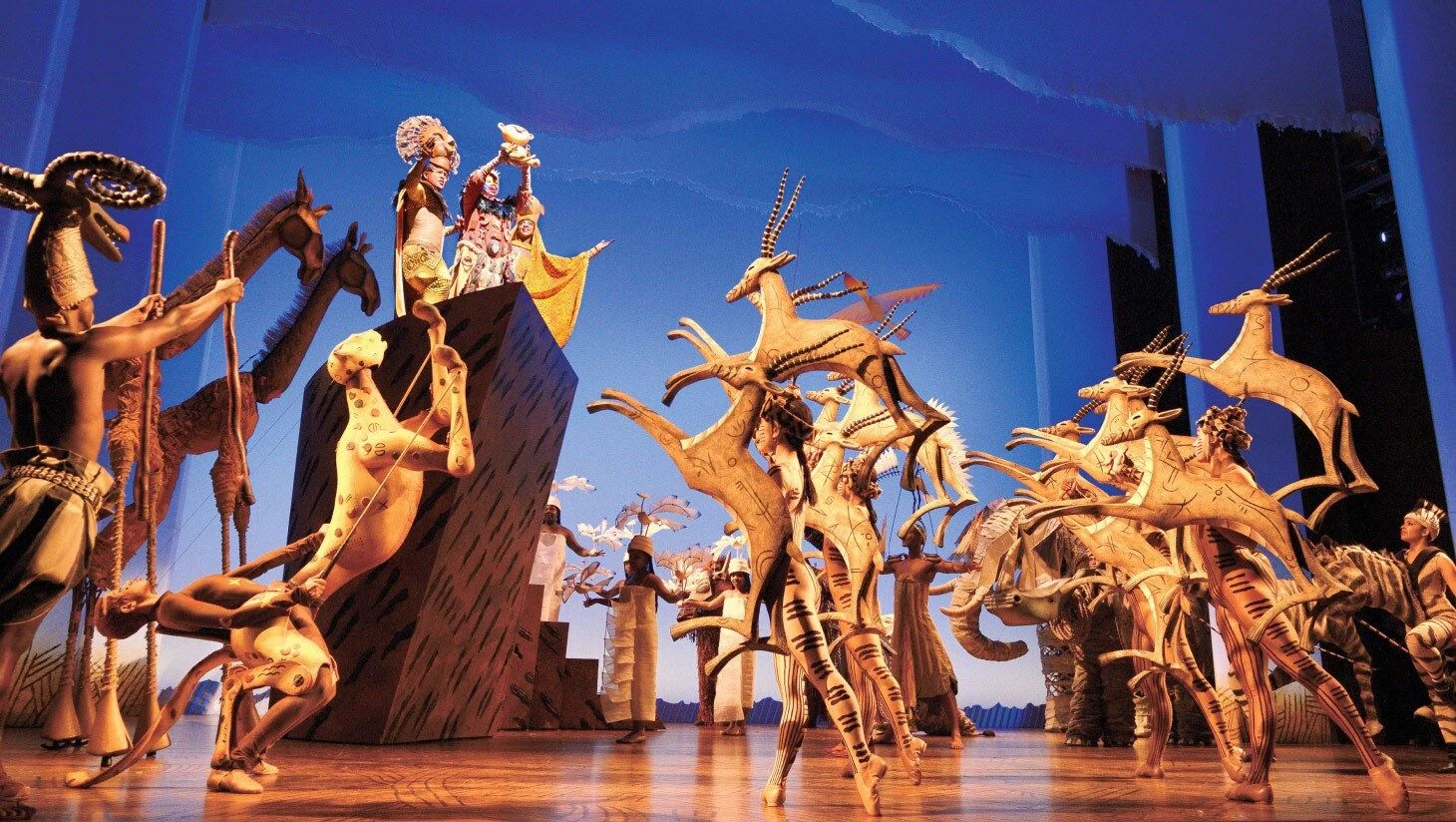
When the animals gather at Pride Rock in The Lion King, the stage fills with performers, puppets and moving forms rather than a screen-bound replica of the 1994 film. That visual language helped turn Disney’s story into a distinctive musical. The production first opened in Minneapolis in 1997; its London engagement began at the Lyceum Theatre on 19 October 1999. The West End run has since made the show a long-standing part of London theatre life.
From film to stage
The musical is based on Disney’s 1994 animated film. Elton John and Tim Rice wrote songs for the original film, and their work provided the stage production with familiar numbers including “Circle of Life”, “Can You Feel the Love Tonight” and “Hakuna Matata”. The musical also introduced new material, with contributions from composers and lyricists including Lebo M, Mark Mancina, Jay Rifkin, Tsidii Le Loka, Julie Taymor and Hans Zimmer. Its book was written by Roger Allers and Irene Mecchi.
Julie Taymor directed the production, shaping a show that uses costumes, masks and puppetry to evoke its animal characters. The visual approach makes the performers’ presence part of the image: audiences can see the human body and the animal figure together, rather than watching actors disappear behind realistic scenery. Richard Hudson designed the scenery, while Taymor and Michael Curry worked on masks and puppets. Garth Fagan choreographed the original Broadway production.
The stage story follows Simba from cubhood to kingship. After his father Mufasa dies in a stampede engineered by Scar, Simba is driven away and grows up with Timon and Pumbaa. His return to the Pride Lands brings him into conflict with Scar, whose rule has left the kingdom in decline. Simba must confront his guilt and take responsibility before the balance of the Pride Lands can be restored. The musical retains the story’s themes of family, power and succession while expanding its scenes and theatrical vocabulary.
A musical made for the theatre
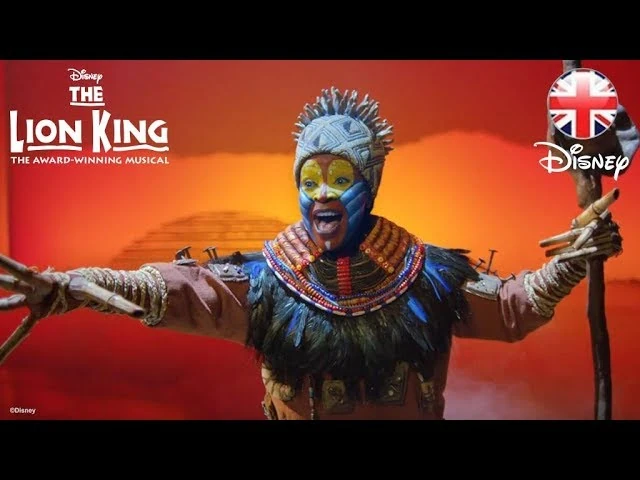
The stage version does more than transfer the film’s plot and songs. It adds scenes and numbers that give other characters room to develop. Rafiki, a female mandrill in the musical, opens the story by gathering the animals and presenting Simba. In “Shadowland”, Nala decides to leave the devastated Pride Lands to seek help. “Endless Night” gives Simba a song in which he reflects on Mufasa’s promise to remain with him. These additions make the stage work its own adaptation, rather than a simple recreation of the film.
Its animal characters are created through different combinations of costume, masks and puppets. Performers portraying giraffes use stilts; other characters appear through larger puppet forms or costumes. For principal lions such as Mufasa and Scar, mechanical headpieces can be raised and lowered to suggest movement. The design depends on precise coordination between performers and objects, while the Lioness Hunt adds a dance sequence in which movement is complicated by the headpieces worn by the dancers.
The music also draws on a wider creative team than the best-known names alone suggest. John and Rice’s film songs sit alongside new compositions and arrangements by other contributors, including Lebo M, Mark Mancina and Hans Zimmer. “One by One”, adapted from material associated with Rhythm of the Pride Lands, begins the second act. “They Live in You”, “Shadowland” and “Endless Night” extend the score beyond the songs most closely associated with the film. The result combines pop songwriting, choral sound and theatrical action.
The Lyceum and a continuing London run
After its first production in Minneapolis and its Broadway opening in 1997, the musical arrived at London’s Lyceum Theatre on 19 October 1999. Its West End production was also directed by Taymor. The original London cast included Cornell John as Mufasa, Rob Edwards as Scar, Josette Bushell-Mingo as Rafiki, and Simon Gregor and Martyn Ellis as Timon and Pumbaa. In the production’s first year, its choreography and costume design were among the elements recognised by the Laurence Olivier Awards; Garth Fagan won for theatre choreography and Julie Taymor for costume design.
The London engagement became an enduring feature of the theatre’s programme. It passed 10,000 performances, and the West End cast appeared at the Royal Variety Performance in 1999 and 2008. In 2022, members of the cast performed at the Platinum Jubilee concert at Buckingham Palace. These appearances carried a production created for commercial theatre into nationally televised and ceremonial events, while keeping the Lyceum as its London home.
The run was interrupted when the COVID-19 pandemic forced theatres in the United Kingdom to close. The production returned to the Lyceum on 29 July 2021. It had also travelled beyond London: a UK tour began in 2012, and a further UK and Ireland tour ran from 2019 to 2023. Those tours brought the musical to audiences outside the capital, while the Lyceum engagement remained its principal British production.
Why The Lion King deserves a place in British Legacy
The Lion King deserves a place in British Legacy because its long West End life shows how an international musical can become part of London’s theatrical history without being British in origin. Its London premiere at the Lyceum in 1999 established a sustained home for a production whose distinctive visual approach depends on performers working openly with puppets, masks, costume and choreography. The result is not merely a retelling of a popular film: it is a stage work built around the practical and expressive possibilities of live performance.
The production’s British significance is also visible in its reach. A continuing Lyceum engagement, performances at the Royal Variety Performance and the Platinum Jubilee concert, and UK and Ireland touring all connect the show with audiences and events beyond a single London theatre. Its revival after the pandemic closure marked the return of a major West End production to live performance. Together, these details make the musical a useful example of the West End’s role as a place where large-scale international work can acquire a lasting London presence, while touring carries that theatrical experience to other parts of the country.
Sources
The Lion King (musical), revision 1376062733
Adapted in part from The Lion King (musical) by Wikipedia contributors, under CC BY-SA 4.0. Text has been edited and combined with the existing article; this adapted text is shared under the same licence. Contributor history.