Rising beside the Thames on the South Bank, the London Eye gave the turn of the millennium a new landmark. Conceived as a celebration of the new era, the observation wheel soon became part of the experience of modern London: a place to look out across the capital, and a prominent feature of its riverside skyline.
A wheel designed for the capital
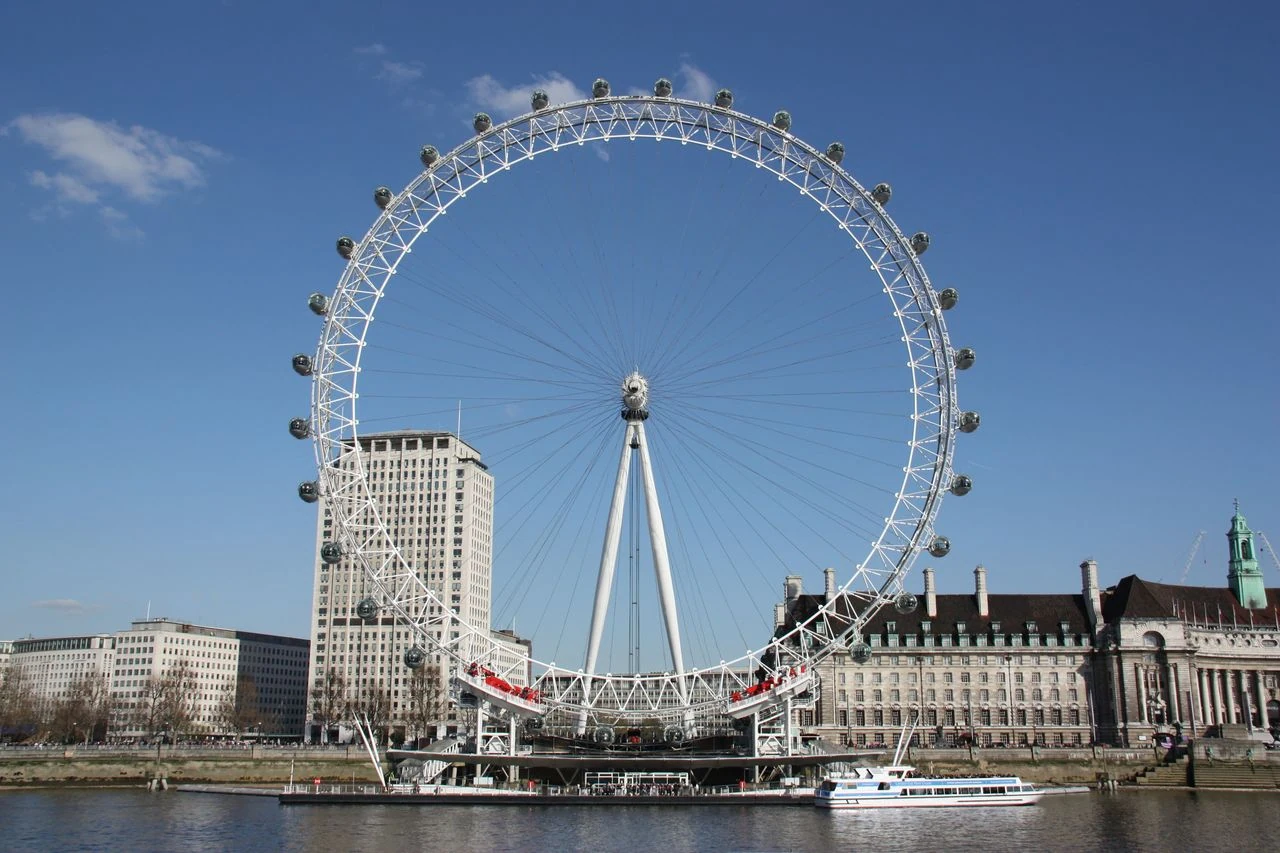
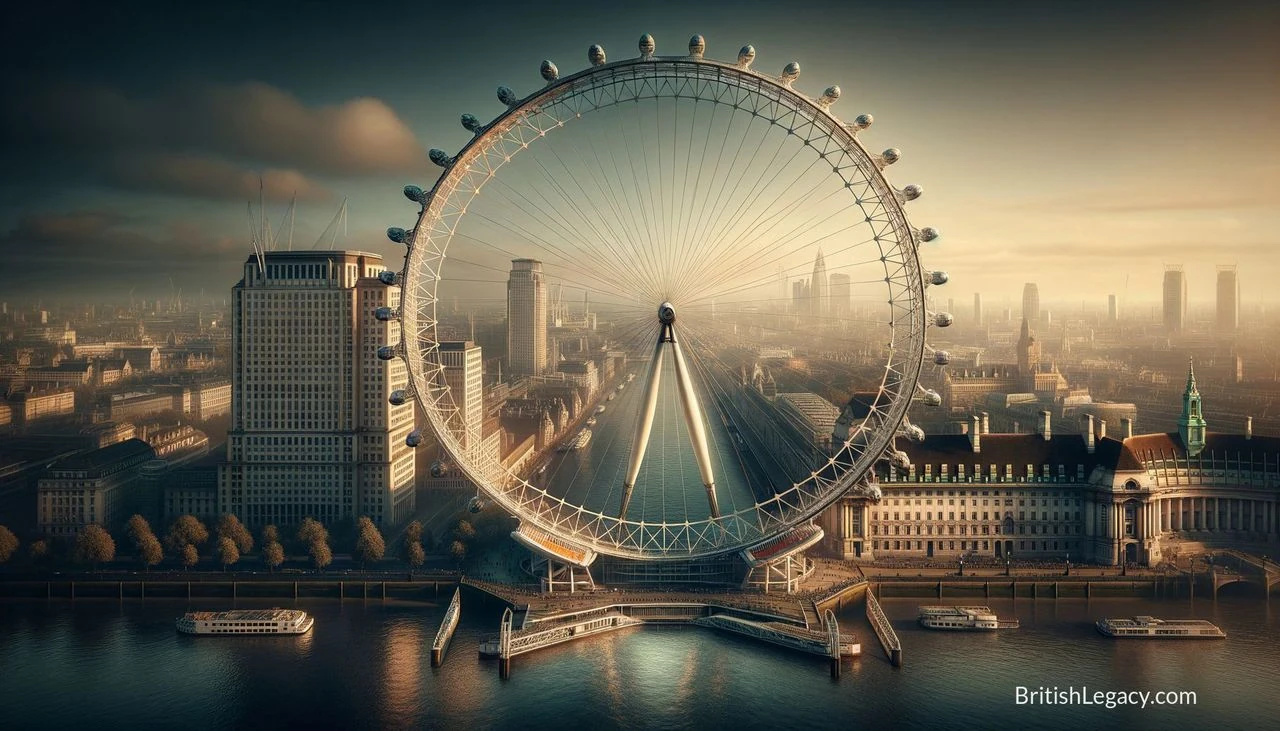
The London Eye opened on 9 March 2000. Designed by architects David Marks and Julia Barfield, it stands 135 metres high and is supported by an A-frame on one side. That arrangement gives the wheel its distinctive profile. Its scale is substantial, but the structure is also designed around a simple visitor experience: a slow circuit above the river, with the city unfolding around the passenger.
Thirty-two glass-walled capsules are arranged around the wheel. Each can carry up to 25 people, giving passengers room to move and look out while it turns. The journey takes about 30 minutes. From the capsules, views on a clear day are said to extend as far as 40 kilometres, taking in landmarks including the Houses of Parliament, St Paul’s Cathedral and the Tower of London. The movement is gradual rather than abrupt, allowing the changing outlook to become the main event.
The wheel’s height and exposed position make it a conspicuous addition to a city whose best-known views have long been shaped by older buildings and the Thames. Rather than replacing those landmarks, it offers a different way to read them: from above, the river and the city’s varied buildings become part of one broad panorama. Its glass capsules turn a large piece of engineering into a public viewing space.
From millennium project to London attraction
The Eye was initially erected to mark the dawn of a new millennium. Its purpose did not end with that occasion. It became an attraction in its own right, drawing visitors who could take in the capital from a position that ordinary street-level sightseeing cannot offer. The wheel’s gradual rotation gives the visit a measured pace, while the elevated viewpoint makes familiar landmarks part of a wider picture.
Its place in public life extends beyond the ride. The London Eye features in New Year’s Eve celebrations and the televised fireworks associated with them. It is also used for private events, including proposals and weddings. These different uses give the structure both a civic presence and a personal one: it can serve as a backdrop to a national celebration or as the setting for a private occasion.
An influence beyond the riverside
The London Eye’s design and success helped establish the observation wheel as a recognisable attraction in its own right. The Singapore Flyer and Melbourne Star are among the projects described as following its example. The Eye is therefore not only a way to view London, but also part of a wider development in how cities present themselves: an elevated ride can be both a visitor attraction and a memorable feature of the skyline.
Its appeal lies in the combination of engineering, location and outlook. The wheel does not ask visitors to choose between seeing a piece of contemporary design and looking at the historic capital; the ride brings those things together. From a capsule, the river provides a route through the view, while the city’s landmarks appear within a changing sweep of buildings and streets. That experience has helped the Eye become a familiar part of London’s tourism offer.
Why The London Eye deserves a place in British Legacy
The London Eye deserves a place in British Legacy because it is a specific, visible example of a contemporary public work becoming part of a city’s identity. Built for the millennium and designed by David Marks and Julia Barfield, it combines a distinctive one-sided support structure with a practical public purpose: carrying passengers above the Thames for a slow, panoramic circuit. Its 32 glass capsules make the city’s landmarks accessible from an unusual vantage point, offering a fresh perspective on a capital whose history is often encountered at street level.
Its contribution is also cultural. The wheel has become associated with New Year’s Eve fireworks, private celebrations and the experience of visiting London, while its design has been linked to later observation-wheel projects abroad. These roles show how a piece of engineering can serve more than one audience: residents and visitors can use it as an attraction, while the city gains a recognisable feature on its riverside. The Eye’s legacy is thus not simply its height or its views, but the way it connects engineering, tourism and public life in the British capital.