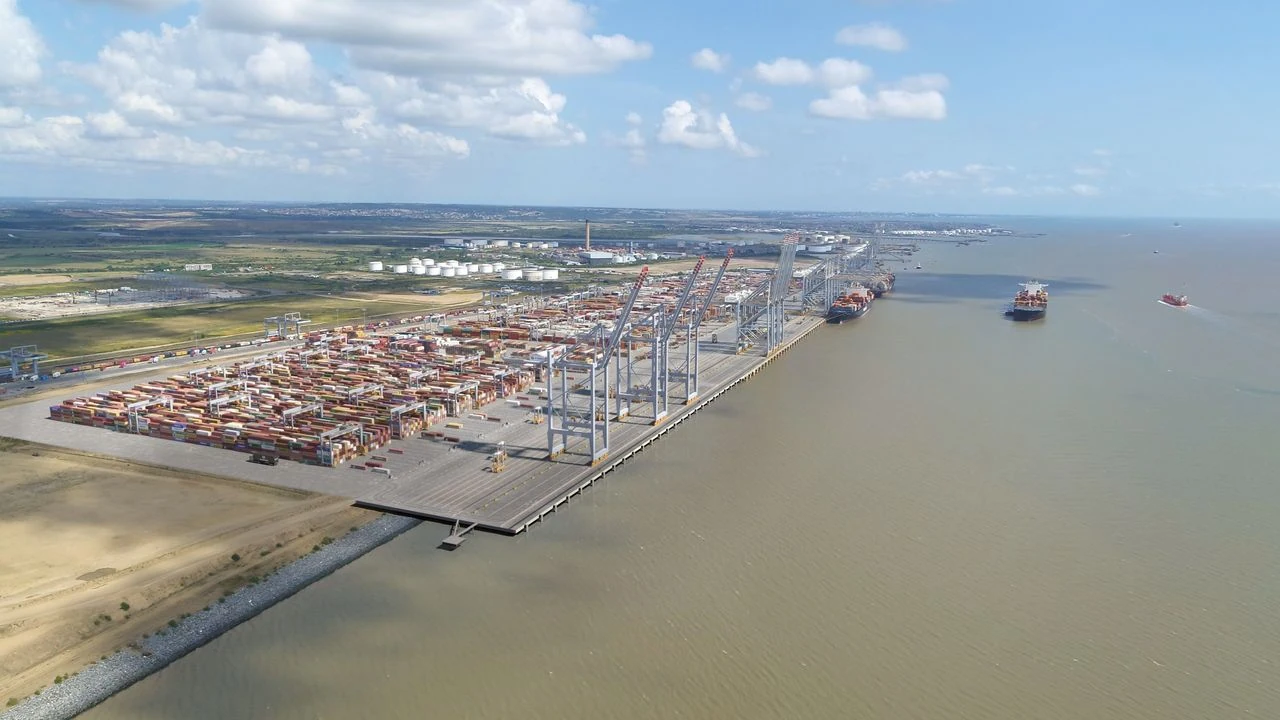
London Gateway is a deep-water port and logistics hub on the north bank of the Thames in Essex. Opened in November 2013, it was developed and financed by DP World, an Emirati logistics company. Its design brings together container shipping, road and rail connections, and a large adjacent logistics park: a combination intended to move imported and exported goods from ship towards distribution and onward delivery.
A port built around connections
The port's location gives it access to the Thames and places it close to London. Its road and rail links connect sea freight with inland transport, allowing goods to be carried onwards to retailers and consumers. The original account presents this arrangement as a way to serve London and wider European markets; more cautiously, it is the integration of transport modes that defines the hub's stated logistical role.
London Gateway is more than a quay for container ships. Beside it is a logistics park described as covering 9.25 million square feet, with warehousing and distribution facilities. The original account also refers to customs and regulatory services. Together, port and park bring cargo handling and storage into the same broader operation, rather than treating the sea journey as the end of the supply chain.
Ships, equipment and the movement of cargo
The port's deep water is intended to accommodate very large container ships. The existing account describes automated cranes and tracking systems as part of its infrastructure, linking those tools to cargo handling and the management of goods through the facility. These features matter because a port's function is not simply to receive ships: it must also transfer containers efficiently between vessels, storage and onward transport.
The account associates more efficient operations with shorter delays and reduced emissions from ships and lorries waiting with engines running. That is a claim about the intended benefit, not a quantified environmental result. It also describes electrified equipment and sustainable building designs as part of the site's green-logistics approach. The available detail does not establish the scale of any emissions reduction, so the environmental case is best understood as a stated ambition rather than a measured outcome.
Trade, employment and the limits of the claims
London Gateway was presented as infrastructure intended to strengthen the UK's capacity to handle international trade. Its combination of deep-water access, warehousing, road and rail links provides the practical basis for that role. Imports and exports depend on connected routes between ports and inland destinations; the hub's significance lies in bringing several parts of that movement together at one site.
The original account says the development has created thousands of jobs and supported local economic activity, as well as providing work in logistics, supply-chain management and maritime commerce. It gives no employment figures, dates or breakdown of those roles, so the scale and distribution of the claimed benefit should not be overstated. Nor does the description establish that the port alone makes British businesses more competitive. Those broader outcomes depend on factors beyond the facility itself.
Likewise, the port has been associated with post-Brexit ambitions for an independently trading, globally connected UK. That is a political framing, not a demonstrated result of the port's development. London Gateway is a privately developed logistics facility, financed and developed by a company based in the United Arab Emirates; its connection to British trade infrastructure is clear, but it should not be presented as proof of a national trading strategy or as an exclusively British engineering achievement.
Why The London Gateway deserves a place in British Legacy
London Gateway merits a place in British Legacy as a substantial piece of contemporary infrastructure on the Thames. Opened in 2013, it combines deep-water container handling with a logistics park, warehousing and distribution facilities, and road and rail links. These elements give the site a practical role in connecting maritime freight with inland movement. Its British significance is geographical and functional: it is based in Essex and forms part of the infrastructure through which goods can enter, leave and move around the UK.
The development also shows why modern public works should be described with care. London Gateway was financed and developed by DP World, an Emirati company, so its story is not a simple account of a wholly British undertaking. Its importance instead lies in how an international operator built a port and logistics hub within Britain, bringing shipping, storage and transport connections together. The site has been credited with creating thousands of jobs and adopting environmental measures, although the available account does not quantify those results. Recording both the facility's concrete role and the limits of the claims made for it offers a more useful legacy than unqualified praise: a clear picture of infrastructure, commerce and the international partnerships that shape them.