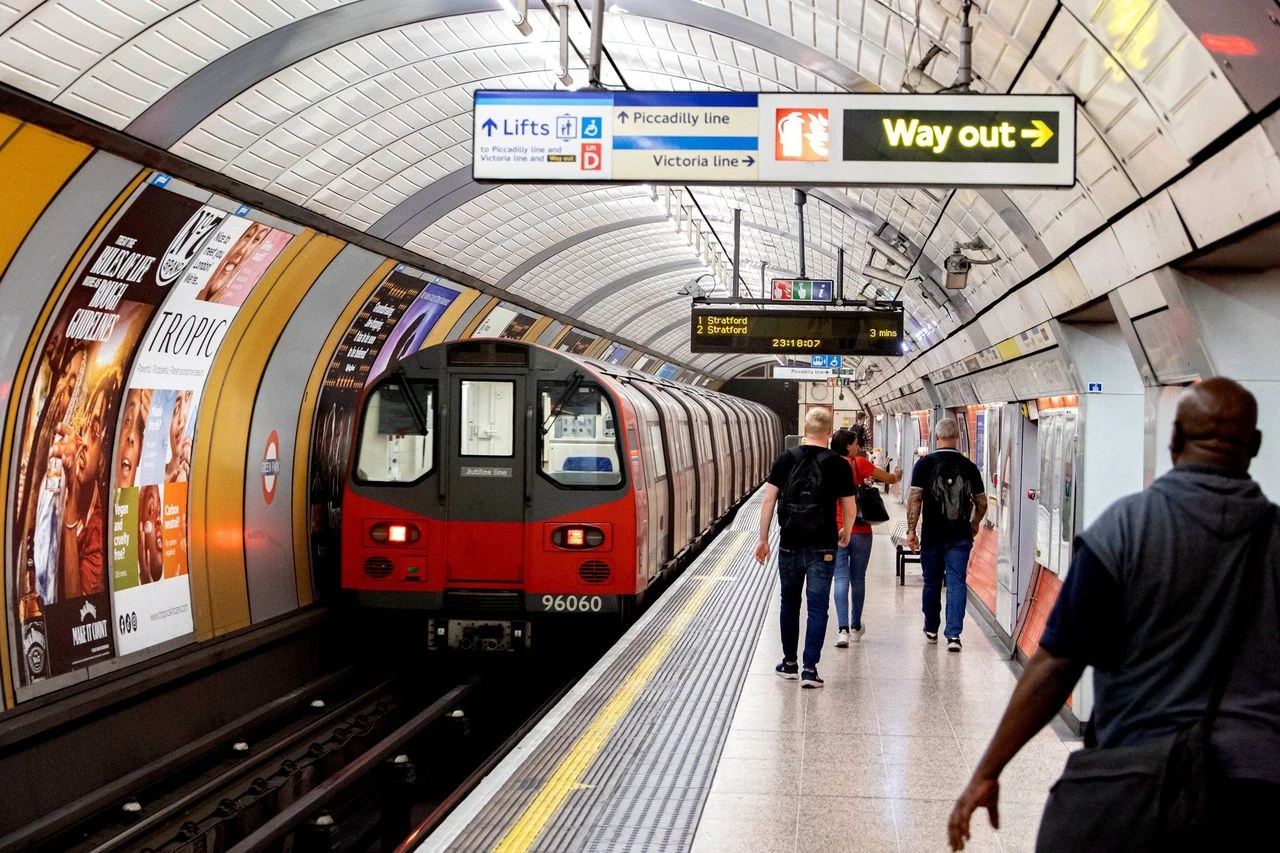
On 10 January 1863, a steam train carried passengers between Paddington and Farringdon through tunnels beneath London. The Metropolitan Railway was the world’s first underground passenger railway. Its opening offered a new way across a crowded city and began a transport system whose influence would be seen not only in engineering, but also in maps, architecture and graphic design.
Today’s London Underground is a network of 11 lines and 272 stations, extending beyond Greater London into parts of Buckinghamshire, Essex and Hertfordshire. Its familiar nickname, the Tube, refers to the circular tunnels used by deep-level trains, although much of the railway runs overground. The network has changed hands, technologies and shape over more than 160 years; it remains both working infrastructure and a distinctive part of London’s public identity.
A railway beneath the streets
The idea of an underground railway linking the City of London with the urban centre had been proposed in the 1830s. The Metropolitan Railway received permission to build one in 1854. Its initial route, opened in 1863, used the cut-and-cover method: builders excavated trenches along streets, constructed the railway and covered the route again. Gas-lit wooden carriages were hauled by steam locomotives. The new service carried 38,000 passengers on its opening day.
Other sub-surface routes followed. The Metropolitan District Railway opened between South Kensington and Westminster in 1868, and the Metropolitan and District companies completed the Circle line in 1884. Their railways expanded through the suburbs, connecting more neighbourhoods to central London. The construction method placed much of this early network close to the surface, but later lines required a different approach.
The City and South London Railway, which opened in 1890, was the first deep-level Tube line. Its circular tunnels were bored beneath the roads, avoiding the need to secure agreements with surface property owners. Electric locomotives hauled small carriages through the tunnels. The Waterloo and City Railway and Central London Railway followed, and the development of electric traction helped make deeper underground travel practicable. The network now includes both larger sub-surface trains and smaller trains designed for deep-level tunnels.
From competing companies to one network
In its early decades, the Underground was not a single, unified railway. Competing companies built and operated different lines. In 1902, American businessman Charles Yerkes established the Underground Electric Railways Company of London to finance and operate three new Tube routes: the Baker Street and Waterloo Railway, later known as the Bakerloo; the Charing Cross, Euston and Hampstead Railway; and the Great Northern, Piccadilly and Brompton Railway. The Bakerloo, Hampstead and Piccadilly lines opened between 1906 and 1907.
Co-operation gradually made the separate services easier to understand and use. A joint marketing agreement brought maps, shared publicity, through ticketing and the first Underground signs at central London stations. In 1933, most of London’s underground railways, tramways and bus services were brought together under the London Passenger Transport Board, which used the London Transport brand. The Waterloo and City Railway remained outside that arrangement until it transferred to the Underground in 1994.
The network continued to develop under successive public bodies. Following the Second World War, plans for expansion were resumed; the Central line’s east and west extensions were completed in 1949. The Victoria line opened in stages between 1968 and 1971, with trains driven automatically. The Jubilee line began operating in 1979, named in honour of Elizabeth II’s Silver Jubilee. Responsibility eventually passed to Transport for London, created in 2000; London Underground Limited became its subsidiary in 2003.
Expansion has continued in more recent decades. The Jubilee line extension to Stratford opened in 1999, adding 11 stations designed with future growth in mind; they included platform-edge doors and step-free access. The Northern line extension from Kennington to Battersea Power Station, via Nine Elms, opened in 2021. The Elizabeth line, which opened in 2022 after the Crossrail project built a new east–west railway beneath central London, connects with Underground stations but is a separate railway, not part of the Underground network.
Design that helps people find their way
The Tube’s cultural presence is inseparable from its visual design. Harry Beck’s diagrammatic map, first printed in 1933, made a deliberate trade-off: it distorted geographical distances and simplified routes so that lines could be read clearly. The diagram developed from an original draft Beck presented in 1931. Its design remains the framework for the familiar Tube map and has been adopted, in varied forms, by metro systems elsewhere.
The roundel and the Underground’s lettering also grew from deliberate design choices. A red circle was used behind station nameboards from 1908. Transport executive Frank Pick, seeking a stronger and more consistent identity, commissioned Edward Johnston to develop a typeface and refine the roundel. Johnston’s typeface was developed in 1916; Pick registered the revised roundel as a trademark in 1917. The resulting design language extended beyond station signs to posters and the broader London Transport identity. Today, the familiar roundel remains a visible emblem of a railway woven into the city’s history.
Station architecture reflects the network’s successive eras. Leslie Green established a distinctive style for stations built by the Underground Electric Railways Company in the early 20th century, using ox-blood-coloured faience tiles. In the 1920s and 1930s, Charles Holden designed modernist and art-deco stations. Later additions brought other approaches: the Jubilee line extension’s stations were designed by architects including Norman Foster and Michael Hopkins. Interior details can make individual stations recognisable, from the Sherlock Holmes silhouettes at Baker Street to Eduardo Paolozzi’s mosaics at Tottenham Court Road.
Art has also been part of the railway’s public life. The Underground commissioned artists and designers to create posters, and Art on the Underground, launched in 2000, renewed that tradition through temporary and permanent works. Mark Wallinger’s Labyrinth installation marked the network’s 150th anniversary. Poems on the Underground has displayed commissioned poetry on trains since 1986. These projects put art into everyday journeys rather than confining it to galleries.
Public service, change and difficult history
The Underground’s history includes more than expansion and design. During the Second World War, many stations were used as air-raid shelters. They did not always offer safety: a bombing at Bank station in 1941 killed 111 people. In 1943, 173 people died in a crush at Bethnal Green station as people sought shelter during a test of air-raid sirens and the firing of an anti-aircraft rocket.
A later disaster led to major changes in safety practice. On 18 November 1987, a fire on an escalator at King’s Cross St Pancras killed 31 people and injured a further 100. In response, wooden escalators were removed, smoking was banned, and improvements included fire detectors, CCTV and better radio coverage for emergency services. The tragedy remains an essential part of the railway’s history: the system’s public value depends on learning from the risks of operating it.
Technology has changed the experience of using the network as well as its infrastructure. Oyster, a contactless smartcard, was introduced in 2003. In 2014, the Underground began accepting contactless bank-card payments, which TfL developed in-house and later licensed to other cities. The Night Tube began in 2016 on the Central and Victoria lines, with service subsequently extended to other lines. These changes sit alongside continuing work on trains, signalling, stations and accessibility.
The Underground serves commuters, visitors and people travelling to London’s cultural and sporting events. Its reach and daily use make it a key part of how the capital functions, while its stations, signs and trains have made it a recurring setting in films, music and literature. The network’s practical role and cultural visibility are closely linked: it is at once a means of getting around and a recognisable feature of the city.
Why the London Underground deserves a place in British Legacy
The London Underground deserves a place in British Legacy because its story joins a practical response to London’s growth with sustained changes in how cities move. The Metropolitan Railway’s opening in 1863 established the world’s first underground passenger railway. Cut-and-cover construction and later deep-level tunnelling allowed the network to develop beneath a crowded city; electric traction made deep Tube services possible. These were not isolated feats but stages in the creation of a complex public service, built by different companies and eventually brought together into a network serving London and neighbouring counties.
Its legacy is also visible above ground, in designs encountered by millions of passengers: Beck’s clear route diagram, Johnston’s lettering and the roundel, as well as station architecture and commissioned art. Those achievements have practical consequences. A comprehensible map helps people navigate; consistent signs give a far-reaching network a recognisable identity; step-free improvements and new station designs address the needs of more passengers. The railway’s record also includes tragedy and the safety changes that followed, a reminder that public infrastructure carries lasting responsibilities. Together, engineering, design, public service and adaptation make the Underground a specifically London story with a wider place in British transport history.
Sources
Adapted in part from London Underground by Wikipedia contributors, under CC BY-SA 4.0. Text has been edited and combined with the existing article; this adapted text is shared under the same licence. Contributor history.