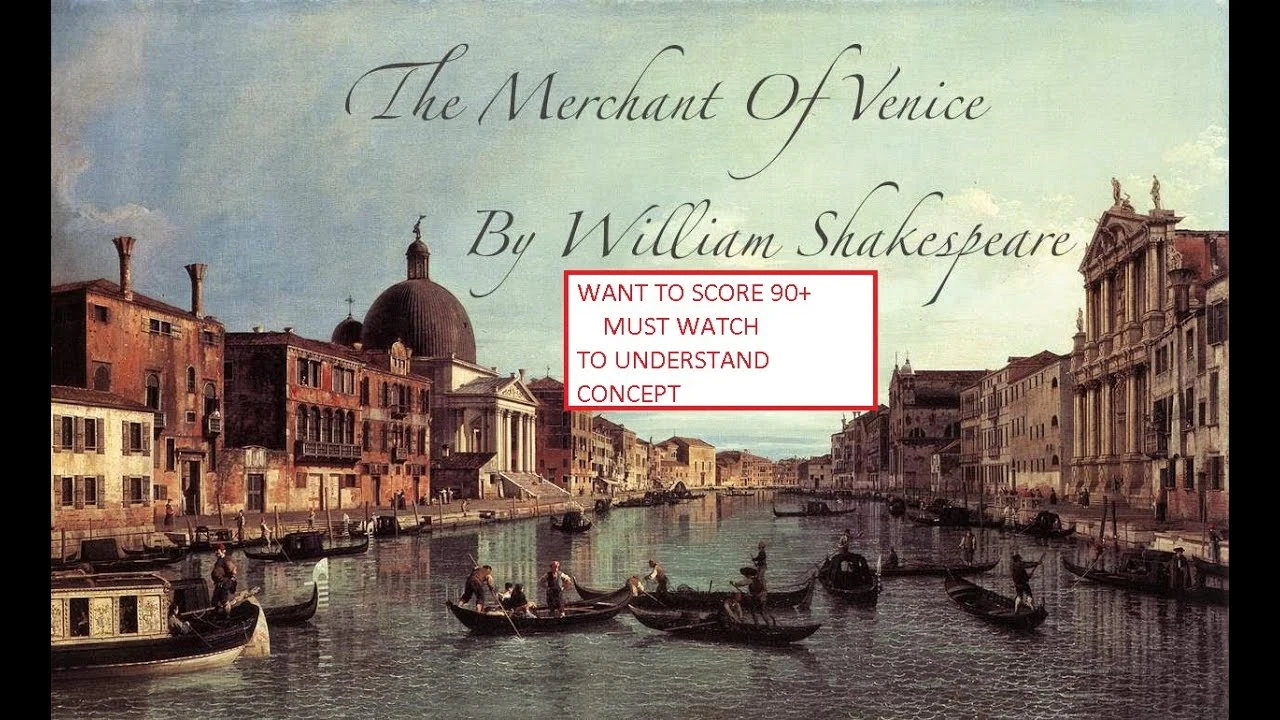
In The Merchant of Venice, a promise made in money becomes a claim upon a human body. Antonio borrows from Shylock on the condition that, if he cannot repay the debt, the lender may take a pound of his flesh. That stark bargain drives the play towards a courtroom confrontation in which mercy, justice and revenge collide—and leaves audiences with a difficult question about who has the power to define justice.
A Venetian bargain
William Shakespeare wrote the play around 1596, setting its action in Renaissance Venice. Antonio, a merchant whose ships are at sea, agrees to stand surety for his friend Bassanio. Bassanio wants money to travel to Belmont and court Portia, a wealthy heiress. Shylock lends the required sum, with the pound-of-flesh condition attached to the bond.
The arrangement turns personal relationships into legal and financial obligations. Antonio accepts the risk on Bassanio’s behalf; Shylock, who has suffered abuse from Christians, insists on the penalty when Antonio cannot pay. The plot does not treat the bond as an abstract puzzle. Its enforcement would injure or kill Antonio, while Shylock’s demand is shaped by the hostility he has endured. The conflict therefore joins commercial life to questions of prejudice and power.
Belmont offers a contrasting strand of the story. Portia’s late father has required her suitors to choose among three caskets—gold, silver and lead—with the right choice winning her hand. Bassanio succeeds by choosing lead. When news arrives that Antonio has defaulted, he leaves for Venice with money from Portia, who follows in disguise with her attendant Nerissa.
The courtroom and the cost of mercy
In Venice, Shylock refuses Bassanio’s offer of repayment and demands the flesh specified in the bond. The Duke refers the case to a young legal authority, Balthasar, who is Portia in disguise; Nerissa appears as the clerk. Portia urges Shylock to show mercy, but he will not yield. The court initially allows him to proceed. Portia then identifies a limitation in the agreement: Shylock may take flesh, but the bond grants no right to shed blood. The legal wording that seemed to authorise the punishment becomes the means of stopping it.
The outcome is not a simple victory for compassion. Shylock is denied payment when he offers to accept money instead. His property is forfeited, his life placed at the Duke’s mercy, and he is forced to convert to Christianity. The ending thus makes the court’s power part of the play’s moral difficulty. Antonio is saved, but Shylock suffers a legal and social defeat that complicates any easy celebration of mercy. The plot’s balances—justice and revenge, forgiveness and coercion—remain unsettled.
That tension is central to the play’s treatment of Shylock. He can be seen as an outsider demanding retribution, but also as a man whose insistence arises in a society that has abused him. The role has consequently invited changing interpretations. The play places the audience close to the force of his grievance while also making his demand for Antonio’s flesh terrifying. Neither response cancels the other.
From the Elizabethan stage to later interpretations
Shakespeare wrote the play during the middle period of his career. The Lord Chamberlain’s Men, his acting company, performed it; the precise circumstances and date of its first performance are uncertain, though records indicate that it was being performed by 1605. Its continuing life in theatre and other forms has carried the story well beyond its original setting. The central roles, especially Shylock, allow each production to bring different emphases to the conflict between individual grievance and social authority.
Actors associated with the role include Charles Macklin in the eighteenth century and Laurence Olivier and Al Pacino in later interpretations. Such changes in performance matter because Shylock’s place in the drama is not fixed by a single moral reading. A portrayal can stress the character’s menace, his vulnerability, or the prejudice that surrounds him. Each choice affects how the courtroom scene and its aftermath land with an audience.
The story also reached screen audiences in Michael Radford’s 2004 film adaptation, starring Al Pacino as Shylock and Jeremy Irons as Antonio. The film opened in the UK on 3 December 2004 and was a United Kingdom, Italian and Luxembourgish co-production. Radford’s version foregrounded the abuse of Venice’s Jewish community and presented Shylock as a tragic figure brought to catastrophe by his flaws. Its treatment of antisemitism received mixed responses: some critics valued the added context but thought it did not prevent Shylock becoming an antisemitic caricature; others felt the film made him too sympathetic.
The film’s reception illustrates the care required in interpreting the play. Giving more attention to the prejudice Shylock encounters can make the injustice surrounding him harder to ignore, but it does not settle the question of how a production should represent the character. Nor does a sympathetic portrayal erase the harm he intends to inflict on Antonio. The drama’s endurance rests partly on this resistance to a neat solution.
Why The Merchant of Venice deserves a place in British Legacy
The Merchant of Venice belongs in British Legacy not because its setting is English, but because Shakespeare’s play has remained part of British theatre and literary culture while addressing questions that extend beyond its Venetian world. Its bond and courtroom scene give abstract ideas a concrete form: a contract is tested against a human body, and the language of mercy is spoken within a system that ultimately imposes severe punishment on Shylock. That dramatic construction continues to make the play available for performance, argument and reinterpretation.
Its legacy also includes the challenge of staging it responsibly. Shylock’s grievance cannot be separated from the prejudice directed at him, yet the play’s conclusion subjects him to forced conversion and dispossession. Those elements make the work valuable not as a comfortable statement of moral certainty, but as a difficult encounter with the effects of unequal power. The continuing range of interpretations—from stage portrayals by actors such as Charles Macklin and Laurence Olivier to Al Pacino’s screen performance—shows how each era revisits that difficulty. British theatre gains from works that invite audiences to examine both their inherited stories and the assumptions through which they interpret them. This play has sustained that scrutiny across centuries.
Sources
The Merchant of Venice (2004 film), revision 1374447312
Adapted in part from The Merchant of Venice (2004 film) by Wikipedia contributors, under CC BY-SA 4.0. Text has been edited and combined with the existing article; this adapted text is shared under the same licence. Contributor history.