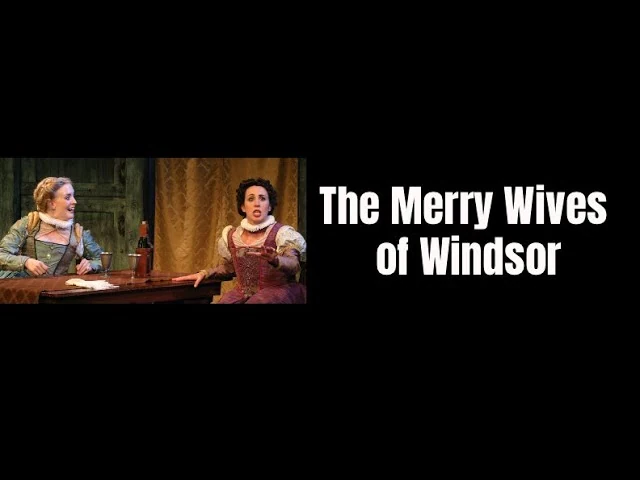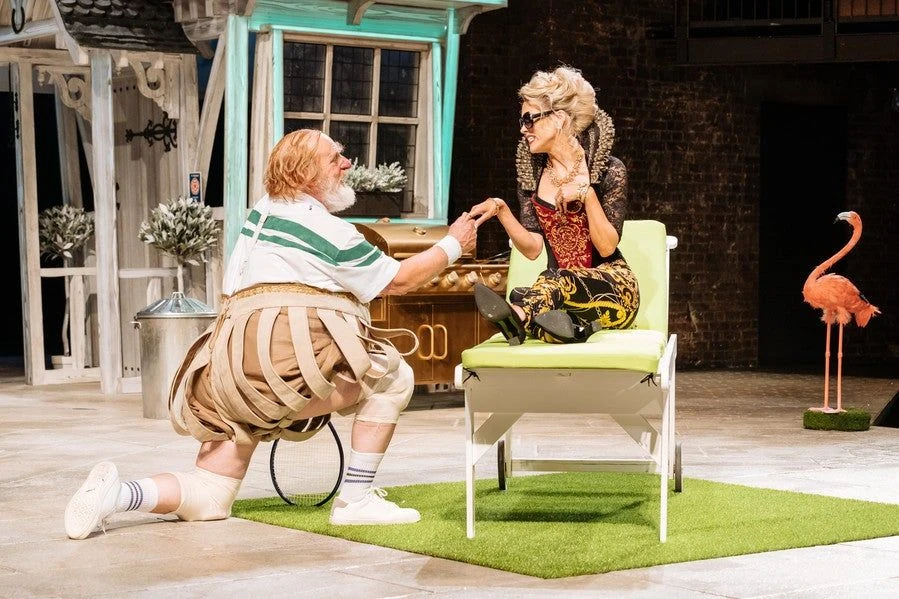
Sir John Falstaff arrives in Windsor short of money and convinced that two wealthy married women can help replenish his purse. Mistress Ford and Mistress Page see through his identical love letters, compare notes and make a game of his presumption. Their answer is not a private rebuke but a sequence of increasingly public tricks: Falstaff is hidden in a laundry basket and dumped into a river, then disguised as a woman and sent away in disgrace. In The Merry Wives of Windsor, the knight who once occupied the world of English history plays becomes the target of a domestic comedy organised by its sharpest observers.
William Shakespeare sets the play in Windsor, Berkshire. Although it nominally belongs to the period of the Henry IV plays, its everyday world is Elizabethan: households, courtship, money, local rivalries and the misunderstandings that let a prank grow into a plot. Its comedy depends less on kings and battles than on people negotiating marriage, reputation and status in a recognisably English town.
Falstaff’s scheme meets the wives’ counterplot
Falstaff sends the same letter to Mistress Ford and Mistress Page, expecting to profit from their supposed affection. His servants Pistol and Nym refuse to deliver the letters; after he dismisses them, they alert the women’s husbands to his intentions. Mistress Ford and Mistress Page discover how alike the letters are and decide to pretend to welcome his advances, turning his confidence against him.
Their first trap leaves Falstaff concealed in a buck basket among dirty laundry. When the jealous Master Ford searches his house, the women have the basket carried away and tipped into the river. Falstaff persists, however, and returns for another appointment. This time the wives disguise him as the “fat woman of Brentford”, a figure Master Ford despises. Ford mistakes the disguised knight for the woman and drives him out, adding another humiliation without curing Falstaff of his delusions.
Ford’s jealousy provides a counterpoint to Falstaff’s attempted seduction. Disguised as “Master Brook”, Ford pays Falstaff to pursue his own wife, hoping to learn what the knight is doing. His suspicions make him an accomplice in the comedy, though he believes he is gathering evidence against his wife. Master Page, by contrast, does not share Ford’s distrust. The difference between the husbands helps the play make jealousy, as well as sexual presumption, part of its farce.
Anne Page and the town’s other entanglements
A second plot concerns Anne Page, whose parents have different plans for her marriage. Mistress Page favours Doctor Caius; Master Page would prefer Slender. Anne loves Fenton, a young gentleman whom her father has rejected because he squandered his fortune on an extravagant life. The lovers arrange to marry despite the plans made for them, with the Host of the Garter Inn helping Fenton.
The adults’ schemes collide during the final prank in Windsor Forest. The wives tell Falstaff to dress as Herne the Hunter and meet them by an old oak. Local children, including Anne and her brother William, appear as fairies and pinch and burn the knight. Meanwhile, Anne’s parents each attempt to arrange a different marriage during the confusion. Anne and Fenton escape those plans and reveal that they have married each other. Slender and Caius discover that they have been deceived about the supposed brides they took away. Falstaff, at last, accepts that the joke is deserved.
The play’s collection of townspeople gives the main plot its bustle. Falstaff’s followers Bardolph, Pistol and Nym, the Welsh parson Sir Hugh Evans, the French physician Caius, Justice Shallow and Mistress Quickly all contribute to disputes and misunderstandings. The Host of the Garter Inn sets Evans and Caius against one another by giving them different meeting places for a duel, then helps bring about their eventual reconciliation. Accents, misused language and social differences supply further comic business, while the play’s concerns with wealth and class shape both Falstaff’s scheme and Anne’s courtship.
A play with an uncertain early history
The exact date of composition is unknown. The play was registered with the Stationers’ Company on 18 January 1602 and published later that year in a quarto edition. It was probably written several years earlier, perhaps by or before 1597, but proposed dates and accounts of its occasion remain matters of debate. A tradition says that Queen Elizabeth I wanted Shakespeare to show Falstaff in love after enjoying the character in the Henry IV plays. The tradition is recorded in accounts from 1702 and 1709; it is not a securely established commission.
Another theory connects the play with the Order of the Garter and a possible performance at a Garter celebration. References in the play have been used to support that proposal, but the evidence does not settle when or for whom Shakespeare wrote it. The first performance that can be dated with certainty took place at Whitehall Palace on 4 November 1604. The play was also performed at the Cockpit in Court in 1638. The suggestion in older accounts that it premiered at the Globe is not established by the documented performance dates.
The Merry Wives of Windsor returned to the stage soon after theatres reopened in 1660, following the Interregnum. Samuel Pepys saw the King’s Company perform it in December that year and again in 1661 and 1667, though he disliked it on each occasion. John Dennis’s 1702 adaptation, The Comical Gallant, failed. In the nineteenth century, Frederick Reynolds included the play in his operatic adaptations, Charles Kean returned to Shakespeare’s text in 1851, and Arthur Sullivan composed incidental music for a 1874 production at London’s Gaiety Theatre, later used at the Haymarket Theatre in 1889.
From Shakespeare’s text to opera and adaptation
The play’s afterlife has not been confined to productions of Shakespeare’s original. It has been adapted for opera at least ten times. Among the best-known musical versions are Otto Nicolai’s Die lustigen Weiber von Windsor (1849), which gives more weight to Anne and Fenton’s romance, and Giuseppe Verdi’s Falstaff (1893), with a libretto by Arrigo Boito. Verdi and Boito drew on the Henry IV plays as well as The Merry Wives of Windsor, reshaping the characters and plot rather than offering a straightforward setting of the comedy.
English composer Ralph Vaughan Williams’s Sir John in Love (1929) took much of its libretto directly from Shakespeare and retained the play’s full cast and the subplot of the duel between Caius and Evans. More recent reinterpretations have moved the comedy into new settings: a Swahili adaptation was performed at Shakespeare’s Globe in London in 2012, while Jocelyn Bioh’s Merry Wives, set among West African immigrants in present-day Harlem, was staged in New York in 2021 and later televised. These versions show how the town’s rivalries, household plots and comic reversals can be reworked for different audiences without erasing the play’s central mechanism: people who assume they control events become the ones exposed by them.
Why The Merry Wives of Windsor deserves a place in British Legacy
The Merry Wives of Windsor belongs in British Legacy because it makes an English town, rather than a court or battlefield, the setting for a Shakespearean comedy. Windsor is not simply a name in the title: it gives the play its social world of households, local reputations, marriage negotiations and public mischief. Shakespeare puts Mistress Ford and Mistress Page at the centre of the action. Their comparison of Falstaff’s letters lets them recognise his plan before he understands that he has been read, and their shared ingenuity drives the comedy towards its conclusion. Their resourcefulness is a specific dramatic achievement; it does not need to be inflated into a modern political claim to matter.
The play’s British legacy also lies in its continuing theatrical life and its capacity to invite new interpretations. Its documented performance history stretches from the early seventeenth century to the return of public theatre in 1660 and subsequent British productions, including the Gaiety and Haymarket stagings accompanied by Sullivan’s music. Its operatic afterlife includes work by Vaughan Williams, while later adaptations have carried its characters and comic structure into different languages and settings. In this way, the play connects Shakespeare’s writing to the working traditions of British theatre: actors, musicians and audiences have repeatedly taken it up, questioned its characters and made its comedy playable again. Its place in the national theatrical inheritance rests on that demonstrable history, not on claims that it has a single, timeless meaning.
Sources
The Merry Wives of Windsor — Wikipedia revision
Adapted in part from The Merry Wives of Windsor by Wikipedia contributors, under CC BY-SA 4.0. Text has been edited and combined with the existing article; this adapted text is shared under the same licence. Contributor history.