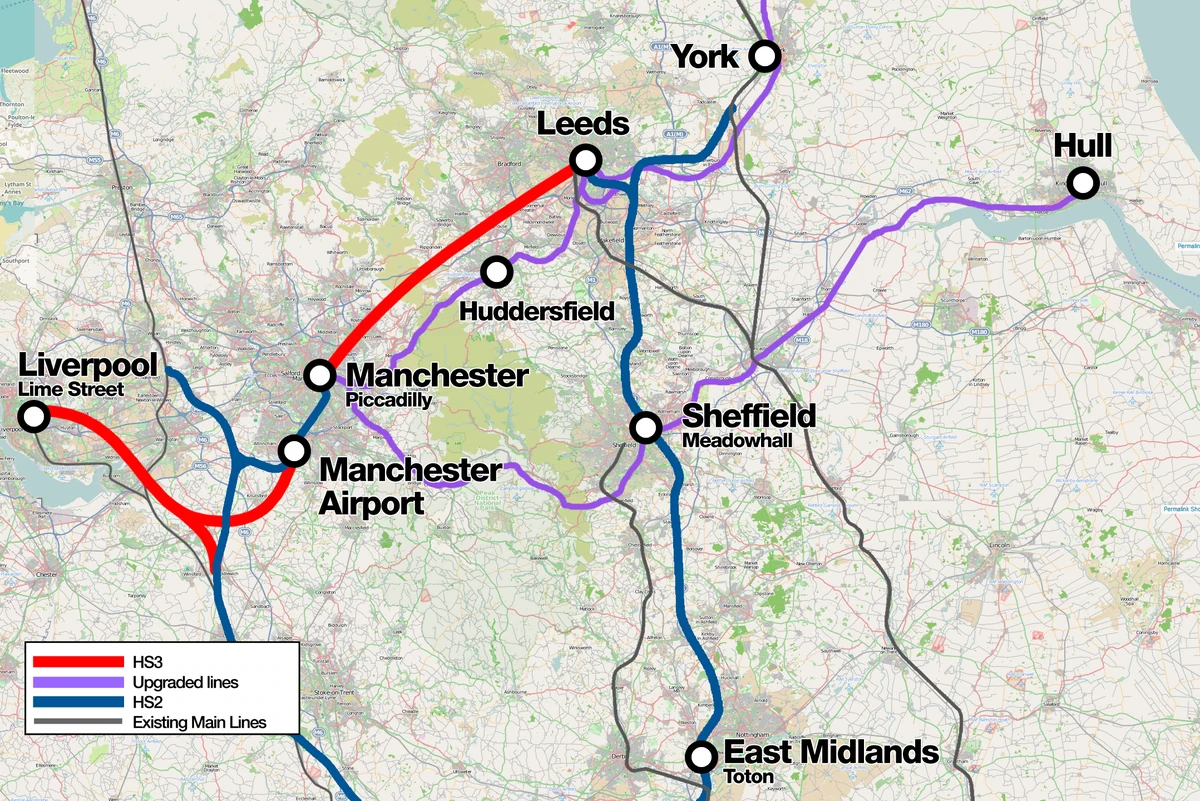
Northern Powerhouse Rail (NPR) is a proposal to improve rail connections between major cities in the North of England. Its ambition is larger than shortening individual journeys: by bringing urban centres closer together, the scheme is intended to support a more connected northern economy and make travel across the region easier. But the network described in the proposal is a vision, not a completed railway, and its potential depends on decisions about routes, construction and funding.
A network across the North
The proposed network links Liverpool, Manchester, Leeds, Sheffield, Newcastle and Hull. Its design combines new lines with substantial upgrades to existing tracks and envisages connections with other major rail projects, including High Speed 2. The proposal also gives a sense of the intended change in journey times: a Manchester–Leeds trip, for example, could take about 30 minutes. That figure is an aspiration in the plan, not a description of a service already in operation.
The cities named in the proposal are not the only places that might benefit. Bradford and Sheffield are identified as examples of urban centres whose economic potential could be better connected to the wider region. The case for NPR therefore rests not simply on trains travelling faster between a handful of destinations, but on the prospect of improving access between centres of work and activity. How widely those gains would be shared would depend on the final network and the services it supported.
Economic and everyday connections
The proposal presents better connections as a way to bring economic hubs closer together and open up a wider range of work and travel options. Faster, easier journeys could help people reach jobs, support business links and attract investment. Those are anticipated benefits rather than guaranteed outcomes: the scheme’s effects would depend on its delivery, the places served and how the railway fitted into people’s daily journeys.
NPR also carries a social and cultural argument. Improved links could make visits between northern cities more convenient, including trips to Liverpool’s docks, Manchester’s music venues, Leeds’ arts scene and Newcastle’s architecture. Easier regional travel might support tourism and cultural exchange, as well as routine journeys. The underlying ambition is to make the North feel less like a collection of separate urban centres and more like a region whose people and institutions can readily meet and work together.
Ambition, environmental claims and practical obstacles
The proposal describes electric trains as a means of encouraging travel by rail instead of car, with the possibility of reducing road congestion and carbon emissions. Those environmental gains are conditional: the text sets out an intended benefit, not measured results from an operating NPR network. The same caution applies to claims about productivity, investment and economic rebalancing. They explain the case made for the project, but they cannot establish what the project would ultimately achieve.
Funding, political commitment and the practical complexity of building and upgrading railway infrastructure are identified as major obstacles. The proposal calls for action by local and national government and private stakeholders, but the scale of its ambitions makes delivery a central question rather than a footnote. Decisions on construction, connections and services would shape both the cost of the scheme and the extent to which its promised benefits reached communities across the North.
Why Northern Powerhouse Rail deserves a place in British Legacy
Northern Powerhouse Rail belongs in a discussion of British public works as a proposal that puts regional connection at the centre of infrastructure planning. Its stated ambition is to link Liverpool, Manchester, Leeds, Sheffield, Newcastle and Hull through a combination of new lines and upgraded tracks, while connecting with projects such as HS2. The proposed journey-time improvement between Manchester and Leeds makes that ambition concrete, while the inclusion of Bradford and Sheffield points to a wider question: whether better transport can spread opportunity beyond the largest or most prominent centres.
The case for the project is not that its promised economic, cultural or environmental benefits have already been achieved. Rather, NPR illustrates how a railway proposal can be asked to serve several public purposes at once: easier journeys, stronger links between places, wider access to work and visitors, and a possible shift towards rail travel. Its place in British Legacy rests on that ambition and on the practical test it faces. Funding, political choices and delivery will determine whether a vision for a more connected North becomes a functioning network and whether its benefits are shared across the region.