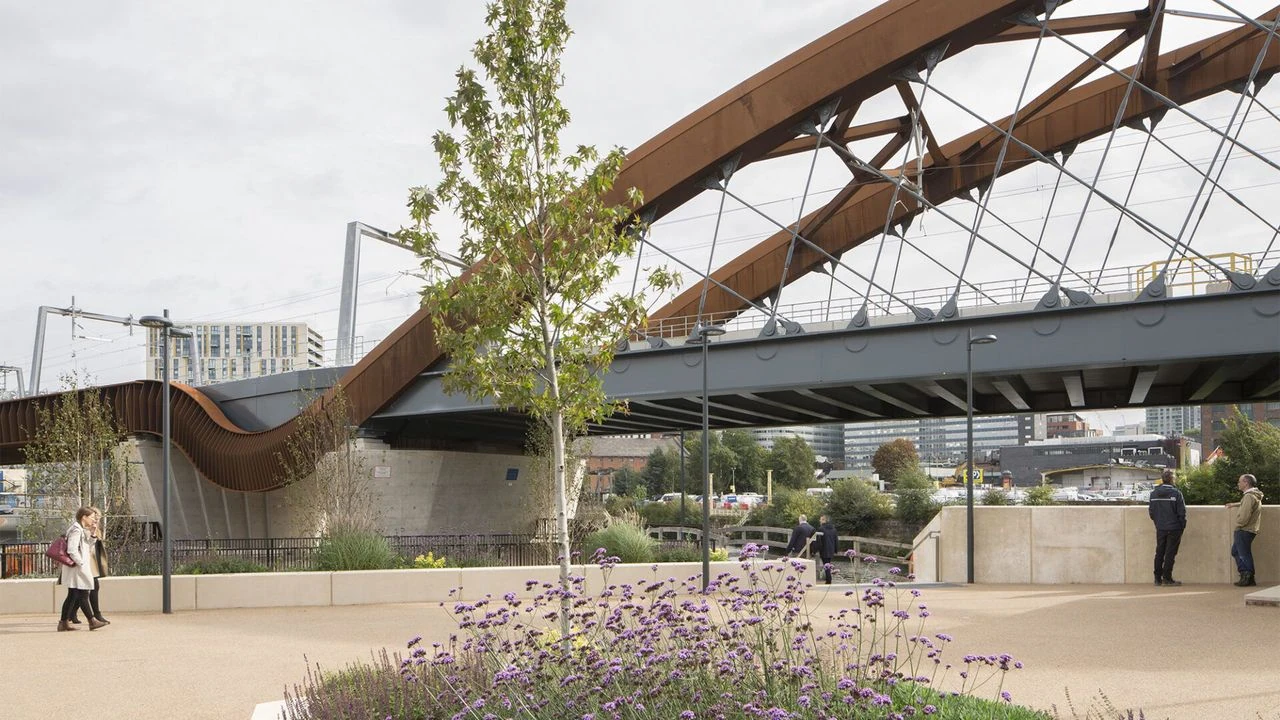
The Ordsall Chord is a short railway line in Ordsall, Salford, connecting the routes serving Manchester Piccadilly and Oxford Road with Manchester Victoria. Opened to passenger services on 10 December 2017, it was designed to let trains run through the city rather than terminate at one of its central stations before turning back. Its history reaches from a proposal in the 1970s to a modern scheme intended to increase capacity and reduce journey times. Its operation has also exposed a limit of infrastructure built in isolation: a new link cannot deliver its full potential if surrounding stations and railway junctions remain congested.
A railway connection proposed decades earlier
By the late twentieth century, Manchester’s rail network was struggling to accommodate demand. Piccadilly and Victoria were not directly linked, and trains terminating at Victoria occupied platform space. One proposed solution, the Picc-Vic tunnel between the stations, was rejected on cost grounds in 1977. A different idea—a curve at Ordsall, then known as the Castlefield Curve—had been put forward in the late 1970s.
A bill for the curve was debated in the House of Commons in June 1979. Although the project received support, opponents argued that a tunnel would be a better answer. British Rail obtained parliamentary powers to construct the line later that year, with the cost estimated at about £10 million. Local political opposition and a shortage of funding meant that construction did not begin, and the proposal was abandoned by 1985.
The idea returned in Network Rail’s 2005 draft proposals for addressing overcrowding, then with an estimated cost of £44 million. In February 2010, Network Rail revived it as part of the Manchester Hub Study, a wider plan for improving rail capacity. The Ordsall link was one part of that programme, not the whole investment: the wider Northern Hub scheme was estimated to cost about £530 million, while £85 million for the chord was announced in the 2011 Budget.
Designing and building the link
The chord’s purpose was to connect Piccadilly and Victoria directly, allowing trains from the east and from Victoria to continue towards Piccadilly and the airport. It was also intended to support changes to train paths and timetables across Manchester. In the wider scheme, planned improvements included new through platforms at Piccadilly and track alterations outside the city, so faster trains could pass slower stopping services. The plans projected journey-time reductions averaging 14 minutes to Leeds and 17 minutes to Liverpool. Those were projected benefits of the wider works, rather than results that the chord alone could guarantee.
Planning the route brought the railway’s historic fabric into the project. The alignment crossed the River Irwell near the Grade I listed 1830 railway bridge associated with the Liverpool and Manchester Railway. Network Rail’s design proposed a new network-arch bridge across the river, while removing the museum’s main-line connection immediately east of the historic bridge. That connection had enabled live steam trips using a replica of an 1830 Planet-class locomotive. The Museum of Science and Industry objected to the plans, citing their potential effect on visitors, volunteers and income.
Network Rail submitted its application under the Transport and Works Act in September 2013. The order authorising construction was made on 31 March 2015, and preparatory work began in October. Foundation work started in January 2016. The project also faced a legal challenge: civil engineer Mark Whitby appealed against approval, seeking an alternative that would preserve the museum connection and heritage structures. The High Court rejected his case in October 2015; the Court of Appeal later granted permission to appeal, but the appeal was rejected after a hearing in March 2016.
A 600-tonne network arch was lifted into place on 21 February 2017. The new crossing and railway works created a direct route where none had existed, while the dispute around the alignment demonstrated that transport projects can bring competing public interests into sharp focus: connectivity, operational capacity and the continued use of historic infrastructure.
Opening, intended benefits and practical limits
The first passenger train crossed the chord at 08:40 on 10 December 2017, running from Manchester Victoria to Oxford Road. The return service continued towards Leeds. The connection opened the possibility of through services between the east and Manchester Airport, including routes from Leeds, Newcastle and Redcar Central. It was also expected to reduce congestion at Piccadilly by cutting the need for some trains to cross the station throat and obstruct other services.
Those ambitions depended on more than the new track. The chord’s use has been limited by a lack of capacity at Piccadilly, Oxford Road and Victoria to accommodate additional through trains. A May 2018 timetable change caused widespread disruption around Manchester, and the hoped-for increase in reliable services did not materialise as expected. Network Rail chief executive Andrew Haines later described the chord as infrastructure that had created new journey opportunities but had not been supported by a sufficiently rigorous operating plan. He pointed to the challenge of running 15 trains an hour across six flat junctions within a few miles, with trains and rolling stock arriving with the potential for delays.
In January 2021, the government published proposals for congestion on the Castlefield corridor through Oxford Road and Piccadilly. One option would have reduced use of the chord to one train in each direction per hour. The contrast between the connection’s intended role and the constraints on its use is central to understanding the project: it provides a route, but effective capacity depends on how the wider railway is built and operated.
Why the Ordsall Chord deserves a place in British Legacy
The Ordsall Chord deserves a place in British Legacy as a specific example of the continuing challenge of adapting a historic railway city to modern travel. Manchester’s central rail routes had developed without a direct connection between Piccadilly and Victoria. The chord addressed that gap with a new link intended to let trains pass through the city and connect journeys towards the airport and the wider network. Its long passage from a 1970s proposal, through cancellation, to revival as part of the Northern Hub also shows how major public works depend on more than engineering: they require funding, legal authority, planning and decisions about which existing connections will be affected.
The project’s legacy is not a simple claim of success. The railway opened and created new journey possibilities, but its practical use has been restricted by limited capacity at neighbouring stations and the difficulty of operating busy, interconnected routes reliably. That qualification makes the chord a useful part of Britain’s transport story. It demonstrates both what a targeted piece of infrastructure can connect and what it cannot solve alone. In Manchester, where the rail network carries the marks of successive generations of development, the chord’s construction and operation offer a grounded lesson in planning: new links work best when the surrounding system is ready to support them.
Sources
Ordsall Chord — Wikipedia revision
Adapted in part from Ordsall Chord by Wikipedia contributors, under CC BY-SA 4.0. Text has been edited and combined with the existing article; this adapted text is shared under the same licence. Contributor history.