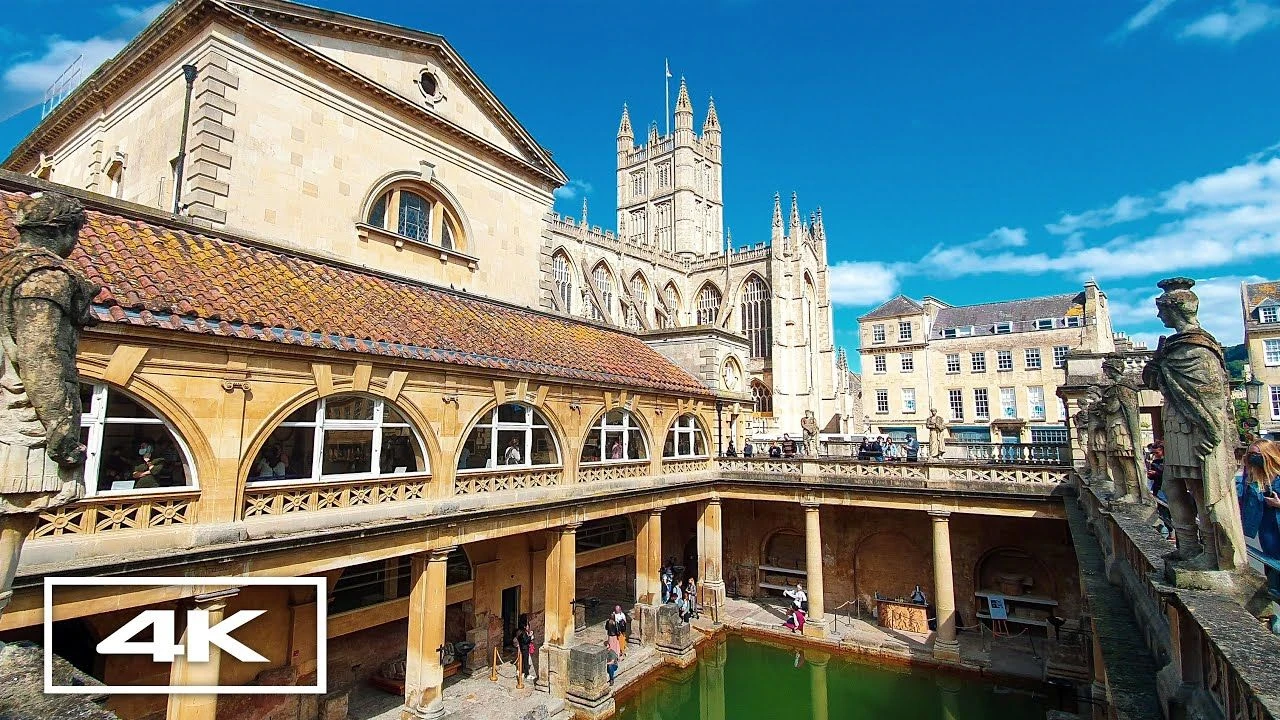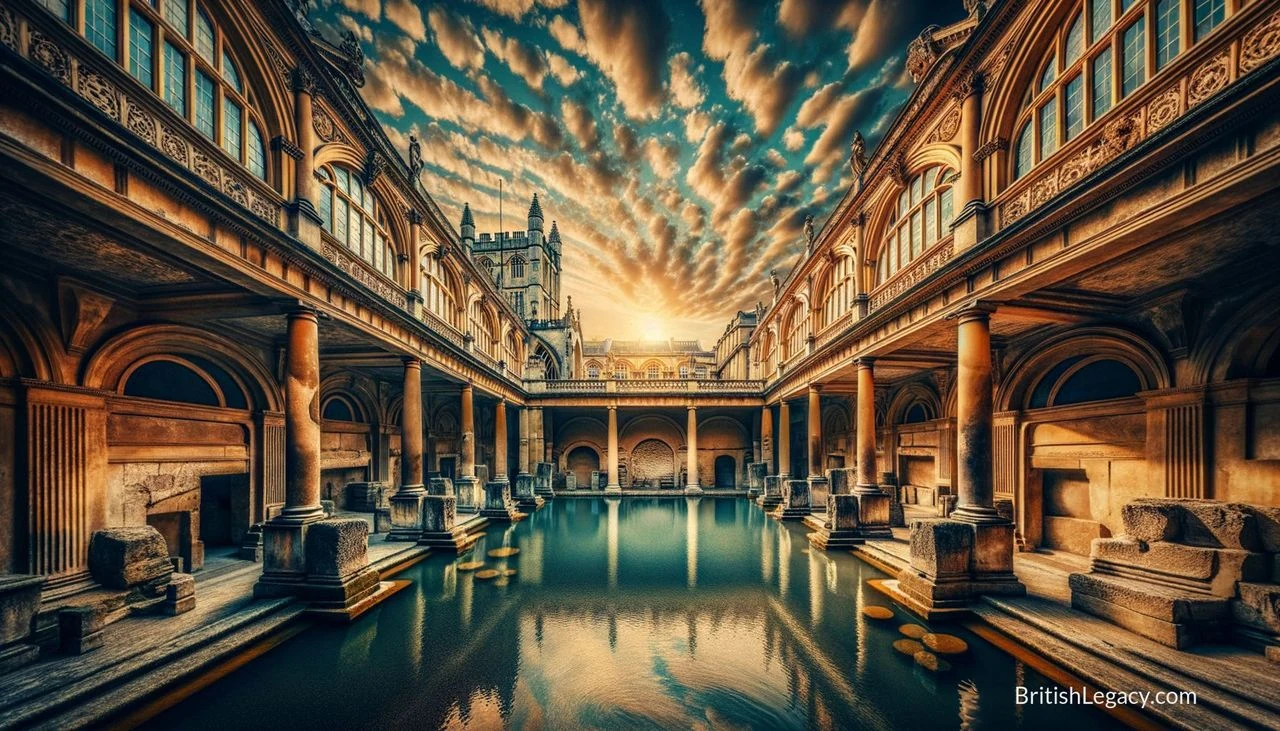
At the centre of the Roman Baths is a natural hot spring, channelled into a complex that joined bathing with worship. Built in Roman Britain at Bath, the site includes the Sacred Spring, a temple dedicated to Sulis Minerva, bathing rooms and a museum. Its stones and water preserve a record of Roman engineering and religious practice, while the finds displayed there offer another route into the lives and beliefs of the people who used the place.
A complex shaped by hot water
The bath complex was constructed around 70 AD above Bath’s hot springs. The spring water, described as rich in minerals including sulphur, was believed by the Romans to have medicinal properties. It was more than a source of heat and water for washing: it was the focus of a substantial public site whose buildings combined bathing and religious activity.
The Great Bath stands at the heart of the complex. Raised above ground level and made using lead-based materials, it gathered the warm spring water into a large pool. The Sacred Spring was another central feature, and continues to flow. These waters gave the site its practical purpose and its religious significance: the spring was treated as a divine source of healing, rather than simply a convenient supply for the baths.
Bathing took place in rooms intended for water at different temperatures. The caldarium was the hot bath, the tepidarium the warm room and the frigidarium the cold bath. Together, these spaces show how the complex organised bathing as a sequence of experiences. The site’s heating arrangements and water management also demonstrate the engineering involved in making a large bathing complex work around a natural spring.
Bathing, worship and Roman engineering
The Roman temple was dedicated to Sulis Minerva, joining the local Celtic goddess Sulis with the Roman goddess Minerva. Its presence alongside the spring and bath house makes clear that the complex served religious as well as practical purposes. The site was not only somewhere to bathe: worship centred on the spring, while the surrounding buildings gave visitors a place to use its water and take part in the life of the complex.
Features described at the site include plunge pools, heating systems, mosaics and an aqueduct system. They belong to a wider picture of Roman construction in which water had to be brought into, heated within and moved through the buildings. The arrangement of sacred spring, temple and bathing rooms also gave the complex a distinct sequence of spaces, each with a different function.
That combination makes the Roman Baths useful for understanding more than building technique alone. The spring points to the place of natural water in religious belief; the temple records the meeting of Celtic and Roman gods; and the bathing rooms show the practical organisation of a public facility. The surviving structures and excavated objects offer different kinds of evidence, from the layout of the buildings to the offerings and personal items associated with the site.
Objects, preservation and visitors
The museum displays objects recovered during excavations, including religious offerings and jewellery. These finds add detail to what the architecture can show. A spring, a temple or a bath room reveals the design and purpose of a space; objects found at the site can provide a more immediate sense of the people who visited it and the activities that took place there.
The complex is presented as a preserved archaeological site, with glass enclosures protecting ancient structures while allowing visitors to see them. Restoration and education help keep the remains accessible as a place to learn, not merely a collection of old buildings. The site also draws visitors to Bath and connects the city’s present-day identity with its Roman past.
Bath is a UNESCO World Heritage city, and the Roman Baths form a prominent part of its historic character. The site’s appeal reaches beyond local history: its buildings and collections allow visitors to explore Roman religious practice, bathing and engineering in one place. The continued display of the spring, the temple and the finds gives the complex its particular value as a public heritage site.
Why The Roman Baths deserve a place in British Legacy
The Roman Baths deserve a place in British Legacy because they preserve a specific meeting of Roman engineering, public life and religious belief in Britain. Their hot spring was not simply exploited as a water source: it became the focus of a complex that included a temple to Sulis Minerva, pools and rooms for bathing at different temperatures. The Great Bath, heating arrangements and water systems make the practical demands of the site visible, while the Sacred Spring shows how the same natural feature could carry spiritual meaning.
The site’s value continues through the evidence it makes available to the public. Its buildings preserve the layout of a Roman bathing complex, and its museum displays offerings and jewellery recovered through excavation. Together, architecture and objects help visitors consider how people used and understood this place, rather than reducing Roman Britain to a date or a set of ruins. In Bath, the complex also gives the city a tangible link to its Roman history and contributes to the experience of a World Heritage city. Its legacy lies in that combination: a distinctive archaeological record, a place of public learning and a continuing connection between Bath and its ancient past.