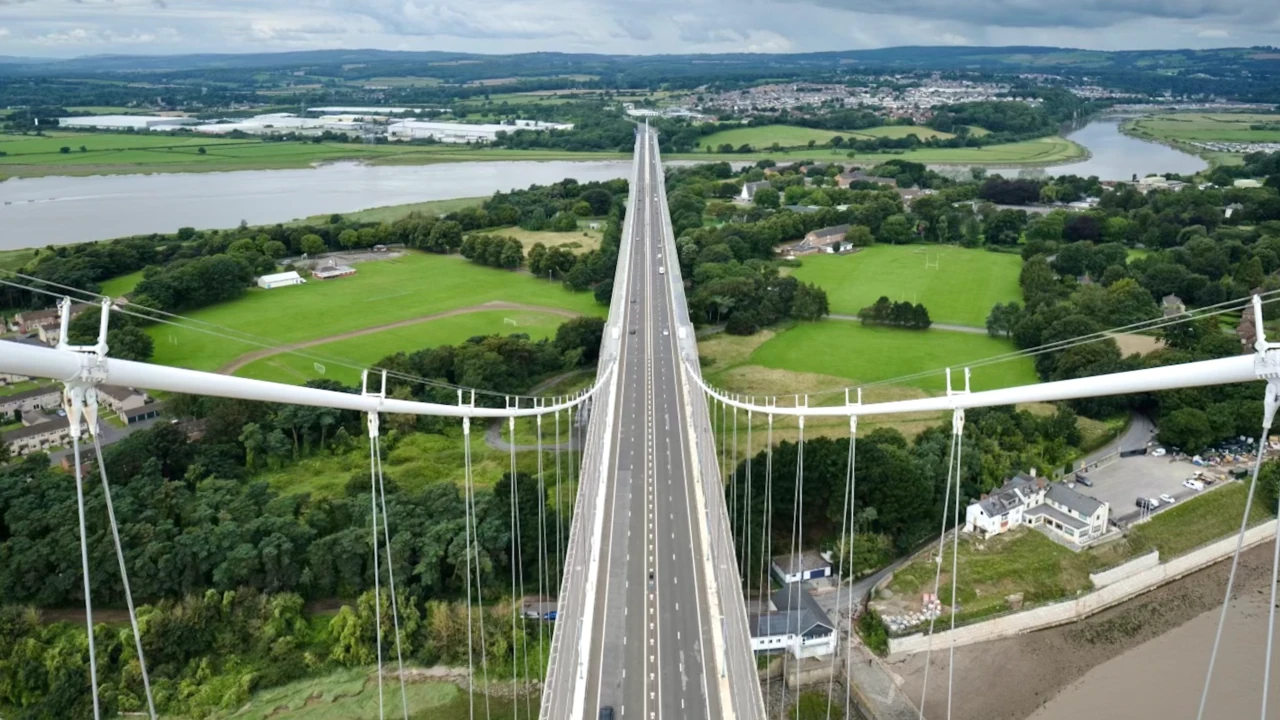
When the Severn Bridge opened in 1966, it provided a permanent road crossing between England and Wales where travellers had previously relied on ferries or a longer route through Gloucester. Its streamlined deck, inclined hangers and substantial main span made it notable as an engineering project as well as a new route across the estuary.
A long-standing case for a crossing
The need for a more direct route across the Severn had been considered from the nineteenth century. For many travellers, getting across the river meant taking a ferry; others made a lengthy detour through Gloucester. The proposal gained momentum in the post-war period, as rising car use strengthened the case for a road connection that did not depend on either option.
Construction began in 1961 under the Ministry of Transport. Engineers Sir Gilbert Roberts and William Brown were among those associated with the project. Five years later, on 8 September 1966, Queen Elizabeth II officially opened the bridge. The change was practical: a crossing that had involved a ferry or a longer journey inland now had a fixed road link.
A distinctive suspension-bridge design
The bridge measures 1,598 metres in length and has a main span of 988 metres. On completion, it was described as the world’s longest suspension bridge outside the United States. Its scale was only one part of its engineering interest. The structure used a streamlined box girder, a hollow deck combining strength with relatively low weight, and inclined hangers rather than vertical ones.
The deck’s aerodynamic form was intended to help the bridge withstand the weather and movement forces that challenge suspension bridges. The inclined hangers were described as reducing oscillation and increasing stability. Together, these choices gave the Severn crossing a recognisable profile and distinguished its design from earlier suspension bridges. The source account presents those features as influential on later bridge design, though it does not identify particular projects that adopted them.
Transport, place and continuing presence
The crossing connected South Wales more directly with south-west England, serving people travelling for commerce, commuting and tourism. It reduced reliance on ferries and on a route through Gloucester, creating a more direct connection across the estuary. The source account also credits the bridge with supporting trade and community connections, but offers no specific measure of those wider effects.
The bridge has appeared in films, documentaries and photographic work, and its form has become part of the landscape’s public image. Its continued use has required maintenance and refurbishment. The later Severn crossing, the Second Severn Crossing, is now known as the Prince of Wales Bridge; it is a separate structure and part of the changing transport network across the estuary.
Why The Severn Bridge deserves a place in British Legacy
The Severn Bridge deserves a place in British Legacy because it answered a clear transport problem with a lasting piece of public infrastructure. Before it opened, crossing the Severn could mean taking a ferry or travelling by a longer route through Gloucester. Its 1966 opening established a permanent road connection between England and Wales, linking South Wales more directly with south-west England. That change matters not as an abstract symbol of progress, but as a practical alteration to how people could travel across the estuary.
Its engineering gives the story a further dimension. At 1,598 metres long, with a main span of 988 metres, the bridge brought together a streamlined box girder and inclined hangers in a major suspension crossing. Its design and recognisable profile have kept it in public view, while maintenance has sustained its transport role. The Severn Bridge therefore represents both the engineering choices behind a landmark structure and the everyday value of a route connecting communities on either side of a national boundary.