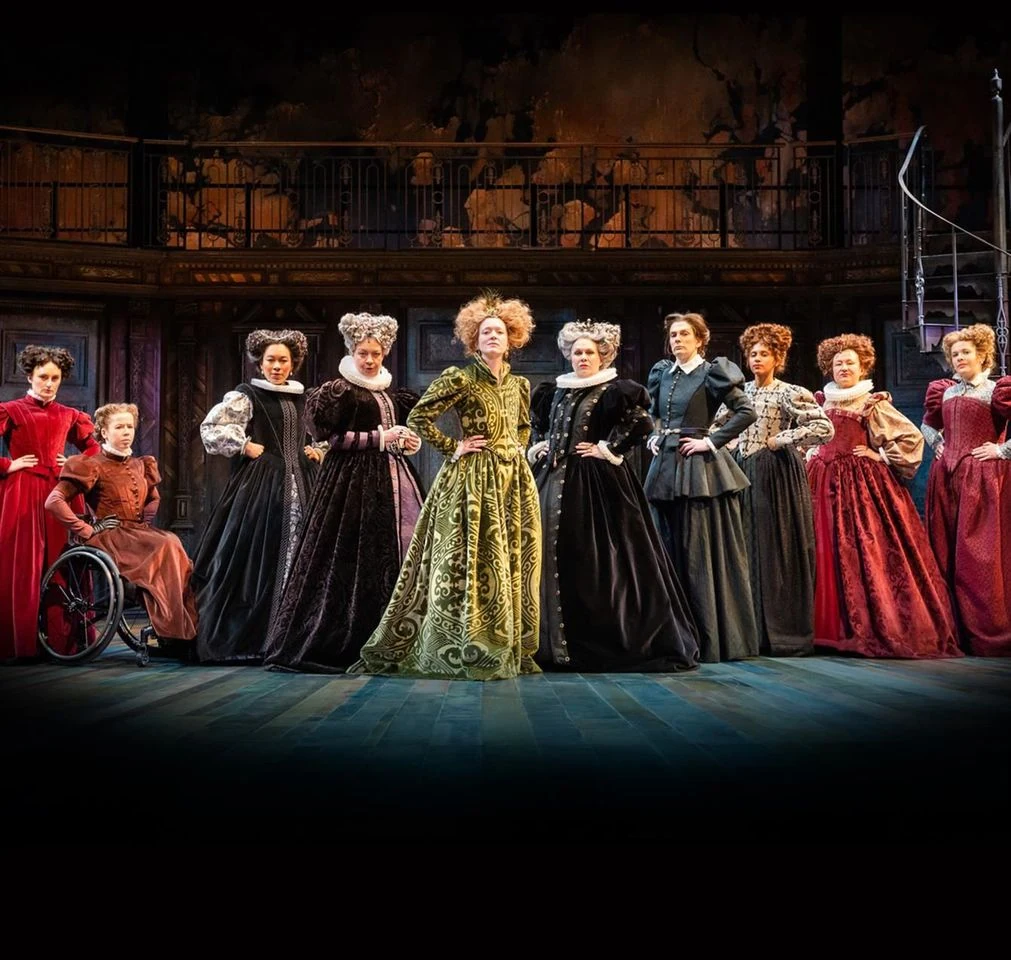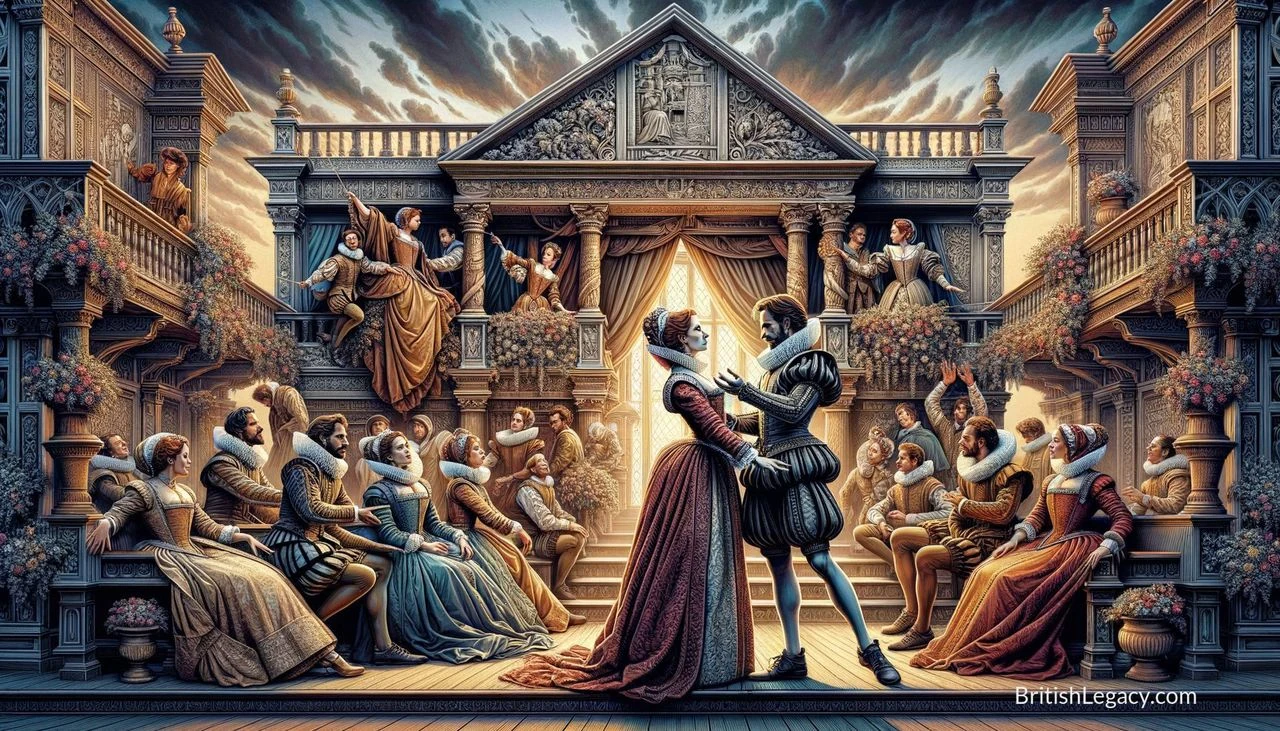
In The Taming of the Shrew, a wager turns marriage into a public contest: which husband can summon his wife most readily? Katherina is the only wife who answers her husband’s call, and her ensuing speech on obedience brings the comedy to its deliberately unsettling close. Whether she has been subdued, is playing a part, or is speaking within a farce remains open to interpretation. That tension has helped keep Shakespeare’s play in performance and in argument for centuries.
A play inside a play
The comedy begins not with Katherina but with Christopher Sly, a drunken tinker whom a mischievous lord tricks into believing that he is an aristocrat. The lord arranges for a play to be performed for Sly’s amusement. The main story is therefore framed as theatre watched by a character who has himself been drawn into a performance. That device complicates the audience’s response: the story of Katherina and Petruchio is presented as entertainment within a prank, rather than as an unframed account of domestic life.
In Padua, Baptista Minola has two daughters. Bianca has several suitors, but Baptista will not allow her to marry until her elder sister Katherina is wed. Men describe Katherina as forceful and difficult; Bianca, by contrast, is treated as the more desirable match. Her suitors join forces to find Katherina a husband so that they can compete for Bianca.
Petruchio, arriving from Verona after his father’s death, says that he wants to marry. He is willing to pursue Katherina for her dowry, and his friend Hortensio helps arrange the match. Meanwhile, Lucentio falls in love with Bianca and disguises himself as a tutor to court her. His servant Tranio pretends to be Lucentio, while Hortensio also approaches Bianca under a tutor’s disguise. Disguise and deception drive the subplot as well as the central courtship.
The courtship and the wager
Petruchio treats Katherina’s anger as kindness, answering her words with calculated misinterpretations. After their marriage, he takes her to his home and denies her food and suitable clothing on the grounds that nothing is good enough. He contradicts her over what she sees and says. On the journey back to Padua, he insists that the sun is the moon; Katherina agrees that it is whatever he chooses to call it. The play presents this as part of his attempt to establish control over their shared account of the world.
The subplot reaches its own conclusion through further deception. Tranio, still impersonating Lucentio, wins Bianca’s hand by promising more than the real Lucentio possesses. He and Lucentio persuade a pedant to pretend to be Lucentio’s father and confirm the proposed marriage. Bianca secretly elopes with the real Lucentio. When the real father arrives in Padua and the imposture is exposed, Lucentio explains what has happened; the fathers forgive the deception.
At the end, three couples are married: Katherina and Petruchio, Bianca and Lucentio, and Hortensio and a widow. The men wager on whose wife is most obedient. Katherina is the only one to come when summoned. She then delivers a long speech advocating a wife’s obedience to her husband, while the other men marvel at Petruchio’s apparent success. The ending makes marriage, money and male authority part of the same public spectacle.
Dating and the play’s uncertain textual history
The play is generally dated to between 1590 and 1592, although its precise composition date is uncertain. Part of the difficulty is its relationship to another Elizabethan play, A Pleasant Conceited Historie, called the Taming of a Shrew, which was entered in the Stationers’ Register in 1594. The two plays have closely related plots but differ in wording and in aspects of their characters and structure. Scholars have proposed several explanations: A Shrew may be a reconstruction, an adaptation, an earlier version, or a source for Shakespeare’s play. The relationship has not been settled.
The surviving publication history adds another distinction. A Shrew appeared in print in 1594, while Shakespeare’s The Shrew was published in the First Folio of 1623. A quarto edition of The Shrew followed in 1631. Earlier editors sometimes incorporated material from A Shrew into editions of Shakespeare’s play; Edmond Malone removed those additions in his 1790 edition, returning to the First Folio text. The history of editing shows that what audiences encounter as the play’s shape has itself been subject to debate.
What does Katherina’s ending mean?
Katherina’s final speech is the play’s most consequential interpretive test. Read literally, it appears to endorse a wife’s subordination. Some readers instead see irony: Katherina may be performing obedience to satisfy the wager, while retaining her independence. Others understand the speech as part of the broad farce established by the Christopher Sly frame, or as evidence that the couple has reached an understanding. The play does not remove the uncertainty, and a production’s choices about tone, gesture and the relationship between the couple can alter the effect substantially.
The disagreement is not merely about whether Katherina means what she says. It also concerns what the comedy asks its audience to find funny. Petruchio’s methods include keeping her from food and clothing and repeatedly contradicting her. The final wager makes the other wives’ obedience a matter for competition among men. A performance can expose the cruelty and self-satisfaction in that contest, or risk treating Katherina’s apparent submission as its uncomplicated comic reward.
The induction matters to these arguments because it draws attention to theatrical illusion. Sly is tricked into a new identity, while the main plot is itself a play staged for him. Critics and directors have differed over whether this frame makes the story feel like farce, gives the audience distance from its conduct, or adds another layer to questions of identity and power. Some productions omit the induction; doing so changes the structure through which the audience first encounters the action.
A story retold in different forms
The play’s afterlife reaches beyond spoken drama. It has been adapted for opera, ballet, musical theatre, film and television. Cole Porter’s musical Kiss Me, Kate places a production of Shakespeare’s play within a story about a married acting couple whose quarrels spill into their work. The 1967 film adaptation starred Elizabeth Taylor and Richard Burton. The 1999 film 10 Things I Hate About You recast the story in a contemporary high-school setting. Other screen versions have included the 1963 western comedy McLintock! and a 1929 film starring Mary Pickford.
These adaptations do not simply transfer the same plot unchanged. Their different settings and forms give directors, writers and performers ways to alter the tone and emphasis. The Christopher Sly frame, the disguises in Bianca’s courtship and the ending’s wager offer distinct material for adaptation; a production can foreground farce, romance, social hierarchy or the troubling force of Petruchio’s conduct. The story’s repeated return to new stages and screens reflects the continuing challenge of deciding how its comedy should be heard.
Why The Taming of the Shrew deserves a place in British Legacy
The Taming of the Shrew belongs in British Legacy as a work of early modern English drama by William Shakespeare that has remained active in performance and adaptation. Its British connection is specific: it is part of Shakespeare’s dramatic writing in English and of the continuing theatrical tradition through which his plays are staged, edited and reinterpreted. Its value is not that it offers an uncomplicated model of marriage or social conduct. The story puts questions of authority, consent, money and performance into a comic structure that audiences and artists have repeatedly had to confront.
The play also demonstrates how a work’s meaning can be shaped by its presentation. Its induction invites audiences to think about theatrical illusion; its disguises make identity and deception part of the action; and its final speech leaves room for competing readings rather than resolving the dispute. Adaptations such as Kiss Me, Kate, the 1967 film and 10 Things I Hate About You show how far the story can travel while retaining recognisable elements of Shakespeare’s plot. For British cultural heritage, that continuing life matters: the play supplies material for new performances and debate, including debate over the gender politics that earlier accounts of its comedy could too easily leave unexamined.
Sources
Adapted in part from The Taming of the Shrew by Wikipedia contributors, under CC BY-SA 4.0. Text has been edited and combined with the existing article; this adapted text is shared under the same licence. Contributor history.