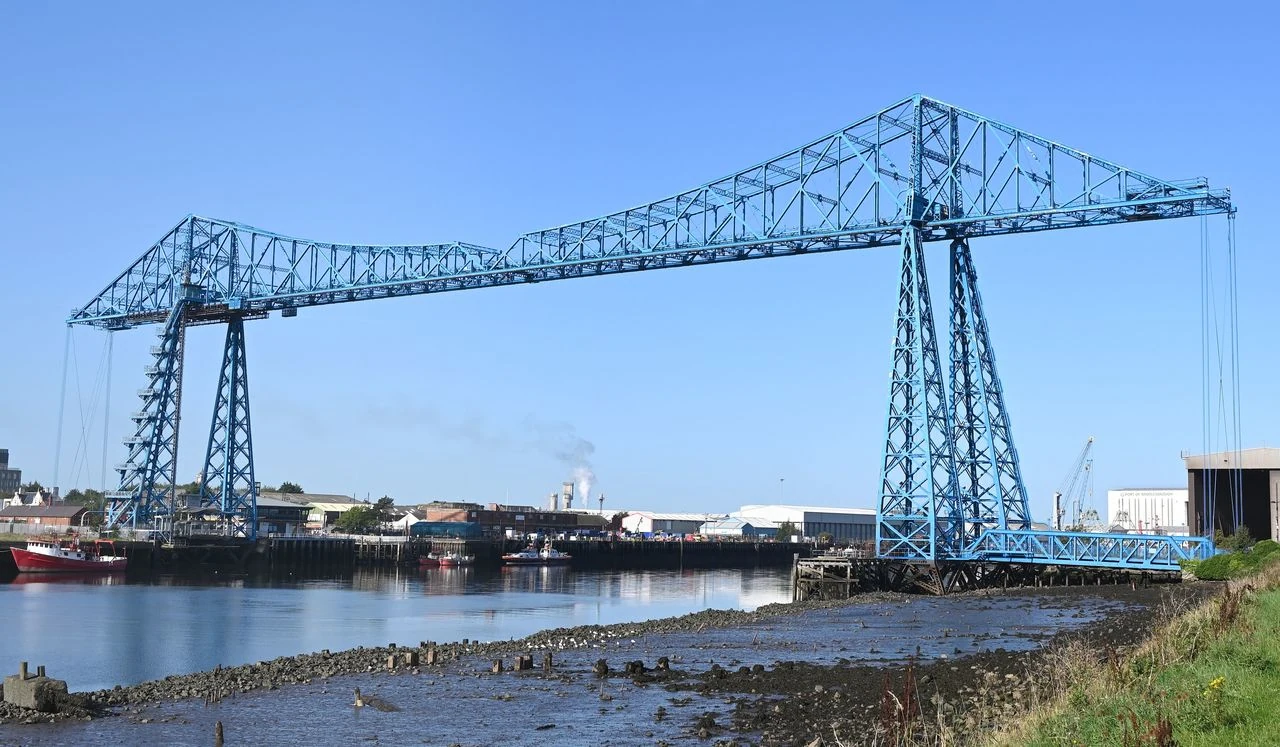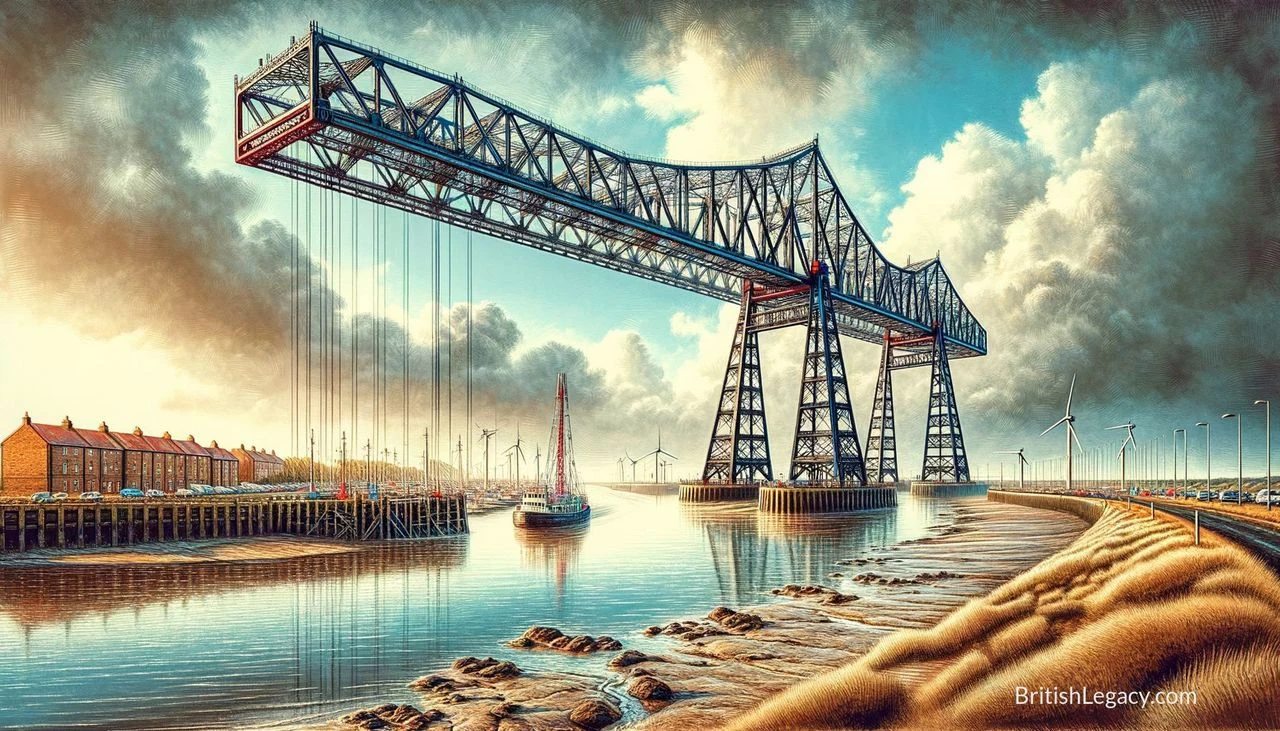
At Middlesbrough, the Tees Transporter Bridge carries people and vehicles across the River Tees without closing the route to ships below. Its gondola travels on rails beneath a fixed steel structure, lifting passengers over the water while maritime traffic can continue to pass. Completed in 1911, the bridge was built for a town shaped by iron and steel production, shipyards and chemical works. More than a century later, its unusual form still makes the practical problem it solved visible in the landscape.
A crossing designed around the river
The bridge connects Middlesbrough with Port Clarence. Instead of carrying a road directly across the river, it suspends a travelling platform, or gondola, from rails beneath the main structure. Vehicles and pedestrians board the platform, which moves from one bank to the other. The arrangement offered a way to maintain a crossing while leaving the river open to shipping—an important consideration on the busy Tees.
The structure was designed by Cleveland Bridge & Engineering Company and Sir William Arrol & Co. It measures 259 metres in length, with a steel framework rising 68 metres above the river. Those dimensions give the bridge its commanding presence, but its defining feature is the relationship between its fixed framework and moving carriage: the crossing itself travels above the water rather than blocking the channel with a conventional road deck.
Built for Middlesbrough’s industrial growth
In the late nineteenth and early twentieth centuries, Middlesbrough grew into a centre of iron and steel production. Its position on the Tees also supported shipbuilding and other industries along the riverbanks. Workers and goods needed to move between the two sides, while ships required room to reach the port. A conventional crossing could have obstructed that traffic; the transporter design addressed both demands in one structure.
The bridge became part of everyday life as well as an answer to an industrial transport problem. Its purpose was not simply to span a gap, but to connect communities and workplaces without preventing the river from functioning as a shipping route. That combination of local access and navigable water helps explain why the transporter form mattered at this particular site.
Landmark, screen presence and preservation
The bridge is now a recognisable landmark associated with Middlesbrough’s industrial past. It has also appeared in film and television, including The Fast Show and Billy Elliot. Such appearances have carried its distinctive silhouette beyond the Tees, though its principal significance remains rooted in the place it serves and the engineering problem its design addressed.
Refurbishment took place in 2011, the bridge’s centenary year. The structure has also been presented to visitors as a heritage attraction, with guided tours and trips up the steelwork offering a closer view of its construction and history. These activities sit alongside its role as a crossing: it is both infrastructure and a place through which the industrial story of the river can be understood.
Why the Tees Transporter Bridge deserves a place in British Legacy
The Tees Transporter Bridge deserves a place in British Legacy because it records a specific meeting of engineering design and local need. Middlesbrough’s industries depended on movement across the river, but the Tees also had to remain accessible to ships. The travelling gondola provided a practical answer, carrying people and vehicles without turning the river into an obstacle for maritime traffic. Its steel frame and moving platform make that solution legible even to a visitor unfamiliar with the history of the town.
Its continuing importance is also local and cultural. The bridge links Middlesbrough and Port Clarence, recalls the industrial activity that shaped the riverbanks, and remains recognisable in the town’s landscape and popular culture. Refurbishment and visitor tours have helped preserve and explain the structure, while its identity as a working crossing connects heritage with everyday use. Rather than standing only as a monument to the past, it shows how an ambitious piece of infrastructure can retain meaning through the practical purpose it was built to serve.