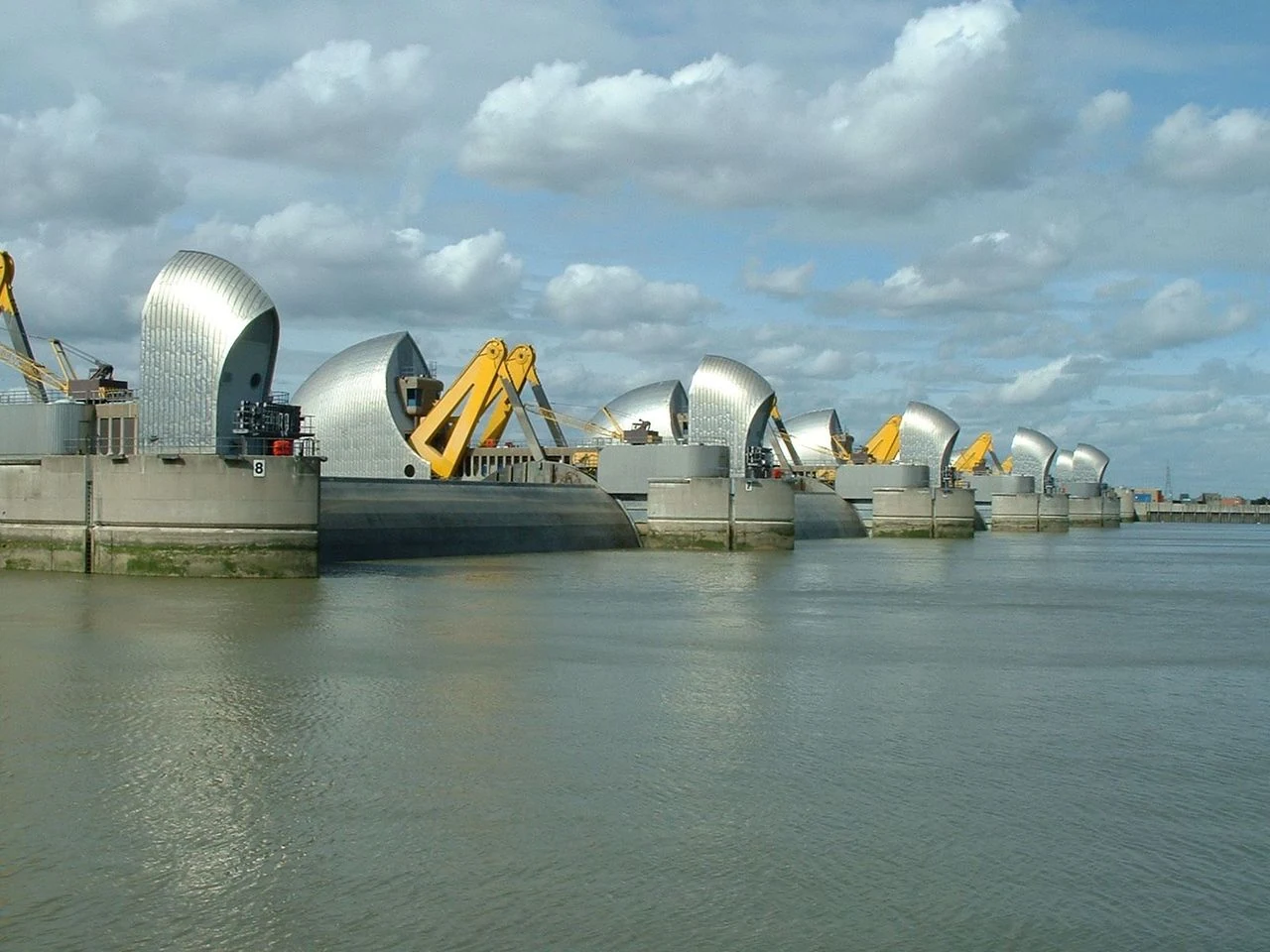
At Woolwich, ten steel gates cross the Thames in a structure designed to meet a danger that reaches London from the sea. The Thames Barrier is a movable flood defence: its gates can be raised to block a tidal surge travelling up the river towards the capital. Completed in 1982, it turns a complex engineering task into a visible part of London’s landscape—and a practical response to the risk of flooding.
A response to the 1953 flood
The case for a major Thames flood defence was sharpened by the 1953 flood, which affected low-lying areas of London and the Thames Estuary and caused loss of life and property. The disaster exposed the vulnerability of communities beside the river and made the need for protection harder to ignore. The Barrier was built to address the threat of tidal flooding, rather than to serve as a general-purpose wall against every kind of flood.
Planning and construction took about a decade, with the completed structure spanning 520 metres across the Thames at Woolwich. Its ten steel gates are supported by concrete piers. The gates have been likened to huge upturned spoons: when open, they sit down so that river traffic can pass; when closed, they turn to form a barrier across the channel. Each gate is described as weighing more than 3,000 tonnes.
How the gates work
The Barrier is not simply a fixed obstruction. Its gates can be raised or lowered in response to tidal conditions, allowing the river to flow normally when the flood risk does not require them to close. When a dangerous surge threatens, the gates are raised to block its route upstream. This ability to change the river’s passage is central to the design: the structure must provide protection while remaining part of a working waterway.
The system’s concrete piers carry the gates, while computer control forms part of its operation. Together, the movable gates, supporting structures and control systems make the Barrier a large piece of infrastructure that must respond to changing conditions. Its purpose is specific and consequential: to reduce the danger of tidal flooding in London. The claim that it protects the city “even under the most severe weather conditions” is too sweeping; the Barrier is a defence against a particular flood threat, not a guarantee against every extreme event.
A working landmark on the Thames
The Barrier’s significance is measured not only by its scale but by its repeated use. The earlier account reports that it has been raised more than 190 times. That figure gives a sense of a structure intended to operate when required, rather than stand as a monument to engineering alone. Each closure is part of the continuing work of managing flood risk for London and the communities along the river.
The Barrier also makes infrastructure legible to the public. A nearby information centre is described as offering visitors an introduction to its history, engineering and operation. The striking gates and piers give the river crossing a strong visual presence, while the visitor facility provides a way to understand why the structure is there. Its public face is therefore linked to its working purpose: protection depends on engineering, but public understanding helps make that purpose visible.
The original account also presents the Barrier as an example studied by engineers and planners beyond the United Kingdom. That international influence is not established here in detail, but the underlying design challenge is clear: how to defend a densely settled river city from tidal flooding without permanently closing its waterway. The Thames Barrier offers one substantial British response to that problem.
Why The Thames Barrier deserves a place in British Legacy
The Thames Barrier deserves a place in British Legacy because it is a major public work built in response to a specific danger to London. The 1953 flood made the consequences of tidal inundation stark; the Barrier’s completion in 1982 brought a large-scale defence into operation at Woolwich. Its ten movable gates, concrete piers and capacity to close across the river represent engineering applied to a continuing civic need. This is a British connection grounded in the location, construction and public purpose of the work, not in a generic claim of national superiority.
Its legacy also lies in the way it combines protection with the life of the river. The gates can be lowered when a closure is not needed and raised when a tidal surge threatens, making the structure both a working defence and a visible landmark. Its repeated operation and nearby information centre help explain how large infrastructure serves communities over time. The Barrier is not a promise that London can never flood; it is a substantial, purpose-built response to tidal risk. That combination of practical function, public visibility and long-term urban protection makes it an important part of Britain’s engineering story.