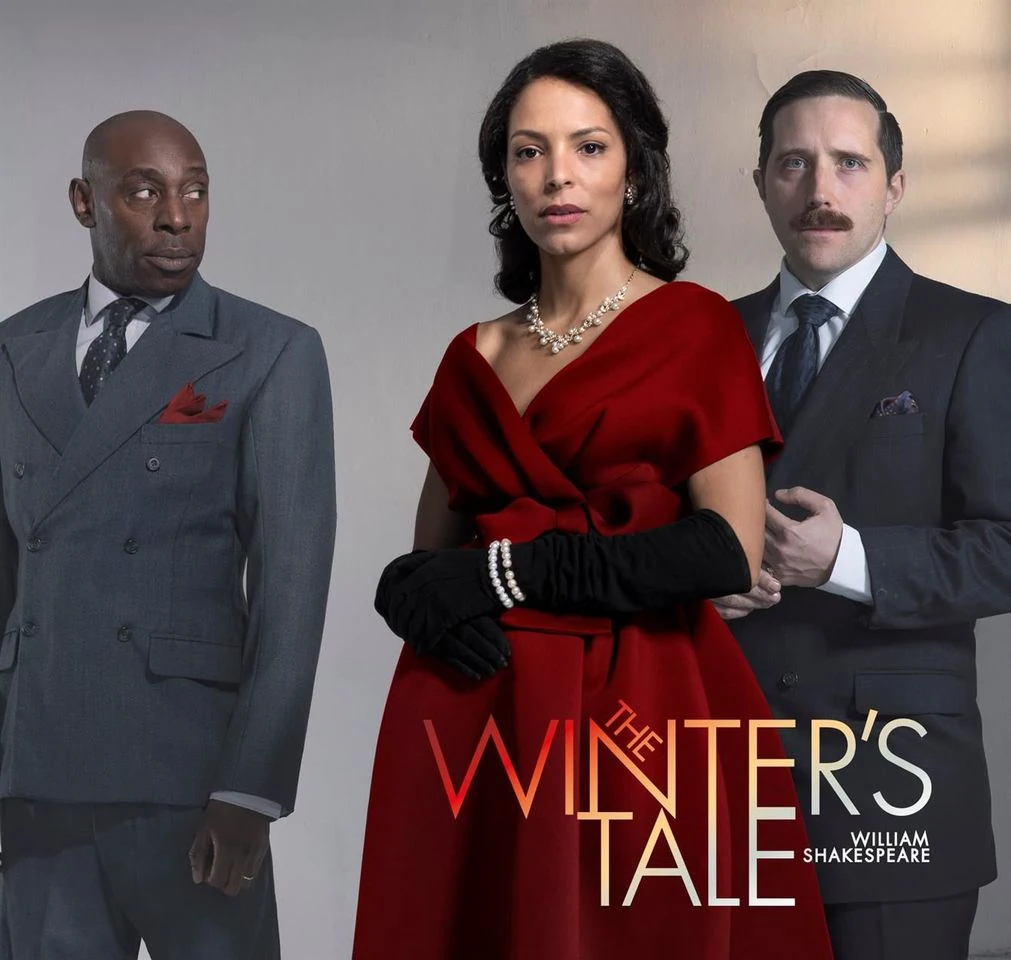
In The Winter’s Tale, a king’s suspicion fractures two families and leaves a child to grow up far from her parents. Shakespeare then lets sixteen years pass before bringing the separated characters together again. The result is a play that begins in psychological crisis and turns towards pastoral comedy, without entirely erasing the grief of what has been lost.
A late play with a divided character
Shakespeare’s play was probably written around 1610 or 1611 and first appeared in print in the First Folio of 1623. It is among his later works. Though grouped with the comedies in the First Folio, it is often described as a late romance: its first three acts are dominated by accusation, imprisonment and death, while the later action turns towards love, recognition and reconciliation. The shift is so marked that the play has also been discussed as a problem play.
The earliest recorded performance was at the Globe in London on 11 May 1611, according to the contemporary observer Simon Forman. The play was also performed at court before King James later that year and at Whitehall in 1613, during festivities preceding Princess Elizabeth’s marriage to Frederick V of the Palatinate. These records place the work in the theatrical and courtly life of Jacobean England, though they do not establish that the Globe performance was its first.
Jealousy, exile and the passage of time
The action begins in Sicilia, where King Leontes and his childhood friend Polixenes, King of Bohemia, have been together for nine months. When Polixenes wishes to return home, Leontes asks his pregnant wife, Hermione, to persuade him to stay. Her success prompts Leontes to suspect that she and Polixenes are lovers. He orders the Sicilian nobleman Camillo to poison Polixenes; instead, Camillo warns him, and the two men flee.
Leontes publicly accuses Hermione of infidelity, imprisons her and insists that her unborn child belongs to Polixenes. He sends Cleomenes and Dion to consult the Oracle at Delphos. Hermione gives birth to a daughter, and her loyal friend Paulina brings the baby before Leontes, hoping to change his mind. He orders Paulina’s husband, Antigonus, to abandon the child in a remote place. At Hermione’s trial, the oracle declares her and Polixenes innocent and says that Leontes will have no heir until his lost daughter is found. Leontes rejects the oracle, then learns that his son Mamillius has died. Hermione swoons and is carried away; Paulina later reports her death. Leontes, stricken by the consequences of his actions, vows to spend his life in repentance.
Antigonus leaves the infant on the coast of Bohemia with a bundle of valuables that suggests her noble birth. He is driven away by a bear, and the child is found by a shepherd and his son. Named Perdita, she grows up unaware of her parentage. After sixteen years, she has fallen in love with Florizel, Polixenes’ son. At a sheep-shearing feast, Polixenes discovers their betrothal and threatens Perdita and the shepherd who raised her. Camillo helps the young couple escape to Sicilia, where Leontes welcomes them.
The play’s final recognition scene gathers the two families at Paulina’s house, where a statue of Hermione appears to come to life. The ending does not settle every question about what has happened to Hermione: the scene allows a miraculous reading, while details in the play have also supported the possibility that she survived in hiding. What is clear is that she and Leontes meet again, and that Perdita is restored to her family. Mamillius, however, remains dead; the reunion cannot undo the earlier loss.
From the First Folio to later stages
The play adapts material from Robert Greene’s prose romance Pandosto, published in 1588. Shakespeare retained much of its story but changed its ending: Hermione survives, and Leontes is reconciled with her. The sixteen-year gap between the third and fourth acts is one of the play’s defining structural choices. Time itself enters as a chorus to announce the jump, carrying the story from courtly tragedy into a pastoral world of shepherds, a feast and Perdita’s courtship.
Its mixture of tones and places has repeatedly tested the boundary between realism and theatrical invention. Bohemia is given a seacoast, despite being landlocked in the geography familiar to Shakespeare’s audiences; the play also locates the oracle at Delphos. Ben Jonson ridiculed the Bohemian coast. Later explanations have treated such details as part of the romance’s deliberately fantastical character, rather than straightforward geographical reporting. The famous stage direction, “Exit, pursued by a bear”, makes the same movement from courtly drama to startling theatrical event.
After a long interval without major performances, David Garrick presented his adaptation Florizel and Perdita in 1753. The play returned to the stage in the nineteenth century, when its pastoral fourth act was especially popular. In the twentieth century, productions more often presented the whole work, including Peter Brook’s 1951 London staging with John Gielgud as Leontes. The Royal Shakespeare Company returned to it in 1993 in a production directed by Adrian Noble, which later played at the Brooklyn Academy of Music. Its continuing presence at Shakespeare’s Globe, including productions in 2018 and 2023, places the play back in a London theatre associated with its early performance history.
Adaptation beyond the playhouse
The Winter’s Tale has travelled through forms beyond spoken drama. A BBC television production, directed by Jane Howell and produced by Jonathan Miller, was broadcast in 1981. Christopher Wheeldon’s full-length ballet, with music by Joby Talbot, was co-produced by the Royal Ballet and the National Ballet of Canada and premiered at London’s Royal Opera House in 2014. Ryan Wigglesworth’s opera based on the play premiered at English National Opera in 2017. These British stages and institutions have helped sustain the work not by fixing it in one form, but by making its shifts between tragedy, comedy and spectacle available to different audiences.
Its story has also prompted modern retellings. Jeanette Winterson’s novel The Gap of Time, published in 2015, reworks the play, as does E. K. Johnston’s 2016 novel Exit, Pursued by a Bear. The range of adaptations reflects the play’s unusually open structure: its lost child, long separation and uncertain reunion can be carried into new settings while retaining the central tension between damage done and the possibility of repair.
Why The Winter’s Tale deserves a place in British Legacy
The Winter’s Tale belongs in a record of British cultural legacy because it joins a documented place in English theatre history with a form that has remained productive on British stages. Its earliest recorded performance at the Globe in 1611, its appearance at court under James I and its later returns at venues including the Royal Shakespeare Theatre, Shakespeare’s Globe, the Royal Opera House and English National Opera trace a long connection between the play and the country’s theatrical institutions. That history is not simply a record of survival: successive productions have had to make sense of a work that refuses to stay within one dramatic category.
The play’s particular achievement is its movement from Leontes’ destructive jealousy to the attempted restoration of a family, with the sixteen-year passage of time making that movement structural as well as emotional. Its ending offers reunion without pretending that every loss can be reversed. This combination has supported new interpretations in drama, ballet, opera and fiction, including works made for British companies and audiences. In that continuing artistic life, Shakespeare’s play demonstrates how an English theatrical work can remain rooted in its early performance culture while being reshaped across centuries and forms. Its legacy lies both in its place on British stages and in the difficult, memorable questions its ending leaves open.
Sources
The Winter’s Tale (revision 1379720458)
Adapted in part from The Winter's Tale by Wikipedia contributors, under CC BY-SA 4.0. Text has been edited and combined with the existing article; this adapted text is shared under the same licence. Contributor history.