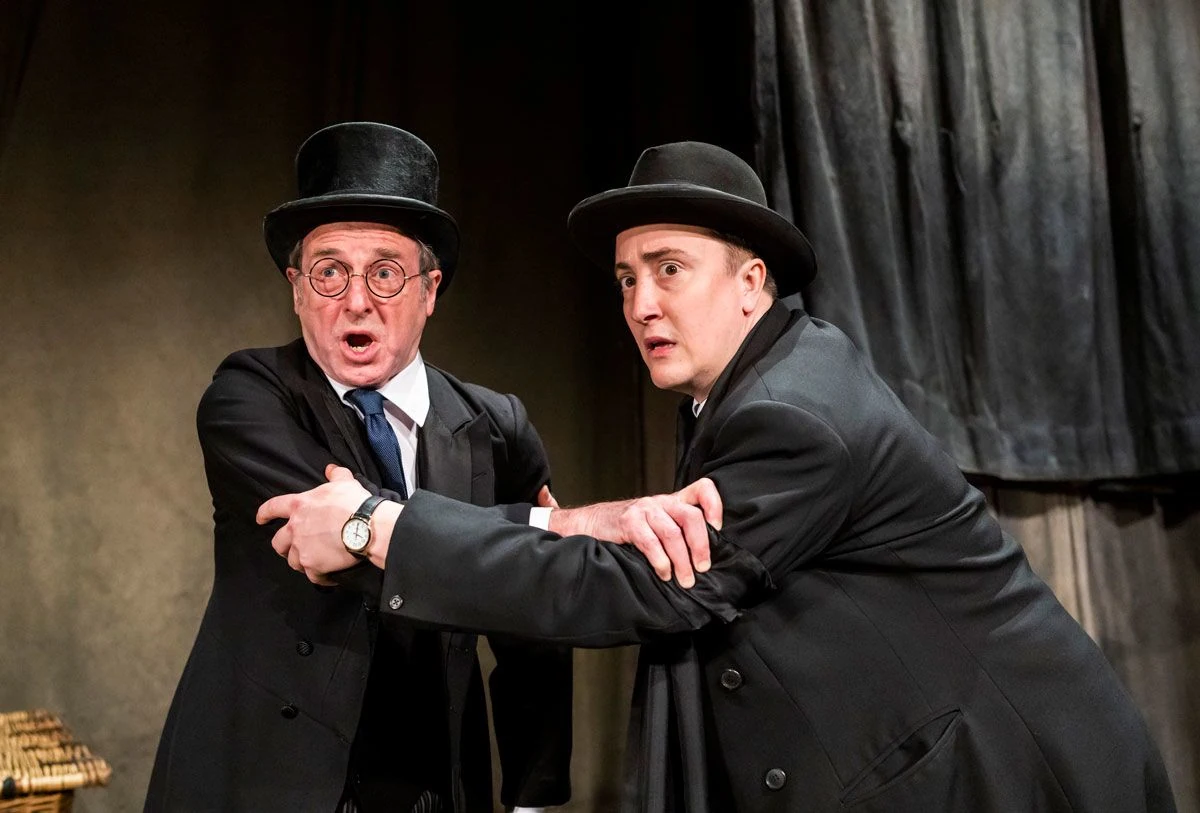
Two actors, a bare stage and the sound of something unseen: Stephen Mallatratt’s adaptation of Susan Hill’s The Woman in Black makes restraint its source of terror. Since its first production in Scarborough in 1987, the play has carried a story of haunting and revenge from a regional theatre to London’s West End, relying on performance and suggestion rather than elaborate effects.
From Scarborough to the West End
Hill’s novel provided the source; Mallatratt shaped it for the stage, with Robin Herford directing the first production at the Stephen Joseph Theatre in Scarborough in 1987. The play moved to the Fortune Theatre in London’s West End in 1989. Its long run there made it one of the longest-running plays in British theatre history, and its changing casts have continued to work within the production’s distinctive two-actor design.
The small cast is central to the form. One actor plays Arthur Kipps, a solicitor haunted by events associated with Eel Marsh House. The other takes several roles. Rather than presenting a large company of characters or a fully realised world, the production asks its performers to establish people and places through changes in role and the audience’s imagination. The arrangement keeps attention closely focused on the actors and on what their story allows the audience to picture.
A story told through suggestion
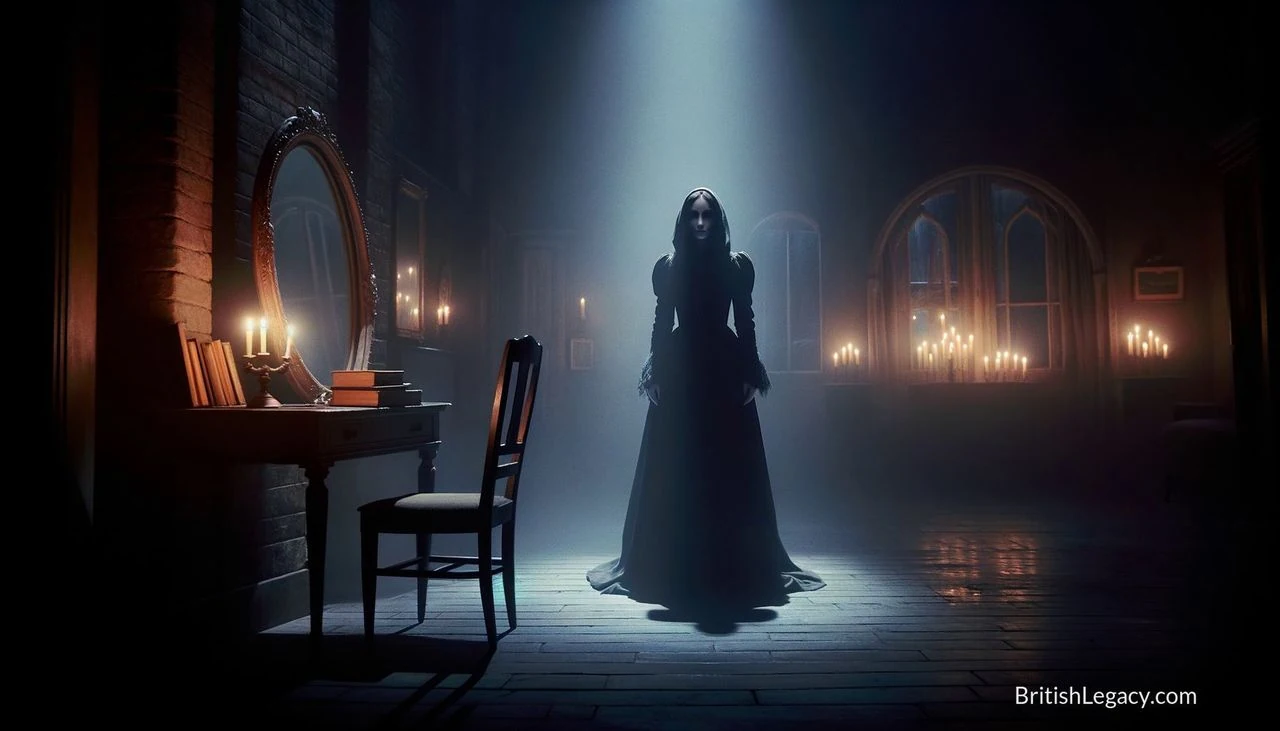
Kipps recounts his experience of being summoned to the funeral of Mrs Alice Drablow, who lived at isolated Eel Marsh House. Surrounded by treacherous marshes, the house holds papers that point towards the spectral figure known as the Woman in Black. As Kipps investigates, the ghost begins to haunt him. Her past and her apparent vengeance become part of the mystery he must confront.
The play moves between past and present as Kipps tells his story. Its central tension comes not simply from the ghost’s appearances but from the gradual disclosure of what she represents and why she is associated with the house. The account’s shift between recollection and events being relived gives the two performers a way to make a small cast carry a larger narrative, while keeping the audience close to Kipps’s growing fear.
The staging supports that uncertainty. Instead of relying on elaborate scenery and special effects, the production uses sound, lighting and the power of suggestion to create its atmosphere. A place, an encounter or a threat can take shape without being shown in detail. What remains unseen is therefore part of the storytelling: the audience must supply what the stage withholds. The spare approach draws on conventions of gothic horror, where anticipation and uncertainty can be as important as a visible apparition.
Beyond the stage
The play’s story has also reached audiences beyond the theatre. Its adaptations include a film featuring Daniel Radcliffe, bringing Hill’s ghost story and Mallatratt’s stage interpretation into another medium. The long-standing stage production and the film have helped keep the title familiar across different forms, although the theatrical version’s defining feature remains the intimacy of two performers telling a tale together.
Its success rests on a specific theatrical choice rather than spectacle: the audience is invited to imagine what a larger production might show. The actors’ changes between roles, the controlled use of sound and light, and the movement between Kipps’s present and past all serve that approach. The result is a ghost story whose stagecraft makes the audience’s own imagination part of the experience.
Why The Woman in Black deserves a place in British Legacy
The Woman in Black merits a place in British Legacy because it joins a British novel, a British stage adaptation and a production history that began in Scarborough before reaching the West End. Its journey shows how a work made for a small cast and a restrained stage can sustain a long public life. The play does not depend on scale to tell its story: two actors, carefully used sound and lighting, and an audience willing to imagine the unseen are enough to make Eel Marsh House and its haunting present in the theatre.
That approach is also a lasting contribution to theatrical storytelling. Mallatratt’s adaptation turns limits of cast and staging into part of the drama, while Hill’s tale supplies the mystery that holds the action together. The production’s endurance and its adaptation for film demonstrate the reach of the story across performance and screen. Its British legacy lies not in generic claims about national character, but in the documented path from Scarborough to London and in a distinctive piece of stagecraft that makes suggestion, rather than display, the engine of suspense.