Thomas Newcomen is easier to overlook than he ought to be. Later engineers refined steam power, and accounts of industrial history can hurry from early experiments to James Watt as though the difficult work had simply been waiting for a more celebrated inventor. But when mines needed machinery that could pump water reliably, it was Newcomen who made steam power practical. His atmospheric engine, first successfully put to work in 1712, helped keep flooded mines operating and changed what could be achieved beneath the ground.
Newcomen did not produce the most efficient steam engine, or the final form of steam power. He produced a machine that people of his time could build, install and use. By helping mines reach deeper seams, it supported the supply of coal and metal that fed Britain’s workshops, foundries and furnaces. Its significance lay in that practical change: steam became a dependable industrial tool, and later engineers had a working machine to improve.
A Dartmouth tradesman and Baptist preacher
Newcomen came from Dartmouth in Devon. He was baptised at St Saviour’s Church on 28 February 1664 and worked as an ironmonger in a port town connected to wider trade. His business specialised in tools and equipment for the mining industry. The difficulties of drainage were therefore not remote technical puzzles: they affected customers who needed to keep shafts open and workings productive. His trade placed him close to the materials and practical problems of mining, even though the engine he developed would require a range of skilled makers to construct.
He was also a Baptist lay preacher, later serving as a teaching elder and then pastor of a local congregation. His working life brought him close to the needs of mining; his religious life connected him with a community beyond his immediate trade. The supplied material describes networks of trust, trade and dissent around him, but does not establish how particular relationships contributed to the engine’s spread. What can be said is that Newcomen was not an isolated inventor detached from everyday work. He was a tradesman whose experience was rooted in practical needs.
The problem was pressing. Mines in Britain faced flooding as they sought coal and metal at greater depths. Earlier devices included Thomas Savery’s so-called fire engine, which used steam and condensation to create a vacuum. The available account describes that approach as limited for the deeper workings increasingly required. Newcomen’s contribution was to arrange the vacuum in a cylinder and use the resulting movement to operate mine pumps. Rather than treating drainage as a problem with a single ingenious answer, his engine made pumping a task that machinery could perform repeatedly.
How the atmospheric engine worked
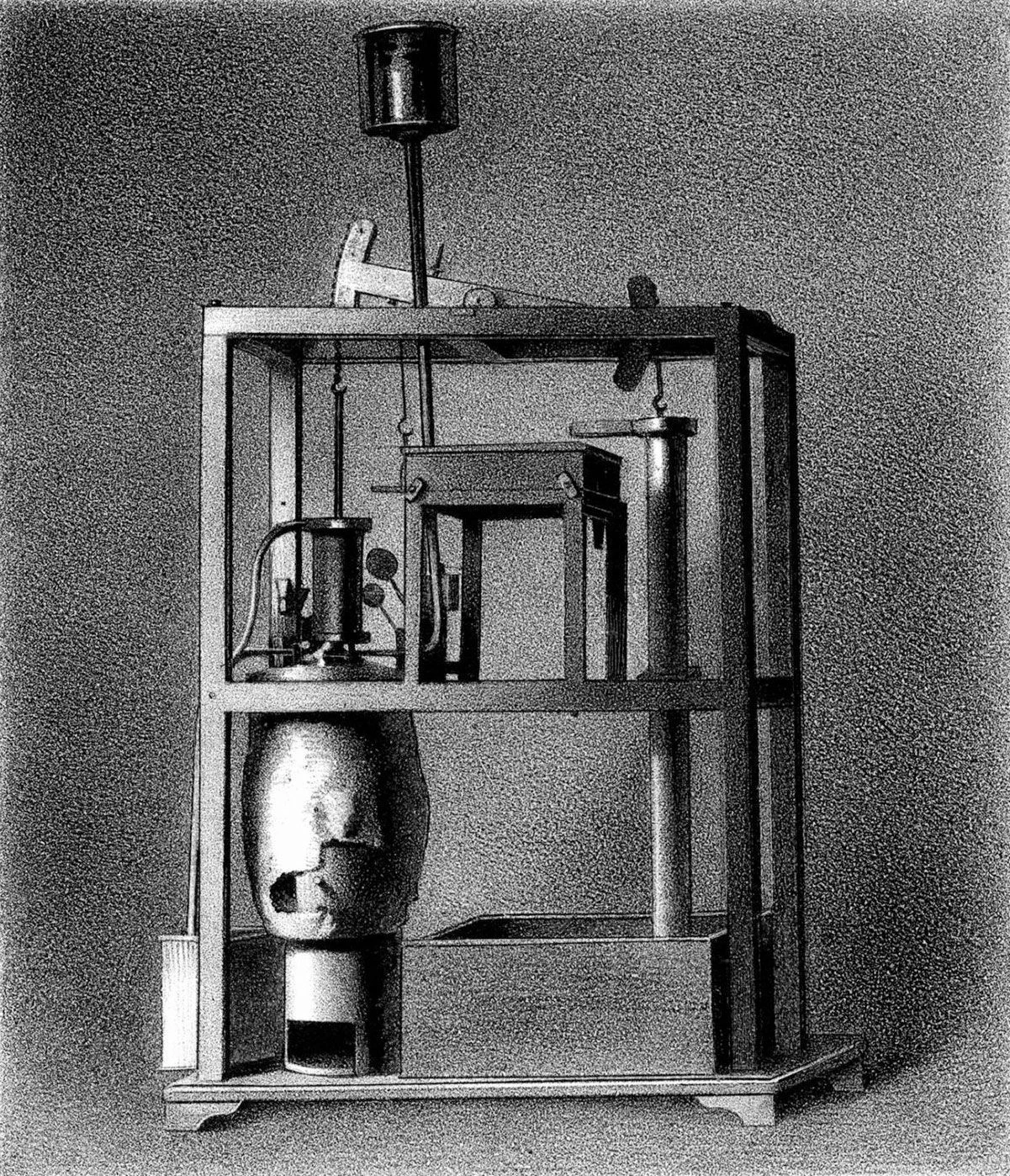
Newcomen’s engine used steam to fill a cylinder containing a piston. When the steam was condensed, it created a partial vacuum. Atmospheric pressure then pushed the piston down. The working force came not from high-pressure steam driving the piston, but from the surrounding air pressing it into the space left by the condensed steam. The name “atmospheric engine” reflects that central feature of its operation.
The piston’s movement was connected to a large rocking beam. Pump rods hung from the other end and descended into the mine. As the beam moved up and down, the rods operated the pump, drawing water from the workings and sending it towards the surface. The cycle converted a movement in a cylinder into the repeated action needed to lift water from below ground. Its principle can be described simply; making the movement reliable enough to be commercially useful was the achievement.
The engine suited the manufacturing capabilities of its time. The supplied material emphasises that it could be made using the skills of carpenters, blacksmiths, founders and boiler makers, at a time without machine tools or reliably uniform metals. Newcomen’s solution was large and sturdy rather than fuel-thrifty. Its cylinder worked under external atmospheric pressure rather than the force of high-pressure steam within it. The crucial measure was not elegance or economy in isolation, but whether the machine could keep pumping in a mine where failure meant renewed flooding and interrupted work.
Newcomen developed the first successful engine of this type with his partner John Calley at the Conygree Coalworks in Tipton, in the West Midlands. That location connects his Devon background with the mining districts where steam-powered pumping became part of working life. The Black Country Living Museum now interprets the breakthrough with a full-size replica. It offers a way to understand the scale of the machine and the relationship between its beam, piston and pump rods, rather than encountering the invention only as a diagram or a name in a list of engineers.
Why 1712 mattered
The year 1712 marks the point at which a steam engine became dependable labour in a mine. Flooding had long limited mining, and the problem became more costly as workings went deeper. Newcomen’s machine did not remove the danger of water, but it changed the prospects of a mine able to install a pump that operated steadily. Deeper seams could become worth pursuing, supplying more coal and metal for homes and manufacture.
The engine was not efficient by later standards. In coalfields, however, its consumption of fuel could be acceptable when small coal that was difficult to sell could be used to fire the boiler. The alternative might be a flooded mine. Newcomen’s success lay in matching a machine to the economic conditions in which it would operate. It did not need to be perfect; it needed to work well enough to be built, installed and paid for. Once used in working mines, it could be copied and improved through experience.
The supplied feature records that by 1733 about 125 Newcomen engines had been installed under Savery’s extended patent in mining districts in Britain and on the European continent. British examples included coal districts in the Black Country, Warwickshire and near Newcastle upon Tyne, as well as Cornish tin and copper mines and lead mines in Flintshire and Derbyshire. The figure is presented here as reported in the supplied material, rather than as an independently verified count. Even so, the range of named districts gives a sense of the varied mining work for which the engine was used.
This spread made the engine more than an isolated experiment. It established a usable type of machinery in places where water obstructed access to mineral resources. The benefits were not confined to the moment when a mine was drained: the possibility of sustained pumping altered the conditions under which mine owners and workers could plan their activity. The engine’s industrial importance came from the repeated work it could do, not from a claim that it solved every difficulty associated with mining.
A foundation for later engineers
The Newcomen engine remained important for roughly three quarters of a century without a material change to its underlying principle. As iron casting improved, larger cylinders could be made from the 1720s onwards, while practical experience helped refine proportions and details. Later in the century, John Smeaton substantially improved the mechanical design, and his changes were adopted quickly. Newcomen’s original arrangement had proved useful enough to give later engineers a platform on which to work.
By 1775, the supplied feature reports, about 600 Newcomen engines had been built. James Watt’s separate condenser then addressed one of the engine’s central weaknesses: heat was wasted as the cylinder was repeatedly cooled. Watt’s design used fuel more economically, especially where coal was expensive, and later developments made steam power more suitable for mills and rotary motion. Those advances do not make Newcomen’s work incidental. Watt could improve a technology that Newcomen had already shown could serve industry.
The shift from Newcomen to Watt was neither immediate nor complete. Older engines, often called Common Engines, remained in use because they were cheaper and less complicated. The supplied material notes that, of more than 2,200 engines built in the eighteenth century, only about 450 were Watt engines. These approximate totals, as reported in the feature, suggest how long a practical earlier design could remain useful alongside a more fuel-efficient alternative. Industrial change did not mean that every machine was replaced as soon as a better design appeared.
The original imported article also says that Newcomen engines continued in use well into the nineteenth century. The supplied material provides no installation-specific examples or dates for that statement, so it should be read as a broad account of their persistence rather than a detailed chronology. The essential point is supported by the account of their long working life: Newcomen made a beginning durable enough to be maintained, adapted and eventually surpassed, rather than a machine whose relevance ended with its first installation.
Engines, places and remembrance
Newcomen died in London on 5 August 1729 and was buried at Bunhill Fields; the exact site of his grave is unknown. The machines associated with his work have left a more visible record. The supplied feature describes a late Newcomen atmospheric engine, built in 1791 by Francis Thompson of Ashover, in the Science Museum. Dartmouth later received a memorial engine, while the Black Country Living Museum uses a full-size replica to explain the 1712 breakthrough.
At Elsecar in South Yorkshire, a Newcomen engine survives in its original location. The supplied feature describes it as the only eighteenth-century steam engine in the world to remain in its original position. Because no fetched research source was supplied for this edition, that superlative is retained as a claim from the supplied material, not presented as independently verified. Its reported survival nevertheless gives the history a physical setting: an engine can be understood in relation to the shaft and industrial landscape it served.
Britain has commemorated Newcomen in another form. The supplied feature states that on 23 February 2012 Royal Mail issued a stamp featuring his atmospheric steam engine in its Britons of Distinction series. The image centred attention on the machine as well as its inventor. It is an apt subject for remembrance: Newcomen’s significance rests on a practical achievement, a piece of machinery that helped keep mines working and made steam a useful source of industrial power.
Why Thomas Newcomen deserves a place in British Legacy
Thomas Newcomen deserves a place in British Legacy because he made a difficult idea work under the conditions of early eighteenth-century industry. Flooded mines restricted access to coal and metal. His atmospheric engine used steam, condensation and atmospheric pressure to operate pumps capable of drawing water from deeper workings. Its considerable appetite for fuel and its size did not prevent it from being useful. In the places where it was installed, keeping a mine dry could matter more than using fuel economically. The engine answered a specific problem, and that practical usefulness helped make it a technology others could adopt.
That contribution mattered beyond Newcomen’s home town. The reported spread of engines through British mining districts connects his invention to coal, tin, copper and lead workings, and to the supply of materials used by other industries. The engine did not single-handedly create industrialisation, and it was not the last word in steam engineering. Its importance was that it made steam-powered pumping serviceable at a time when mines needed a dependable response to water. Later mechanical refinements and Watt’s separate condenser belong to the same continuing story of solving problems through improvement.
Newcomen’s story also remains tangible in the places and objects associated with his engine: the full-size replica in the Black Country, the reported surviving engine at Elsecar, the museum machine and Dartmouth’s memorial. These reminders connect a Devon ironmonger and Baptist preacher with the industrial districts that put his work to use. His British legacy is technical and geographical: an invention shaped by the needs of mining, built through the skills available at the time, and remembered in the landscapes and collections that interpret it. That is a substantial contribution to the country’s working inheritance, and one that merits attention alongside the later engineers who developed steam power further.