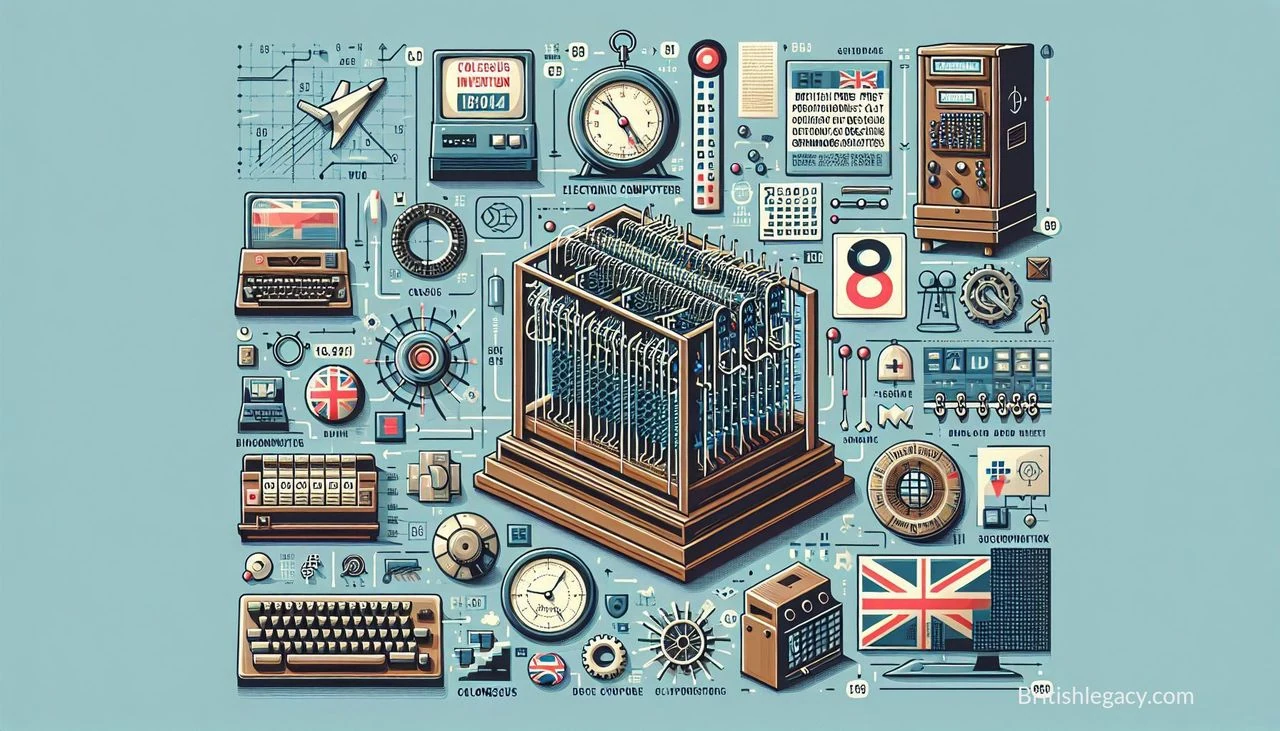
Tommy Flowers helped make electronic computing practical. An engineer trained in the day-to-day demands of Britain’s telephone system, he designed Colossus, a specialised machine that enabled Bletchley Park to test possibilities in German Lorenz traffic at unprecedented speed. Colossus was not a general-purpose computer in the later sense, and Flowers did not solve the cipher alone: mathematicians developed the methods it carried out. His achievement was to recognise that electronics could perform the work reliably, then turn that conviction into working machines. After wartime secrecy delayed public recognition, he returned to communications engineering and helped oversee ERNIE, the electronic machine that generated Premium Bonds numbers.
Learning how to make electronics dependable
Thomas Harold Flowers was born in Poplar, east London, on 22 December 1905, the son of a bricklayer. He began his engineering career as an apprentice in mechanical engineering at the Royal Arsenal in Woolwich. Alongside his work, he attended evening classes at the University of London, studying electrical engineering. The combination was important: he learned both the principles of electrical systems and the practical discipline required to build equipment that had to function reliably.
In 1926 Flowers joined the telecommunications branch of the General Post Office (GPO). Four years later he moved to the Post Office Research Station at Dollis Hill, where he would spend much of his career. From 1934 he explored the use of electronic valves in telephone exchanges. These thermionic valves could amplify signals and support electronic circuits, but their perceived fragility made large-scale use seem risky to some engineers.
Flowers had experience that challenged that assumption. By the outbreak of the Second World War, telephone equipment designed by him used thousands of valves. In a stable circuit, with the valves left operating rather than repeatedly switched on and off, he believed they could be dependable. This was not a speculative preference for new technology: it grew from the demands of communications systems he had worked on for years. The experience would prove central when he was asked to help automate wartime codebreaking.
From the Bombe to the Lorenz problem
Flowers’s first contact with Bletchley Park came in 1941. Alan Turing, working on the relay-based Bombe used against German Enigma messages, asked for help with a counter. That project was abandoned, but Turing had seen the value of Flowers’s engineering. In February 1943 he introduced Flowers to Max Newman, who was seeking a way to mechanise part of the attack on the Lorenz cipher.
Lorenz was used for high-level German teleprinter communications. It was a different and more complex system from Enigma, and the work of analysing it involved testing too many possibilities to be carried out quickly by hand. The codebreakers’ mathematical understanding of the system was essential. Bill Tutte and other mathematicians worked out its logical structure; the outstanding engineering challenge was to make the necessary tests fast enough to be useful.
An early attempt to mechanise the task was Heath Robinson, designed by Flowers and Frank Morrell at Dollis Hill. Its operation required two fast paper tapes to remain synchronised. That mechanical arrangement limited its speed and reliability. Flowers proposed a different approach: use one tape to carry the intercepted message and generate the cipher machine’s wheel patterns electronically. Instead of asking machinery to keep two moving tapes in step, his design would use circuits to carry out the repeated calculations.
The proposal depended on using far more valves than earlier electronic devices had required. Some at Bletchley Park doubted that such a large system could work reliably. Flowers’s experience with telephone equipment gave him reason to disagree. With the support of Dollis Hill director W. G. Radley, he pressed ahead at the Post Office Research Station, using some of his own money to build the machine.
What Colossus did—and what it did not
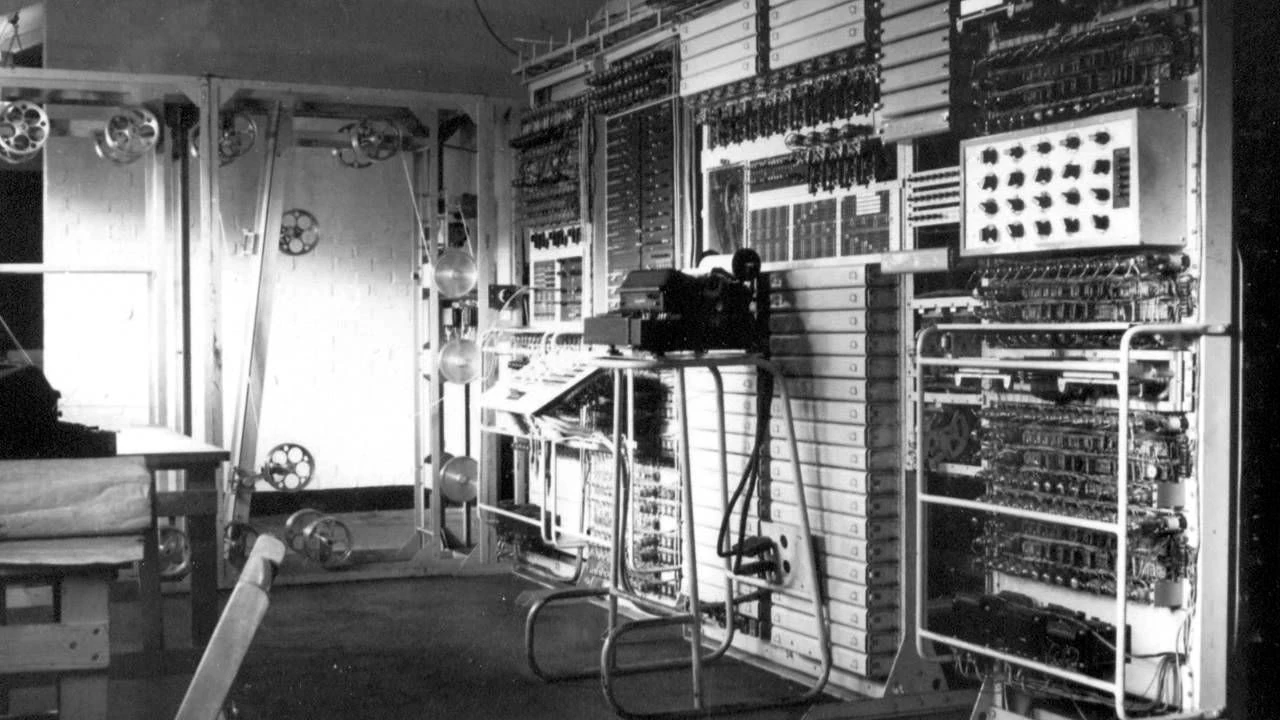
The first machine, later known as Colossus Mark 1, was built by Flowers’s team in eleven months. It used about 1,500 valves. It ran at Dollis Hill in November 1943, reached Bletchley Park in January 1944 and began operating there in early February. The name Colossus, given by Bletchley Park staff, reflected the machine’s size.
Colossus read punched paper tape carrying intercepted Lorenz messages. Photoelectric equipment read the tape at high speed; electronic circuits then tested patterns and relationships relevant to the codebreakers’ methods. Its work was specialised and its programmability limited. Switches, plugs and settings configured it for particular tasks; it was not a stored-program computer like later machines, nor did it interpret German messages for itself. Its importance lies in what it actually did: carry out large numbers of logical and statistical tests on real data far more rapidly than manual methods allowed.
Flowers’s central design decision was to generate the wheel patterns electronically, rather than use a second tape that had to be synchronised with the message tape. Colossus therefore did not simply make Heath Robinson run faster. It changed the method used to tackle the problem. The system’s electronic circuits could perform repeated operations at speed, while the experience behind their design came from Flowers’s work on telephone switching.
The first machine’s success led Flowers to develop a more powerful version. Colossus Mark 2 used about 2,400 valves; the first Mark 2 entered service at Bletchley Park on 1 June 1944, shortly before the D-Day landings. Its contribution formed part of a wider intelligence effort involving codebreakers, mathematicians and engineers. The machines helped Bletchley process high-level German traffic, including communications between Field Marshal von Rundstedt and Berlin. They turned mathematical insight into a practical capacity to examine messages at wartime speed.
Ten Colossi were completed during the war, and an eleventh was ready by its end. Colossus was therefore more than an experimental prototype. It became a small fleet of specialised computing machines. The distinction matters: Flowers’s accomplishment was not to produce a modern computer in one leap, but to design and build an electronic system that worked at scale for a defined and urgent purpose.
Secrecy, cost and the return to communications
After the war, Flowers received little public recognition for his part in the work. He was awarded £1,000, which did not cover his personal expenditure on Colossus; he shared much of the payment with staff who had helped build and test the machines. He later applied to the Bank of England for a loan to develop similar equipment. He could not explain that he had already designed and built machines of this kind, because the work remained secret. The application was refused.
The secrecy that protected the wartime work also delayed Flowers’s place in the public history of computing. His family knew that he had done secret and important work, but the significance of Colossus was not fully acknowledged until the 1970s. By then, public accounts of computing had developed without the full story of the machine and the engineers who had made it work.
Flowers returned to the Post Office Research Station and became head of its Switching Division. He and his group pioneered work on all-electronic telephone exchanges, completing a basic design by about 1950 that led on to the Highgate Wood exchange. This was a continuation of the engineering problems he had addressed before the war: using electronics to handle communications reliably. In 1964 he joined Standard Telephones and Cables as head of advanced development, continuing to work on electronic switching, including a pulse-amplitude modulation exchange. He retired in 1969.
Another post-war project brought electronic machinery into public life in a very different way. Flowers was involved in the development of ERNIE, the Electronic Random Number Indicator Equipment used for Premium Bonds. He was responsible for overseeing its delivery, with Harry Fensom, another Colossus veteran, as chief engineer. The first ERNIE began producing winning numbers on 1 June 1957. It was a civilian application of electronic engineering, not a codebreaking machine, but the connection in Flowers’s career is clear: both projects depended on making complex electronic equipment perform a specific task consistently.
Recognition and remembrance
Flowers was appointed a Member of the Order of the British Empire on 2 June 1943. Later honours included an honorary Doctor of Science from Newcastle University in 1973 and the Martlesham Medal in 1983, the first time the award was made. In 1976 he published Introduction to Exchange Systems, a book on the engineering principles of telephone exchanges. He died in Mill Hill, London, on 28 October 1998, aged 92.
The physical Colossus machines were largely dismantled after the war. A working Mark 2 replica, rebuilt by a team of volunteers led by Tony Sale between 1993 and 2008, is now displayed at The National Museum of Computing at Bletchley Park. Flowers knew of the reconstruction and described aspects of the design and construction that helped it proceed. The replica makes the engineering legible: Colossus was not an abstract idea, but a large, intricate machine built to process information.
His name also remains visible in places and institutions associated with engineering and education. English Heritage placed a blue plaque at the former Post Office Research Station in Dollis Hill in 2023. A Tommy Flowers Centre in Tower Hamlets opened in 2010; the building is now part of the borough’s pupil referral unit. BT named a computer science scholarship and award after him and opened the Tommy Flowers Institute for ICT training at Adastral Park in 2016. In 2018, a room at the refurbished Institution of Engineering and Technology in London was named the Flowers Room.
Why Tommy Flowers deserves a place in British Legacy
Tommy Flowers deserves a place in British Legacy because his achievement joined sound engineering to a pressing public need. Colossus helped Bletchley Park turn the mathematicians’ analysis of Lorenz into a practical process capable of testing possibilities at speed. Flowers did not work alone, and the machine did not decipher messages by understanding their content. Its importance was more concrete: it provided the electronic capacity to carry out repeated calculations that would otherwise have taken too long. By trusting evidence from telephone engineering, Flowers was willing to build a machine on a scale that others doubted could be reliable.
His contribution also extended beyond wartime intelligence. At the Post Office Research Station, Flowers helped advance all-electronic telephone exchanges; at Standard Telephones and Cables, he continued developing electronic switching. His role in overseeing ERNIE’s delivery carried electronic engineering into a national savings scheme used by the public. These are distinct achievements, but together they show an engineer moving between urgent wartime work and civilian infrastructure, applying practical knowledge rather than seeking novelty for its own sake.
That record is particularly worth remembering in Britain, where the institutions behind engineering—the Post Office, its research station and the Bletchley Park effort—were central to Flowers’s work. Secrecy meant that recognition came late, and the wartime machines themselves were mostly dismantled. The surviving replica, the Dollis Hill plaque and the institutions bearing his name help restore the connection between a British engineer and the systems he helped make possible. His legacy is not a claim that every later computer descended directly from Colossus. It is the more defensible and substantial achievement of proving what electronic machinery could do in practice, then continuing to apply that knowledge to communications and public services.
Sources
Adapted in part from Tommy Flowers by Wikipedia contributors, under CC BY-SA 4.0. Text has been edited and combined with the existing article; this adapted text is shared under the same licence. Contributor history.