In Twelfth Night, or What You Will, a shipwreck separates twins Viola and Sebastian, setting in motion a comedy in which appearances mislead almost everyone. Viola survives by disguising herself as a young man, Cesario, and enters the service of Duke Orsino. He sends Cesario to court Olivia; Olivia falls for the messenger, while Viola has fallen for Orsino. Around this knot of unreturned love, Shakespeare builds a second comedy of household disorder, as Olivia’s steward Malvolio is deceived by a forged letter. The play’s pleasure lies not just in the confusion, but in the way its disguises expose the uncertainty of love, status and identity.
A comedy made for a season of revelry
Shakespeare is believed to have written the play around 1601–02. Its full title refers to Twelfth Night, the twelfth night after Christmas, associated with the close of the Christmas season and the Feast of Epiphany. Festive customs linked with the occasion included reversals of ordinary roles and licensed disorder. The play turns that spirit into theatre: Viola takes on a male identity, social expectations are unsettled, and Sir Toby Belch resists Malvolio’s attempts to impose order on Olivia’s household.
The story draws on earlier sources. One is Barnabe Rich’s tale “Of Apollonius and Silla”, published in 1581 and itself derived from a story by Matteo Bandello. The play has also been linked to the Italian comedy Gl’ingannati, written by members of the Accademia degli Intronati of Siena in 1531. Shakespeare reshapes these materials around the separated twins and the intersecting plots of mistaken identity, courtship and practical joking.
Illyria, the play’s setting, lends the action an atmosphere of distance and possibility. The name refers to an ancient region on the eastern Adriatic, but Shakespeare’s imagined place also carries English details. The text includes “Westward ho!”, a cry associated with London boatmen, and refers to “The Elephant”, a London pub name. These touches sit alongside the play’s foreign setting, making Illyria feel at once removed from England and open to recognisable customs and comic types.
Viola, Cesario and the crossed courtships
After the shipwreck, Viola believes her twin brother has drowned. With a captain’s help, she disguises herself as Cesario and finds work in Orsino’s household. Orsino is preoccupied with Olivia, who refuses his advances while in mourning. He makes Cesario the messenger for his suit. The plan misfires: Olivia falls in love with Cesario, unaware that the page is Viola, while Viola’s own affection is for Orsino. The triangle depends on what each character can see and what the audience knows.
Viola’s disguise also places the play’s gender comedy within the conventions of Shakespeare’s stage. Female roles were played by boys or men in the original theatre; an actor playing Viola therefore performed a woman who was pretending to be a man. The layered disguise could sharpen the uncertainty around desire and identity. It also gives Viola access to a role normally denied to her: as Orsino’s servant and confidant, she can move between the duke and Olivia, even as she struggles to speak plainly about her own feelings.
Sebastian, rescued by the sea captain Antonio, eventually reaches Illyria. Because he and Viola look alike, other characters mistake him for Cesario. The confusion becomes dangerous when Sir Toby and his companions persuade Sir Andrew Aguecheek to challenge Cesario to a duel. Sebastian is caught up in the confrontation, and Olivia, taking him for Cesario, asks him to marry her. When the twins finally appear together, Viola’s identity can be revealed and the principal courtships resolved: Olivia and Sebastian are joined, and Orsino turns to Viola.
Malvolio and the cost of the joke
The subplot gives the play a sharper edge. Malvolio, Olivia’s steward, rebukes Sir Toby, Sir Andrew and their late-night revelry. Maria, another member of the household, devises revenge with Sir Toby, Sir Andrew and Fabian: she forges a letter that appears to come from Olivia. Its instructions encourage Malvolio to wear yellow stockings cross-gartered, behave rudely to the other servants and smile constantly before his mistress. He follows the directions, convinced that Olivia loves him.
Olivia is startled by the change and believes Malvolio has lost his reason. His tormentors exploit that judgement, confining him in a dark room and continuing the deception. Feste, Olivia’s fool, joins in by taking on the voice of Sir Topas, a curate. The plot is comic in its ingenuity, but the humiliation is real within the play: Malvolio leaves vowing revenge. Its conclusion is not simply a tidy restoration of harmony. The romantic misunderstandings are resolved, yet the treatment of the steward leaves a disturbance behind the celebration.
Feste’s songs and comments contribute another kind of perspective. He moves between the households and their different moods, offering wit without belonging wholly to either the lovers’ story or the practical joke. The play’s attention to performance is explicit, too. When Olivia asks Cesario whether he is a comedian, Viola replies, “I am not that I play.” The line speaks directly to a comedy in which people act roles, misread one another and struggle to distinguish a performed identity from a private one.
From Middle Temple Hall to the modern stage
The earliest documented public performance took place at Middle Temple Hall in London on 2 February 1602, Candlemas. The law student John Manningham recorded seeing a play called Twelfth Night, or What You Will there. The work did not appear in print until its inclusion in the First Folio of 1623. Its early performance history also includes court performances in 1618 and 1623.
After the Restoration, Sir William Davenant’s adaptation was staged in 1661, with Thomas Betterton as Sir Toby. The original Shakespearean text returned to the stage at Drury Lane in 1741. Later British performance landmarks include productions at the Old Vic and Sadler’s Wells. Lilian Baylis reopened Sadler’s Wells in 1931 with a production featuring Ralph Richardson as Sir Toby and John Gielgud as Malvolio. The Old Vic reopened in 1950, after damage during the London Blitz, with Peggy Ashcroft as Viola.
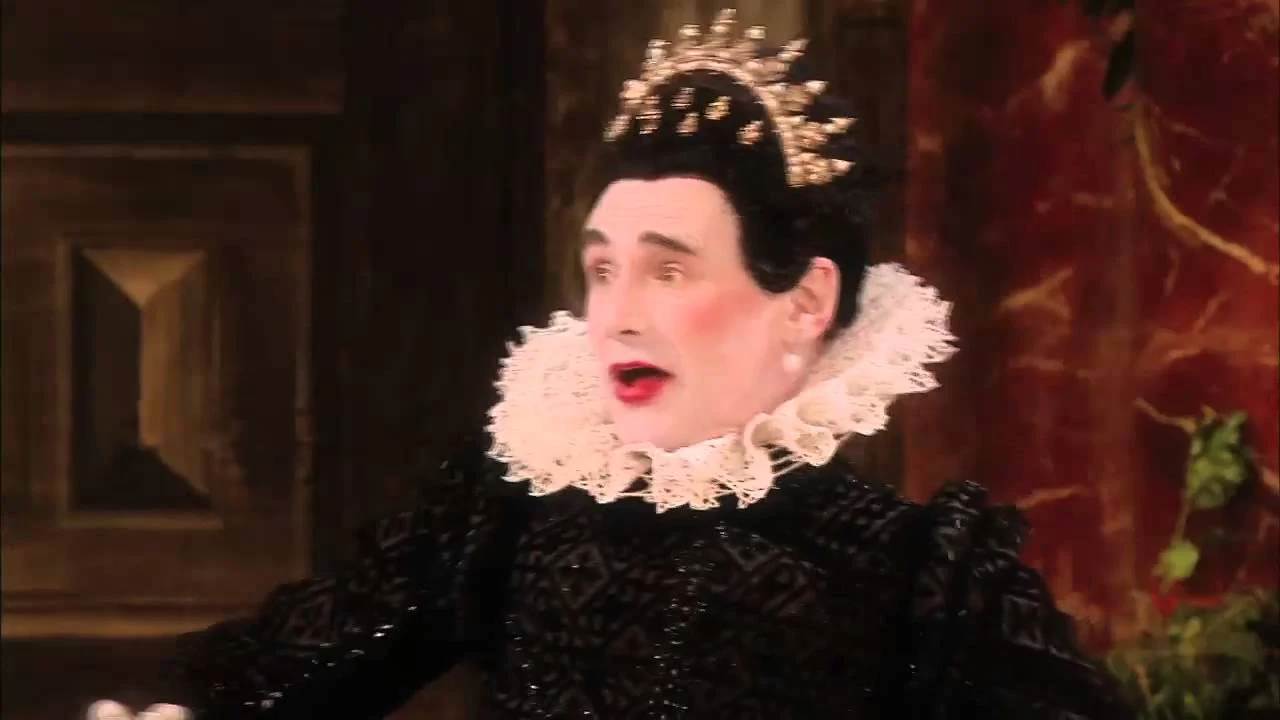
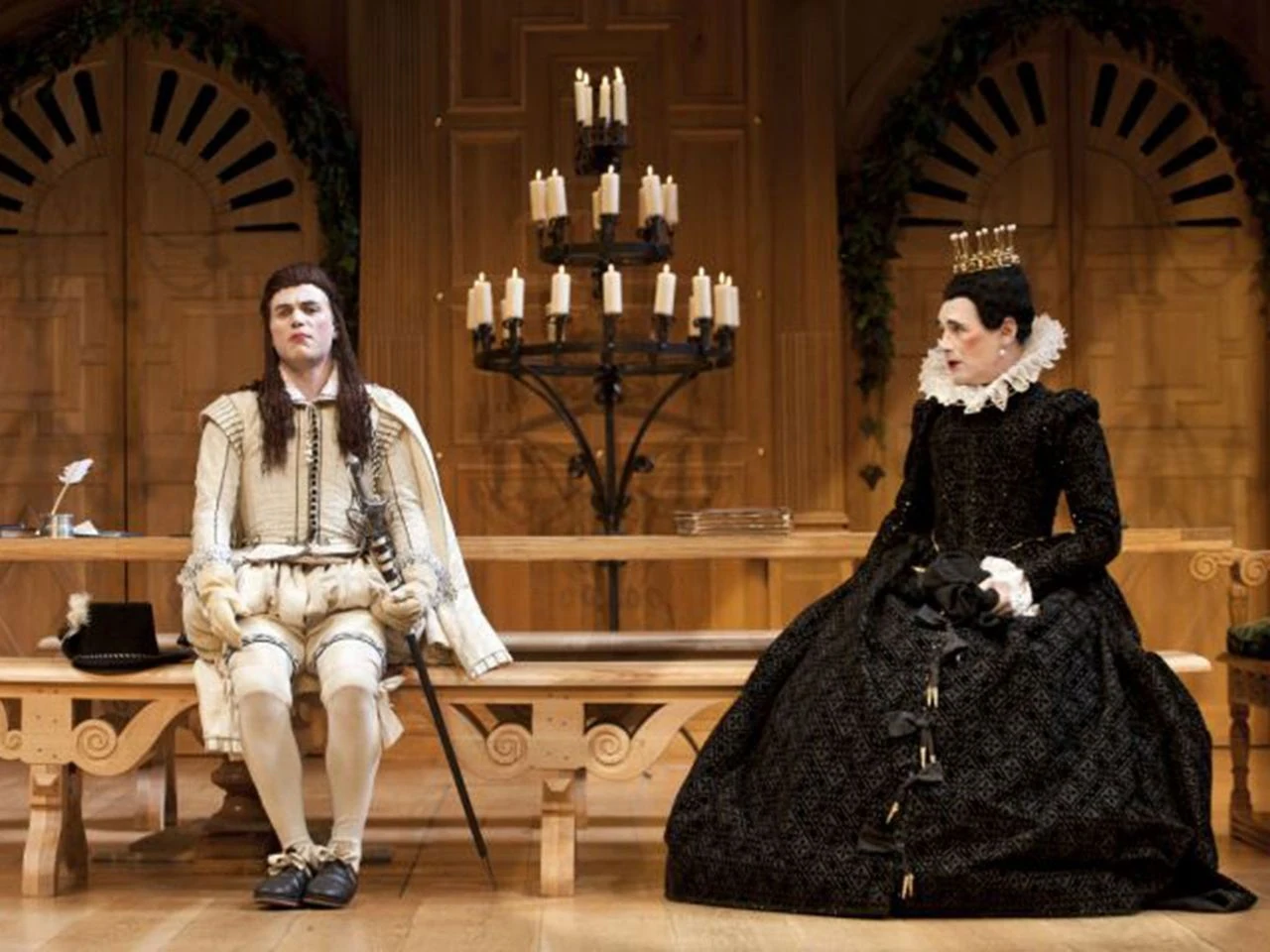
Twentieth-century productions have repeatedly changed the emphasis without losing the play’s central complications. The Royal Shakespeare Company’s 1966 production, with Diana Rigg as Viola, made gender transgression more visible; John Barton’s 1969 staging featured Judi Dench as Viola and Donald Sinden as Malvolio. Later, Shakespeare’s Globe presented the play with an all-male company, including Mark Rylance as Olivia in 2012. A production at the National Theatre in 2017 recast Malvolio as Malvolia, played by Tamsin Greig, using the change to explore gender and sexuality.
Adaptations have carried the story beyond the stage. Trevor Nunn’s 1996 film moved it to the nineteenth century, while the 2006 teen comedy She’s the Man recast the plot around school and football. Television has offered several versions, including the BBC’s 1980 production with Felicity Kendal as Viola. Radio has its own British history with the play: a BBC adaptation broadcast on 28 May 1923, with Cathleen Nesbitt as both Viola and Sebastian, was the first complete Shakespeare play broadcast on British radio. These different forms have kept the comedy available to audiences beyond the theatre.
Why Twelfth Night deserves a place in British Legacy
Twelfth Night belongs in British Legacy not simply because Shakespeare is a defining figure in English literature, but because the play’s history is closely tied to British theatrical life. Its first documented public performance took place at Middle Temple Hall in London in 1602, and its later story runs through important stages including Drury Lane, the Old Vic, Sadler’s Wells, the Royal Shakespeare Company, the National Theatre and Shakespeare’s Globe. The BBC’s complete radio adaptation in 1923 also shows how the work entered a new British medium as broadcasting developed. These are specific links between the play and the institutions, performers and audiences that have sustained theatre in Britain.
Its continuing value is also in the questions its comedy makes playable. Viola’s disguise puts gender and performance at the centre of the plot; the love triangle makes desire depend on mistaken perception; and Malvolio’s humiliation complicates the apparently happy ending. Successive productions have found room to shift the emphasis, from the conventions of an all-male early stage to later interpretations that bring gender roles into sharper view. Film, television and radio have offered further routes into the story. That combination of a durable theatrical structure and a capacity for new interpretation explains why Twelfth Night remains more than a historical artefact: it is a work repeatedly made present on British stages and in British culture.
Sources
Twelfth Night (revision 1379624328)
Adapted in part from Twelfth Night by Wikipedia contributors, under CC BY-SA 4.0. Text has been edited and combined with the existing article; this adapted text is shared under the same licence. Contributor history.