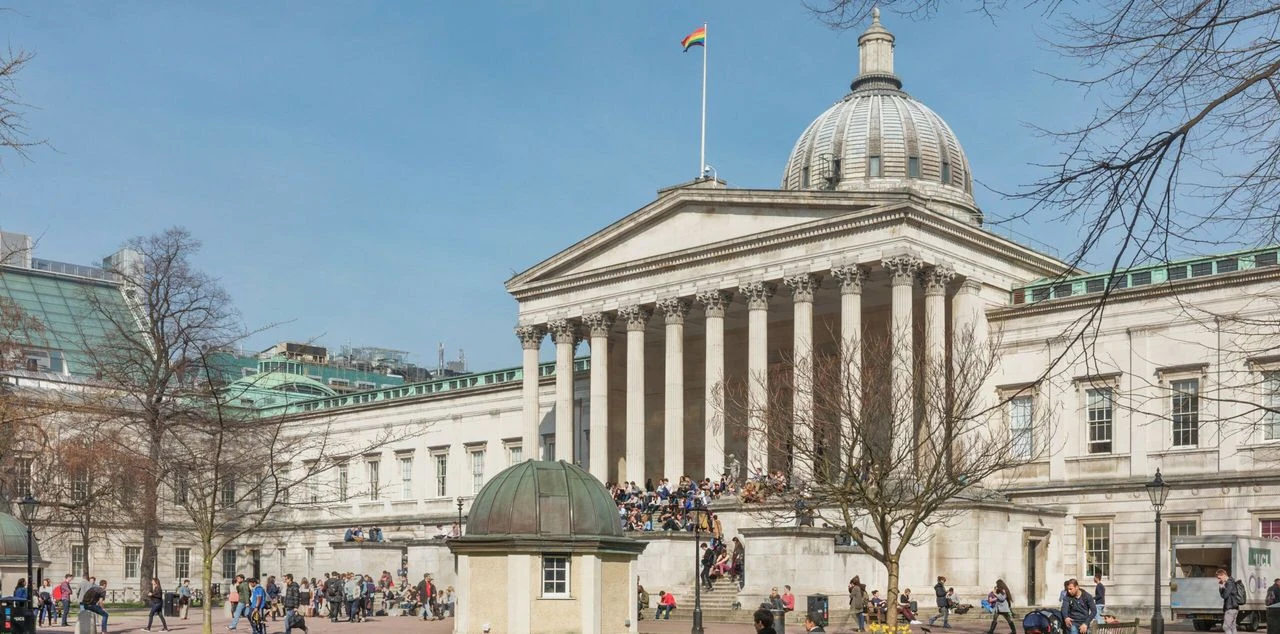
University College London began with a challenge to the boundaries of higher education. Founded in 1826 as London University, it was intended as a secular alternative to Oxford and Cambridge: a place where students would not be excluded because of their religion. Its early history was less a simple march towards openness than a long negotiation over who could study, who could award degrees and what kind of institution it would become. That tension between ambition and constraint has shaped UCL ever since.
A new university in London
London University was founded on 11 February 1826 without legal recognition as a university or the power to award degrees. Its founders had been influenced by radical ideas about education and society, particularly those associated with philosopher Jeremy Bentham. His role, however, was more limited than popular accounts of him as the university’s founder suggest: he bought a share and offered advice, while the founding group included figures such as James Mill and Henry Brougham.
The college’s secular principle distinguished it from England’s established universities. It admitted students without regard to religious affiliation, but its early institutional position was uncertain. After nearly a decade of seeking recognition and degree-awarding powers, it accepted the government’s proposal to become a college within a new University of London. A royal charter established University College, London in 1836, alongside King’s College as one of the new university’s first affiliates. The University of London acted as an examining body; its first students matriculated in 1838, and degrees were awarded in 1839.
Teaching developed across a range of fields. Medical classes began in 1828, and University College Hospital opened in 1834 to serve as a teaching hospital. The college appointed Britain’s first professor of geography in 1833 and established a chair of political economy in 1828. The Slade School of Fine Art followed in 1871. These developments made the institution more than a single experiment in admissions: it was building a teaching and research presence within the growing city.
Access, degrees and institutional change
UCL’s history of women’s education requires a more precise account than the familiar claim that it admitted women on equal terms with men from its beginning. Women attended classes connected with the college before formal admission, including through the Ladies’ Educational Association. In 1878, the University of London received authority to award degrees to women, and UCL admitted women to its faculties of Arts and Law and of Science. Engineering and most medical study remained closed to them; women were admitted to medical studies in 1917, with restrictions on numbers after the First World War. UCL was among the early institutions to open university-level study to women, but access was neither immediate nor equal across all subjects.
Its legal and academic status changed repeatedly. In 1907, UCL merged into the federal University of London and surrendered its legal independence, becoming University of London, University College. A new charter in 1976 restored its legal independence, though not the power to award its own degrees. Reorganisation in 1993 gave UCL and other colleges direct access to government funding and the right to confer University of London degrees themselves. UCL received its own degree-awarding powers in 2005; after an application made under the University of London Act 2018, it gained formal university status in 2023 while remaining part of the University of London.
Expansion also came through mergers. UCL joined with institutions including the Institute of Archaeology, Middlesex Hospital Medical School, the Royal Free Hospital Medical School, the School of Slavonic and East European Studies and, in 2014, the Institute of Education. These changes brought new fields and professional communities into the institution, while making its present structure the product of a wider London educational landscape rather than a single founding moment.
Research, teaching and a changing city
UCL’s work spans the sciences, medicine, engineering, the arts and social sciences. Its research history includes the discovery of naturally occurring noble gases, work on hormones, the invention of the vacuum tube and advances in modern statistics. The institution’s researchers and former students include Francis Crick, a co-discoverer of the structure of DNA, and Joseph Lister, a pioneer in the use of antiseptics in surgery. Nobel Prize affiliations extend across alumni and academic staff; the supplied Wikipedia account records 33 laureates as of 2025. Such examples give substance to UCL’s research identity without reducing it to a list of celebrated names.
The university’s work is distributed across an urban campus and sites beyond Bloomsbury. Its principal campus remains around Gower Street, close to teaching hospitals and research institutes in central London. In East London, UCL East opened in stages at Queen Elizabeth Olympic Park: One Pool Street opened in 2022, and the Marshgate building followed in 2023. The development extended teaching and research into Stratford and gave the university a substantial presence in a part of the capital reshaped by the Olympic Park.
UCL also maintains museums and collections that connect research with public learning. The Petrie Museum of Egyptian Archaeology, the Grant Museum of Zoology and Comparative Anatomy and the UCL Art Museum preserve and present material from different fields. The Grant Museum began as a teaching collection in 1827; the Petrie Museum grew from a donation by Egyptologist Amelia Edwards in 1892. These collections make the institution’s academic work visible beyond lecture rooms and laboratories.
Its influence is not confined to campus. UCL is a member of the Russell Group and the League of European Research Universities, and works with research, health and educational partners. Its Centre for the Study of the Legacies of British Slave-ownership examines the historical consequences of slave ownership and its continuing legacies. UCL Press, established in 2015, was the first fully open-access university press in the UK, making its books available to read and download without charge. These activities show different ways a London institution can contribute: through research partnerships, historical inquiry and wider access to academic publishing.
Progress, responsibility and public scrutiny
UCL’s history cannot be told only as a story of widening access and discovery. Francis Galton’s eugenics laboratory, initially funded by his donation to the University of London, transferred to UCL in 1907. The university later acknowledged its role in the development and promotion of eugenics, apologising in 2021. It also renamed buildings and a lecture theatre that had commemorated figures associated with the field. The episode is a reminder that research institutions must account for the consequences of ideas they once legitimised, as well as celebrate work that has benefited society.
UCL has also faced scrutiny over its modern institutional responsibilities. Wikipedia records disputes over employment practices, student accommodation, equality and campus protests, among other issues. Those controversies sit alongside initiatives intended to widen access, including contextual admissions offers for some applicants from disadvantaged backgrounds. The institution’s founding commitment to secular education should not be mistaken for a guarantee that equality has been achieved. Its history shows how principles are tested, extended and sometimes found wanting in practice.
Why University College London deserves a place in British Legacy
UCL deserves a place in British Legacy because its history illuminates a defining question in British education: who gets access to knowledge, and on what terms? Founded as a secular alternative to Oxford and Cambridge, it helped establish a different model of higher education in London. Its later admission of women to several faculties in 1878 mattered, but the restrictions that remained are part of that story too. The institution’s changing legal status, its mergers and its eventual authority to award its own degrees show how British universities have been shaped by negotiation between public purpose, law and institutional autonomy.
Its legacy also rests on work with consequences beyond the university. UCL researchers contributed to advances in science and medicine, while museums and collections bring material scholarship into public view. The Centre for the Study of the Legacies of British Slave-ownership examines a difficult national history; UCL Press has made open-access academic publishing part of the British university landscape. At the same time, UCL’s apology for its role in promoting eugenics demonstrates why legacy must include accountability, not just achievement. Together, these strands make UCL a significant British institution: influential in research and education, connected to London’s changing communities, and still obliged to examine the effects of its own history.
Sources
Adapted in part from University College London by Wikipedia contributors, under CC BY-SA 4.0. Text has been edited and combined with the existing article; this adapted text is shared under the same licence. Contributor history.