The University of Bristol’s story begins before it became a university. University College, Bristol, opened in 1876; the institution received its royal charter in 1909. Its history brings together an early commitment to educating women, the growth of engineering and medical teaching, internationally recognised research and a campus woven into the city. It is also a history that includes difficult questions about the wealth behind its foundation and the symbols it has chosen to retain.
A college becomes a university
University College, Bristol, opened to men and women from the outset. Its first intake comprised 99 day students—30 men and 69 women—and 243 evening students. It was the first university college in the country to admit women on the same basis as men. That early openness had limits: women were not permitted to take medical examinations until 1906.
Bristol Medical School, founded in 1833, merged with the college in 1893. Engineering followed a different route. The engineering department of the Merchant Venturers’ Technical College—whose origins lay in the Bristol Trade and Mining School of 1856—became part of the university in 1909 after disputes with the college in the 1890s. The merger of the engineering faculty into the university was completed in 1949.
The college’s move towards university status depended on substantial gifts from the Wills and Fry families. In 1908, donations, including £100,000 from Henry Overton Wills III, were offered to endow a university for Bristol and the West of England on condition that it secured a royal charter within two years. The charter was granted in December 1909. Wills became the first chancellor, with Conwy Lloyd Morgan as the first vice-chancellor.
The origins of that philanthropy are part of the institution’s history, too. The Wills family made its fortune in tobacco plantations, while the Fry family’s wealth came from chocolate. A university-commissioned 2018 study estimated that 85 per cent of the philanthropic funds used for the institution’s foundation depended on the labour of enslaved people. The engineering school’s predecessor had a separate connection: it was run by the Colston Trustees until 1885. This history gives the university’s founding a more complicated context than a simple account of civic generosity.
Buildings, research and an expanding university
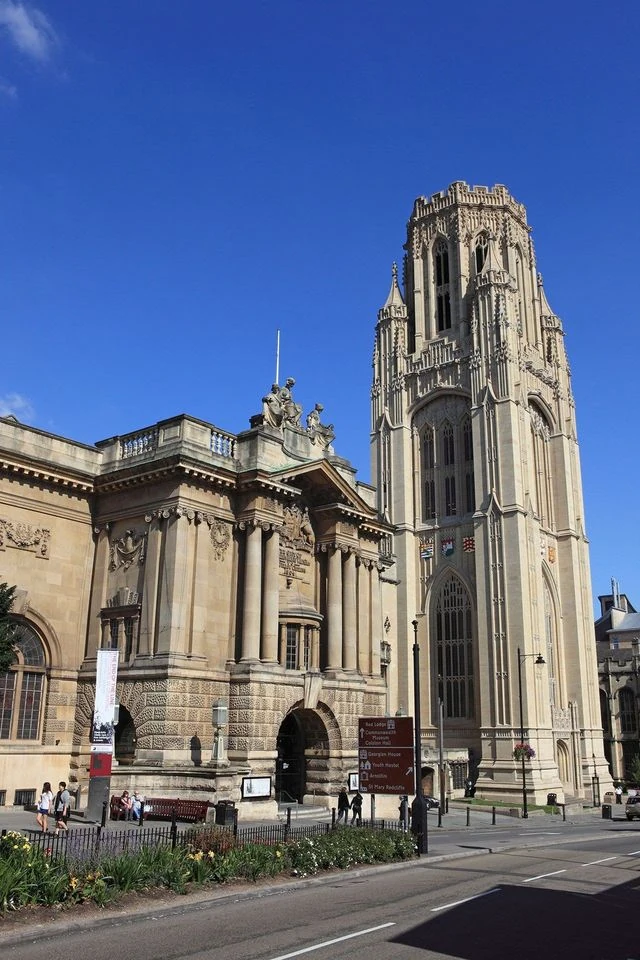
The Wills Memorial Building, begun in 1913 and completed in 1925, became one of the most recognisable signs of the university’s growth. In 1920, George Wills bought the Victoria Rooms and endowed them to the university as a students’ union. The university’s physical story is not confined to monumental buildings: it is spread across the city, although many activities are concentrated in the central University Precinct and the Tyndall’s Park area.
Research and teaching developed alongside the buildings. Paul Dirac graduated in engineering in 1921, then took a second degree in mathematics at Cambridge in 1923. His subsequent work on quantum mechanics brought him the 1933 Nobel Prize in Physics. In the late 1920s, the H. H. Wills Physics Laboratory opened under the direction of Ernest Rutherford. These milestones offer a glimpse of the university’s place in the development of modern science, rather than a complete measure of its work.
The university continued to broaden its academic provision. In 1947, it established the country’s first degree in drama and introduced special entrance examinations and grants to assist servicemen returning after the Second World War. Later developments included a centre for deaf studies, established in 1981, and the Norah Fry Centre for research into learning difficulties, founded in 1988. In 2004, work was completed on the Bristol Laboratory for Advanced Dynamics Engineering, an engineering facility officially opened by Queen Elizabeth II in March 2005. A Centre for Nanoscience and Quantum Information opened in September 2009.
Today, the university is organised into three faculties: Arts, Law and Social Sciences; Science and Engineering; and Health and Life Sciences. The range spans subjects from history, law and policy studies to engineering, chemistry, medicine, dentistry and veterinary science. It is a member of the Russell Group, a network of research-intensive British universities, as well as the Coimbra Group and the Worldwide Universities Network. The university’s published account reports 13 Nobel laureates among its alumni and faculty.
A city campus and a changing public face
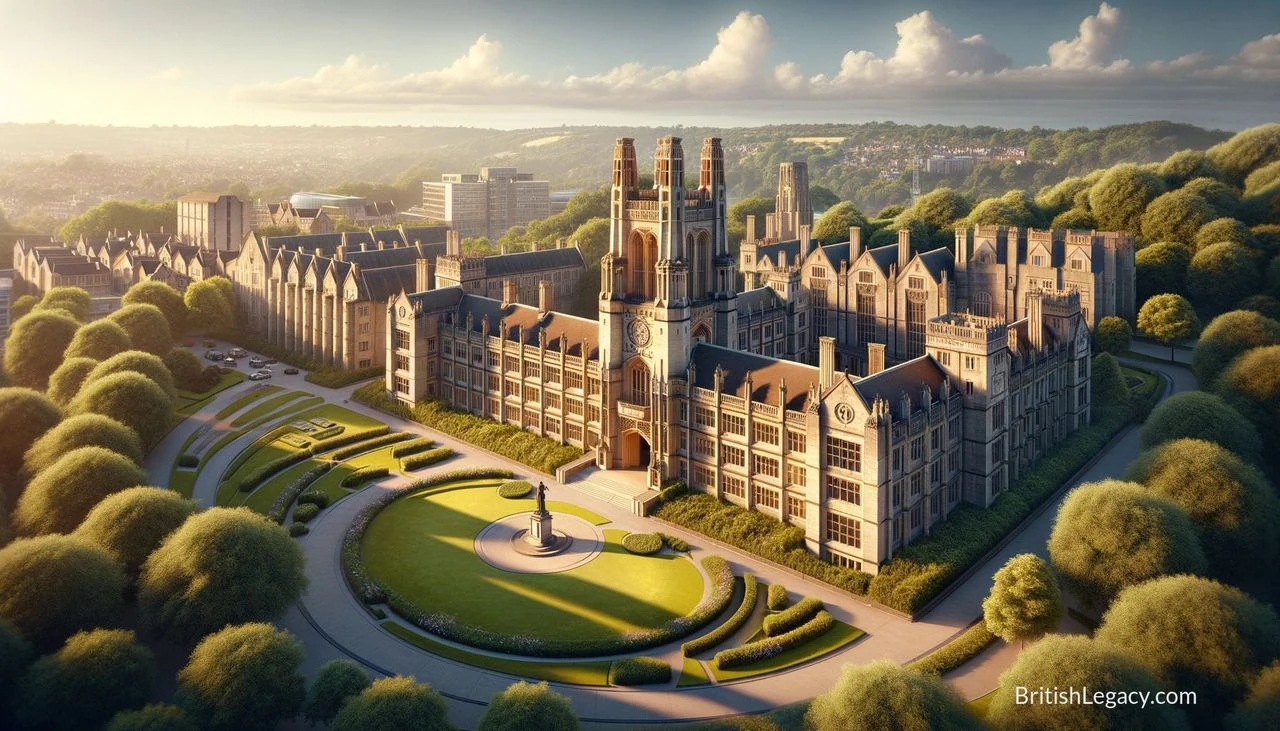
Bristol does not have a single, self-contained main campus. Its precinct sits within the city, among buildings with different histories and uses. The Wills Memorial Building remains a landmark; the Victoria Rooms house the Music Department; and the university’s botanic garden, first established in 1882, has a history that began close to the college in Clifton. The university also uses adapted Victorian houses and modern facilities. Together, these sites make the institution part of Bristol’s urban fabric rather than a separate university town.
The university’s civic role has sometimes been visible in student life and public debate. In 1968, students held a sit-in as part of a national campaign for greater student representation in university governance. The Bristol protest also called for students from other establishments in the city to be allowed to join the union. The university’s students’ union, formed in 1924 through the merger of the university guild and club, remains a channel for student representation and societies.
Its public symbols have also changed. A university logo introduced in 2004 combined images associated with the Wills and Fry families, Edward Colston and the city of Bristol. In 2024, the university revised the emblem, removing the dolphin associated with Colston and adding an image of moving pages and a bookmark. The change reflects a broader effort to reconsider how historical associations are represented, while the older arms continue to be used for specific historical or ceremonial purposes.
Education and research are only part of the university’s presence in the city. The university and Bristol City Council jointly developed Bristol is Open, a project focused on research and city-scale digital experimentation. Its work included trials involving open-access Wi-Fi and smart-city technology; the partnership began in 2015 and ended in 2019, when the council took full control of its operations. The example shows how the university’s work has at times extended beyond its own buildings and into civic infrastructure.
Why the University of Bristol deserves a place in British Legacy
The University of Bristol deserves a place in British Legacy because its history illuminates several strands of British higher education at once. Its 1876 predecessor admitted women and men on the same basis, an important founding principle even though medical examinations remained closed to women until 1906. Its later university combined teaching traditions and institutions that had developed separately in Bristol, from medicine to engineering. The story also shows how research, public service and student life have changed over time: from the post-war provision for returning servicemen to the city-facing technology project Bristol is Open.
That legacy should not be reduced to institutional prestige. Bristol’s research community and alumni include figures such as Paul Dirac, whose university education preceded work recognised with a Nobel Prize. Its buildings and facilities record successive phases of growth, while its present faculties bring arts, social sciences, science, engineering and health disciplines together within one urban institution. Equally, the university’s foundation and changing emblem make clear that heritage involves difficult choices as well as achievements. Recognising the sources of philanthropic wealth, and revising a symbol associated with Colston, places that history in public view. The university’s British significance lies in this combination: educational opportunity, research and civic presence, alongside an ongoing need to examine the past that helped shape it.
Sources
Adapted in part from University of Bristol by Wikipedia contributors, under CC BY-SA 4.0. Text has been edited and combined with the existing article; this adapted text is shared under the same licence. Contributor history.