The University of Edinburgh began with a civic decision: a town council, acting under a royal charter, established a college that opened its doors in 1583. Over the centuries, it became a centre of the Scottish Enlightenment, a major institution for medical and scientific study, and an enduring presence in the cultural and intellectual life of Scotland’s capital. Its history is not simply a succession of famous names. It is also the story of a university shaped by its city, its public purpose and recurring disputes over who could study there.
A college founded by the city
The university’s origins go back to 1582, when King James VI granted the Edinburgh town council a charter to create a college. The institution, initially known as Tounis College, opened on 14 October 1583. It was unusual in Scotland: unlike the country’s earlier universities, it was established by secular authorities rather than through a papal foundation. The first intake numbered about 80 or 90 students, and teaching began with a small staff led by theologian Robert Rollock. The college’s name gradually changed during the 17th century, as it came to be known as the University of Edinburgh.
That civic beginning did not mean the university was free from political or religious pressure. The town council retained substantial authority over appointments, teaching and examinations, and its relationship with the university was sometimes strained. In 1690, a government visitation following the Glorious Revolution led to the dismissal of Principal Alexander Monro and several professors and regents accused of Jacobite sympathies. Later, the university’s authority over its own affairs was strengthened by the Universities (Scotland) Act 1858.
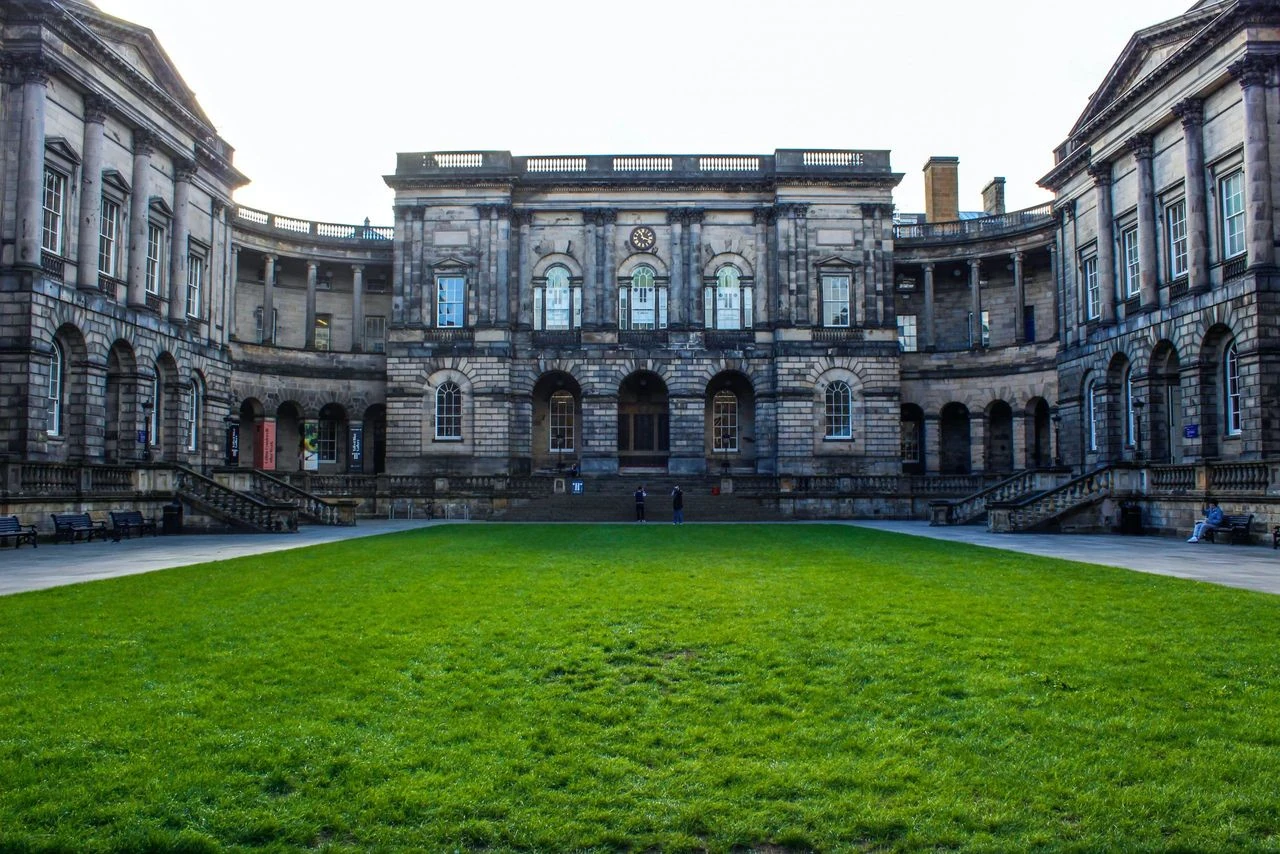
Expansion changed both the institution and its surroundings. A Faculty of Law was established in 1707, a Faculty of Arts in 1708 and a Faculty of Medicine in 1726. In 1708, Principal William Carstares replaced the regenting system with a structure based on professors and chairs. The university acquired its first purpose-built premises, Old College, after plans by Robert Adam and William Henry Playfair. The Medical School’s new building opened in 1884, and McEwan Hall, designed by Robert Rowand Anderson, was presented to the university in 1897.
Edinburgh and the Enlightenment
During the 18th century, the university became one of the centres of the Scottish Enlightenment. Its professors and intellectual community included the chemist Joseph Black, economist Adam Smith, historian William Robertson, philosophers David Hume and Dugald Stewart, physician William Cullen and social thinker Adam Ferguson. Their work ranged across disciplines rather than remaining within narrow academic boundaries. Edinburgh’s organisation around professors and chairs helped create opportunities for that exchange, while the city itself supplied a lively setting for debate.
The university’s influence also travelled through its graduates. Edinburgh-trained physicians helped establish medical schools elsewhere, including institutions in North America and Australia. The scale of that influence is part of the history of the university’s medical teaching, but so is the development of knowledge within Edinburgh itself. Its professors contributed to the formation of the Royal Society of Edinburgh in 1783; Joseph Black founded the world’s first Chemical Society in 1785. The university’s subsequent scientific work has covered a wide range of fields, from engineering and mathematics to genetics and informatics.
Research became associated not only with individuals but also with institutions and places. The university’s science and engineering campus, King’s Buildings, was developed in the south of the city after the university bought land there in 1919. The Roslin Institute, now part of the university, became internationally known in 1996 when its researchers created Dolly the sheep, the first mammal cloned from an adult cell. Roslin is based at Easter Bush, where veterinary teaching and animal-science research are also carried out.
Access, argument and a changing university
The university’s history also records the barriers faced by people seeking an education. In 1869, the Edinburgh Seven, led by Sophia Jex-Blake, became the first group of matriculated undergraduate women at a British university. They studied medicine amid harassment and opposition, including the Surgeons’ Hall riot of 1870. The university did not allow them to graduate at the time, but their campaign attracted national attention and helped bring the question of women’s access to medical education into public debate. Legislation in 1876 enabled women to practise medicine, and women were eventually permitted to study at all Scottish universities in 1889. Edinburgh admitted women to graduate in medicine in 1893; the Edinburgh Seven were commemorated at the university in 2015 and posthumously awarded medical degrees in 2019.
Other changes reflected political upheaval and the needs of students. The Polish School of Medicine, established in 1941, taught in Polish and awarded Polish medical degrees during the Second World War. It enrolled 336 students before closing in 1949. The university also expanded through institutional mergers: Moray House Institute of Education joined in 1998, and Edinburgh College of Art formally merged with the university in 2011. Today its colleges cover arts, humanities and social sciences; science and engineering; and medicine and veterinary medicine.
Edinburgh is an urban university, spread across several sites rather than enclosed on one campus. Its main locations include the Central Area, King’s Buildings, BioQuarter, Easter Bush and the Western General. Historic buildings sit alongside modern teaching and research facilities. The university’s cultural role is similarly woven into the city: McEwan Hall and other university venues host events, while buildings including Teviot Row House and the Pleasance become Edinburgh Festival Fringe venues during August. The university’s student association represents students and supports more than 250 societies.
Research, teaching and public life
The university combines a long institutional history with a broad present-day academic remit. Its schools span subjects from literature, history and law to medicine, veterinary studies, engineering and informatics. Research institutes and centres include the Roslin Institute and the Centre for Regenerative Medicine. In 2018, the university joined a regional city deal involving the UK and Scottish governments, local authorities and other educational institutions. The resulting Data-Driven Innovation initiative included hubs such as the Bayes Centre and Edinburgh Futures Institute, bringing research and teaching into contact with wider economic and social questions.
Libraries and buildings form part of this public and academic inheritance. Edinburgh University Library was founded in 1580, before the university opened, following the donation of a collection by Clement Litill. Its later Main Library in George Square, designed by Basil Spence, opened in 1967. Across the city, university buildings serve students and staff while also contributing to Edinburgh’s architectural landscape. The institution’s teaching, research and cultural activities are therefore not separate from the city around it: they take place within it, and help shape the places where people study, work and meet.
The university’s history includes continuing argument as well as achievement. Students and staff have used its institutions and public spaces to debate education, working conditions and investment. Such disagreements are part of the life of a large university, where decisions about resources and priorities affect a wide community. Edinburgh’s long record of change—from its civic foundation and contested governance to the expansion of subjects, campuses and access—helps explain why its story cannot be reduced to rankings or a list of discoveries.
Why the University of Edinburgh deserves a place in British Legacy
The University of Edinburgh deserves a place in British Legacy because its history shows how an institution rooted in one Scottish city could influence education, public life and research far beyond it. Its foundation by the town council under James VI’s charter, and its opening in 1583, give it a distinctive civic origin. In the 18th century, its teachers helped make Edinburgh a leading centre of the Scottish Enlightenment. The university’s medical school and its graduates carried knowledge into institutions elsewhere, while later research at the Roslin Institute produced Dolly the sheep, a landmark in the history of genetics.
Its legacy also includes people who challenged the limits of higher education. The Edinburgh Seven’s campaign brought women’s access to medical study into national debate, and the university’s eventual recognition of them—through commemoration and posthumous degrees—forms part of that continuing history. Across its campuses, libraries, schools and public venues, Edinburgh has linked learning to the city’s civic and cultural life. That combination matters: the university is not only a repository of past achievement, but a working institution where research, teaching and public debate continue. Its Scottish setting and British educational significance belong together, without needing to turn its history into a claim of uncomplicated progress.
Sources
University of Edinburgh — revision 1378833083
Adapted in part from University of Edinburgh by Wikipedia contributors, under CC BY-SA 4.0. Text has been edited and combined with the existing article; this adapted text is shared under the same licence. Contributor history.