Founded in 1451, the University of Glasgow has changed its city as much as its address. It began in buildings beside Glasgow Cathedral, moved to the High Street and, in 1870, relocated west to Gilmorehill. Across those centuries it educated clergy and professionals, contributed to the Scottish Enlightenment and developed alongside the industries that transformed Glasgow. Its history is not only a roll-call of famous graduates: it is also a story of changing ideas about who higher education should serve.
A medieval foundation in a changing Scotland
The university was established by a papal bull from Pope Nicholas V, following a proposal by King James II. The document gave Bishop William Turnbull permission to establish a university in the city. Teaching began in the Chapter House of Glasgow Cathedral before moving to nearby premises known as the Auld Pedagogy. In 1460, the university received land on the east side of the High Street, where it remained for about four centuries.
Its early faculties were Arts, Divinity, Law and Medicine, although formal teaching in medicine did not begin until 1714. The university’s original foundation document, the papal bull, was taken to France in 1560 by Archbishop James Beaton during the political upheaval of the Scottish Reformation. It was not recovered, but the bull remains the authority by which the university awards degrees.
Glasgow is one of Scotland’s four ancient universities and the fourth-oldest in the English-speaking world. Its early history was not one of universal access: like other pre-modern universities, it chiefly educated students from wealthy backgrounds. That began to change in the nineteenth century, when Glasgow became a pioneer in serving students from the growing urban and commercial middle class. It prepared them for established professions such as law, medicine, teaching, the civil service and the church, while also training increasing numbers for science and engineering.
From the High Street to Gilmorehill
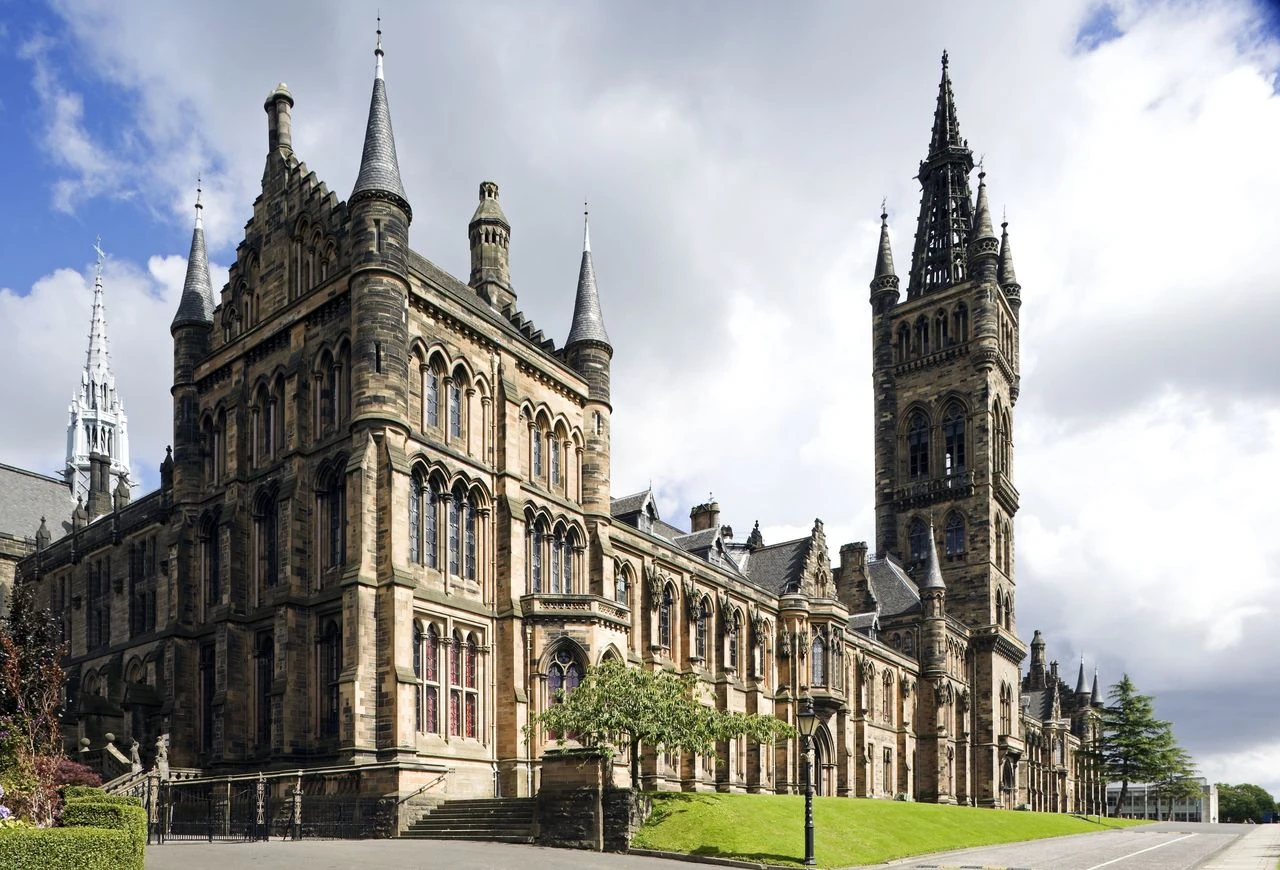
The university’s successive homes record the growth of both the institution and the city. Its High Street buildings developed over time into a substantial complex of courtyards, gardens and a chapel. As the university expanded and the surrounding area became increasingly crowded, space became a pressing problem. In 1870 it moved to Gilmorehill, then a greenfield site in Glasgow’s West End.
The new campus was designed by Sir George Gilbert Scott in the Gothic Revival style. Its Main Building, completed in stages, combined a monumental appearance with a structure using a then-modern iron frame. The Bute Hall, used for examinations and graduation ceremonies, and the campus’s distinctive tower became defining features of the site. Parts of the old High Street buildings were saved: the Pearce Lodge and the Lion and Unicorn Staircase were transferred to the new campus.
Gilmorehill did not end the need to adapt. The growing university spread into nearby buildings and new facilities, including the James Watt Engineering Building, opened in 1959. Other campuses and sites followed: the veterinary school moved to Garscube in 1954, and the university also operates at Dumfries, where the Crichton Campus was established during the 1980s in partnership with other institutions. The Hunterian Museum and Gallery, the university library and the chapel add cultural and commemorative dimensions to the campus. The chapel, completed in 1929, honours members of the university community who died in the two world wars.
Enlightenment, engineering and medicine
Glasgow was part of the Scottish Enlightenment of the eighteenth century. Among the figures associated with the university are the economist Adam Smith and the physicist Lord Kelvin. James Watt’s work at Glasgow led to a stable steam engine, a development connected with the Industrial Revolution. The university’s history also includes John Anderson, professor of natural philosophy, who pioneered vocational education for working men and women during industrialisation. His educational work led to Anderson’s College, later part of the institutional history that culminated in the University of Strathclyde.
Engineering teaching has been part of Glasgow’s development since the nineteenth century. Queen Victoria founded the UK’s first chair of engineering at the university in 1840, and the Faculty of Engineering was formally established in 1923. The institution’s later colleges and schools span engineering, science, medicine and the humanities, among other fields. That breadth is a continuation of a long institutional pattern: professional education and practical knowledge have sat alongside scholarship in the arts and sciences.
Medical research is another part of that record. In 1974, Glasgow professors Graham Teasdale and Bryan Jennett developed the Glasgow Coma Scale, a tool used to assess patients with traumatic brain injuries. Teasdale’s work is a specific example of the university’s contribution to clinical practice, rather than a general claim about medical excellence. Glasgow’s wider history of medicine includes Joseph Lister, a surgeon associated with the university, and a medical faculty whose formal teaching began in the early eighteenth century.
Teaching, research and public life
The university’s influence is visible in the range of people who studied and worked there. Alongside Smith, Kelvin and Watt, its alumni and associated figures include surgeon Joseph Lister, missionary David Livingstone, writer James Boswell and the physicist Jocelyn Bell Burnell. Its graduates have also entered political life: William Lamb, Henry Campbell-Bannerman and Bonar Law became British prime ministers, while Donald Dewar, Nicola Sturgeon and Humza Yousaf became First Ministers of Scotland. The university is affiliated with eight Nobel Prize winners.
Glasgow’s institutional reach extends beyond its academic departments. Its present-day structure includes four colleges, covering arts and humanities; medical, veterinary and life sciences; science and engineering; and social sciences. The university is a member of the Russell Group and Universitas 21, and its research includes work across disciplines. In 2014, its university court voted for the institution to become the first academic institution in Europe to divest from the fossil fuel industry, following a campaign led by the Glasgow University Climate Action Society.
Teaching and student life have also developed through institutional change. In 1973, Delphine Parrott became the university’s first female professor. The university’s former faculties were replaced in 2010 by four larger colleges, a structure intended to encourage interdisciplinary research. Students are represented by a Students’ Representative Council and have two separate students’ unions, the Glasgow University Union and the Queen Margaret Union. Their distinct histories reflect the university’s former male-only status and the later incorporation of a women’s college; both unions now admit students of all sexes.
Why the University of Glasgow deserves a place in British Legacy
The University of Glasgow deserves a place in British Legacy because its history connects major changes in education and society to a particular Scottish institution. Founded in 1451, it belongs to the country’s ancient universities, yet its story is not confined to medieval origins. In the nineteenth century it helped widen higher education beyond wealthy students, preparing people from a growing urban and commercial middle class for professions and, increasingly, scientific and engineering work. The move from the High Street to Gilmorehill records the practical consequences of that growth, while the university’s changing faculties and campuses show an institution repeatedly adapting its teaching to new needs.
Its legacy is also concrete. James Watt’s work at Glasgow contributed to the development of the stable steam engine; the university’s engineering teaching became an established faculty; and the Glasgow Coma Scale, developed by Graham Teasdale and Bryan Jennett, provided a lasting clinical tool for assessing traumatic brain injury. The university has also been associated with influential work in economics and physics, and its graduates have helped shape political, scientific and cultural life. These achievements matter not as a claim of unbroken greatness, but because they show how education, research and public life can meet. Glasgow’s continuing presence in its city, alongside its campuses and partnerships, makes that history part of Scotland’s and Britain’s living educational heritage.
Sources
Adapted in part from University of Glasgow by Wikipedia contributors, under CC BY-SA 4.0. Text has been edited and combined with the existing article; this adapted text is shared under the same licence. Contributor history.