The University of Manchester grew from a practical question: how could scientific knowledge help people at work? Its institutional story began in 1824 with the Manchester Mechanics’ Institution, founded to teach science relevant to working people’s occupations. The university that now bears the city’s name took its present form much later, in 2004, when two institutions with intertwined histories merged. Between those dates lie the development of civic higher education, major scientific work and a continuing relationship with Manchester’s cultural and industrial life.
From mechanics’ institute to civic university
The university traces its origins to the Manchester Mechanics’ Institution, founded in 1824 by the chemist John Dalton and Manchester businessmen and industrialists. Its founders believed that professions relied on scientific principles and that teaching those principles could encourage practical innovation. A second institutional strand began with Owens College, established in 1851 through a bequest from the textile merchant John Owens. The college offered education on non-sectarian lines and became a centre for teaching and research in the expanding industrial city.
Owens College moved to Oxford Road in 1873 and became part of the federal Victoria University in 1880. That body received a royal charter and was England’s first civic university. After Liverpool and Leeds became independent, it was renamed the Victoria University of Manchester in 1903; the following year it absorbed Owens College. Meanwhile, the Mechanics’ Institution had developed into the Municipal College of Technology and, later, the University of Manchester Institute of Science and Technology (UMIST).
Although UMIST gained independent university status in 1994, the two Manchester institutions continued to collaborate. Their merger was agreed in 2003, and the present University of Manchester was officially launched on 1 October 2004, when Queen Elizabeth II bestowed its royal charter. The new institution joined histories that had developed alongside the city’s growth, rather than beginning with a single founding moment.
Research shaped by Manchester’s civic tradition
Manchester’s history in science includes work on the structure of the atom by Ernest Rutherford, who established its nuclear structure while at the university. The institution and its predecessors also became associated with the development of the Manchester Baby, the world’s first stored-program computer, built at the university. These achievements sit within a broader record spanning science, engineering, medicine, mathematics and the humanities.
Graphene research is among the university’s more recent high-profile scientific stories. Physicists Andre Geim and Konstantin Novoselov received the Nobel Prize in Physics in 2010 for their work on the material. Rather than treating that recognition as proof of a single institution’s dominance, it is part of a longer research culture rooted in Manchester’s scientific and technical education. The current university is a member of the Russell Group and the N8 Group, and the Wikipedia account reports that it ranked fifth in the UK for research power in the 2021 Research Excellence Framework.
Research has also extended beyond laboratory science. The university’s predecessor institutions and the current institution have been associated with figures in mathematics, philosophy, economics, history and the arts. Among those named in its history are the mathematician Alan Turing, the philosopher Ludwig Wittgenstein, the birth-control campaigner and women’s rights pioneer Marie Stopes, and the author Anthony Burgess. The breadth of these associations reflects a university whose work has not been confined to one discipline.
Collections and buildings open to the city
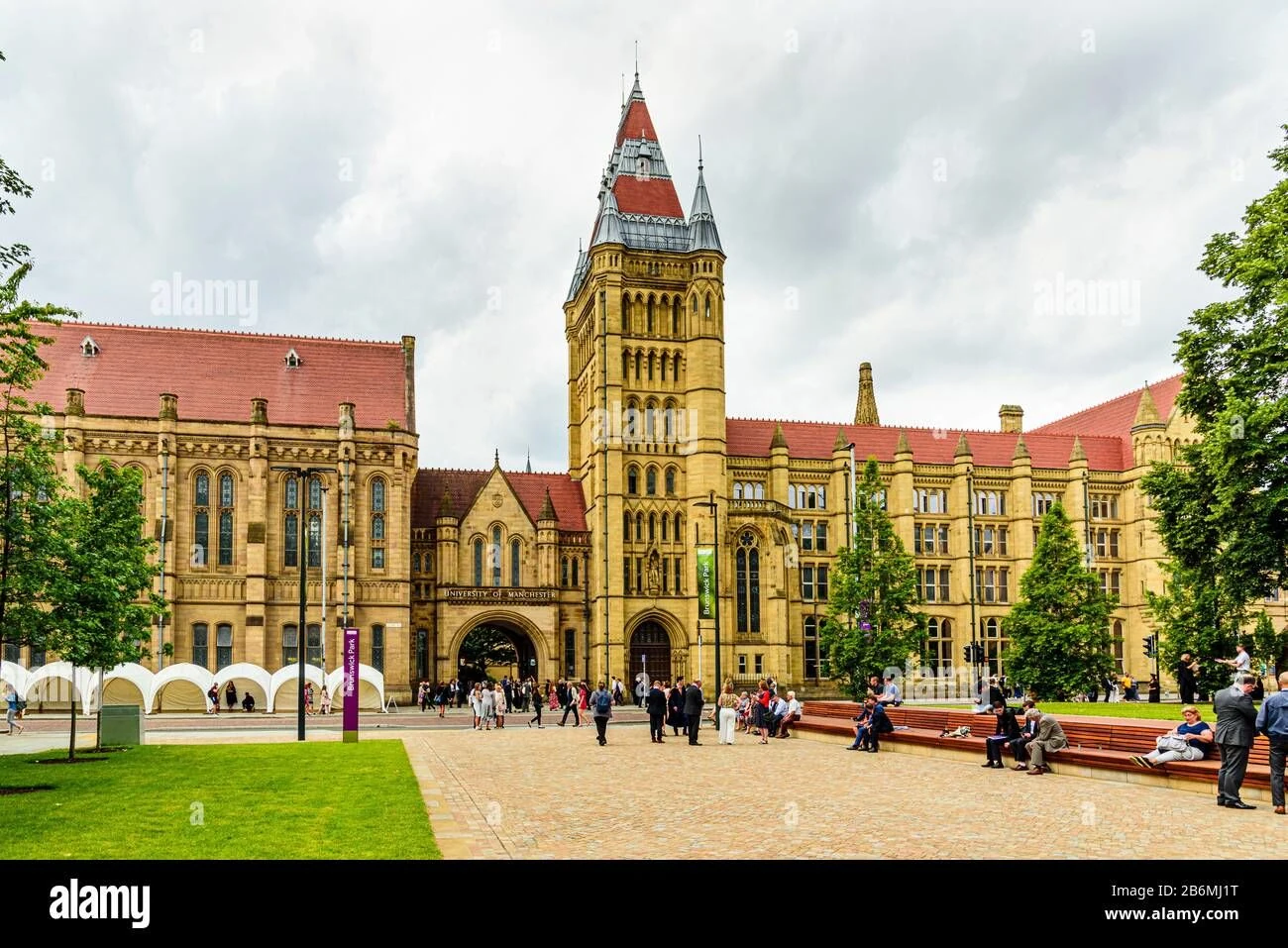
The university’s presence is woven into Manchester rather than set apart from it. Its main site lies south of the city centre, with university buildings interspersed among streets and other city buildings. The historic Old Quadrangle, designed in a Gothic style by Alfred Waterhouse, includes the John Owens Building, the Beyer Building, the Manchester Museum, the Christie Library and Whitworth Hall. The buildings took shape over several decades, from the John Owens Building in 1873 to Whitworth Hall in 1902.
Its cultural institutions make the university’s work visible beyond teaching and research. The Manchester Museum holds collections from across the world and opened to the public in 1888. The Whitworth Art Gallery, founded in 1889, has collections including British watercolours, textiles, wallpapers, prints and sculpture. The John Rylands Library, founded as an independent institution by Enriqueta Augustina Rylands in memory of her husband, holds historic books, manuscripts, archives and papyri. These collections are not merely campus amenities: they are public-facing resources held within a university setting.
Further afield, the university operates Jodrell Bank Observatory in Cheshire, a UNESCO World Heritage Site. Its Lovell Telescope, named after the University of Manchester professor Bernard Lovell, was built in the 1950s. Together, the observatory, galleries, library and museum connect academic work with the region’s cultural and scientific life.
A university in a living city
The institution’s civic character is visible in its physical setting and in its long-standing engagement with practical questions. Its present organisation spans three faculties: Biology, Medicine and Health; Science and Engineering; and Humanities. The university also has a history of research in social sciences and international development, including work associated with humanitarian and conflict response. These areas sit alongside, rather than in place of, its better-known scientific achievements.
That relationship with the city is not always straightforward. Student protests over accommodation costs and living conditions took place in 2020 and again in 2023, according to the Wikipedia account. The 2020 actions ended with a negotiated rent reduction; the later dispute included occupations, marches and rent withholding. Such episodes form part of the record of a large institution whose decisions affect students’ everyday lives as well as its academic reputation.
The university’s scale is substantial: its 2024/25 student total was reported as 46,305. It attracts students from many countries, while its Students’ Union represents the student body. Its academic press, Manchester University Press, publishes scholarly books and journals, extending the institution’s role in circulating research beyond the campus.
Why University of Manchester deserves a place in British Legacy
The University of Manchester deserves a place in British Legacy because its story shows how British higher education developed in response to the needs of an industrial city. The Mechanics’ Institution taught scientific principles relevant to working lives; Owens College expanded access to non-sectarian education; and the later civic university joined teaching and research to the life of Manchester. The 2004 merger brought together institutions with distinct but connected histories, preserving a tradition of practical learning while creating a major modern research university.
Its legacy is also public and tangible. Work associated with the university includes Rutherford’s research into atomic structure and the development of the Manchester Baby, while its research on graphene brought international recognition to Geim and Novoselov. Beyond laboratories, the Manchester Museum, Whitworth, John Rylands Library and Jodrell Bank Observatory place collections and scientific facilities within reach of wider communities. These institutions preserve and share knowledge, not only produce it. The university’s civic significance therefore rests on a combination of educational purpose, research and public access. Its continuing connection to Manchester—through its buildings, collections, students and contested decisions—makes its history part of the city’s ongoing story, not simply a record of past honours.
Sources
University of Manchester — Wikipedia, revision 1375545389
Adapted in part from University of Manchester by Wikipedia contributors, under CC BY-SA 4.0. Text has been edited and combined with the existing article; this adapted text is shared under the same licence. Contributor history.