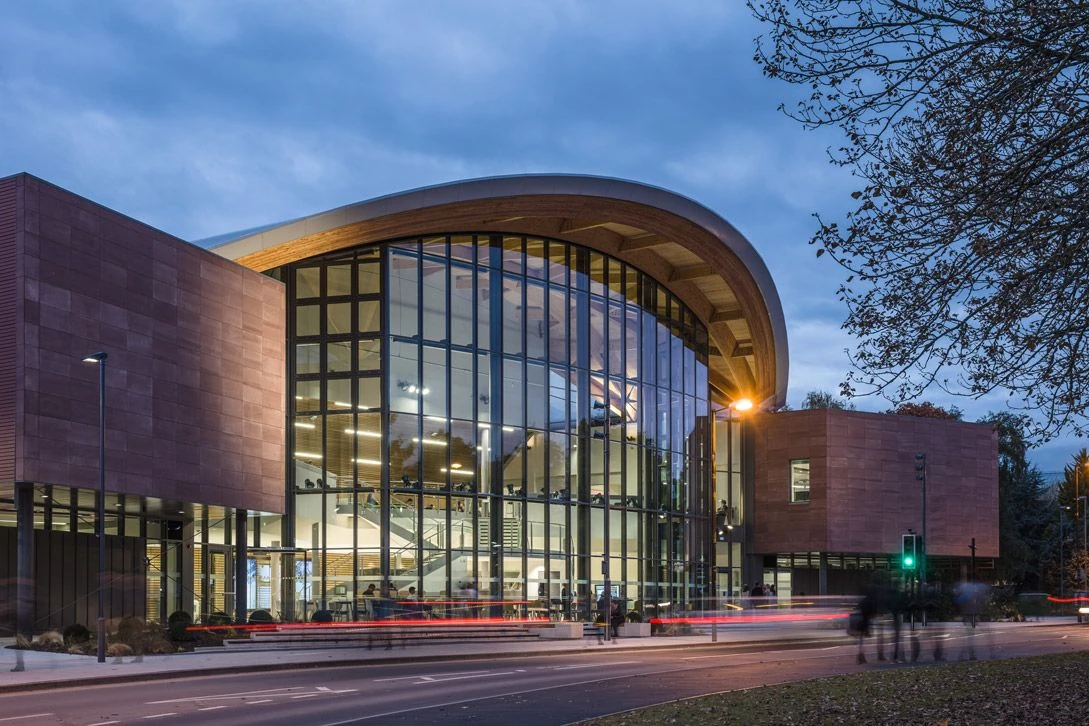
The University of Warwick began in 1965 as part of a government initiative to expand higher education. Its name can suggest a location in the town of Warwick, but its main campus lies on the outskirts of Coventry, close to the boundary between the West Midlands and Warwickshire. The institution has developed a distinctive character from that setting: a research university whose history includes close engagement with business, manufacturing and the wider region.
A university built for a changing region
The idea of establishing a university in Warwickshire arose after the Second World War. Local city and county councils eventually provided the impetus and a site for the new institution. There was discussion over whether it should bear Coventry’s name or Warwickshire’s; “University of Warwick” was chosen, although the town of Warwick is some distance to the south-west of the campus.
The university received government approval in 1961 and its Royal Charter of Incorporation in 1965. It admitted a small first intake of postgraduate students in 1964, followed by 450 undergraduates in October 1965. The campus has since expanded through the purchase of adjoining farmland. Warwick also incorporated Coventry College of Education in 1979 and, in 2004, Horticulture Research International.
Warwick’s early development included an approach that set it apart from more traditional models of university life. Under vice-chancellor Lord Butterworth, it became the first UK university to adopt a business approach to higher education, develop close links with the business community and seek commercial value from research. That direction brought opportunity as well as debate. Historian E. P. Thompson’s Warwick University Ltd., published in 1970, examined controversy over university priorities, a student occupation of the Registry in 1967 and the discovery of files concerning surveillance of students and staff.
Research, manufacturing and public life
Some of Warwick’s most enduring connections between academic work and industry run through Warwick Manufacturing Group, founded in 1980. WMG works across engineering and technology, and is among the university’s prominent units for developing and applying research. The university has also established commercial activities including the University of Warwick Science Park and Warwick Ventures. This focus has been influential, but not without critics: the debate over whether commercial priorities can sit comfortably alongside the interests of staff and students remains part of the institution’s history.
Engineering collaboration is visible in the National Automotive Innovation Centre, developed at Warwick with funding from Jaguar Land Rover and the UK government. Its purpose is to support research and development in new automotive technologies. Warwick was also selected to host the Advanced Propulsion Centre, a programme intended to support UK-based research and development of lower-emission powertrain technologies. These initiatives connect university research with a major British industrial challenge: developing vehicles and manufacturing expertise while reducing dependence on fossil fuels.
Warwick’s academic work extends beyond engineering and business. Researchers associated with the university have contributed to fields including economics, statistics, computing and medicine. The university’s account of its research history notes contributions to the development of penicillin, music therapy, computing standards and complexity theory. Warwick Medical School was established in 2000; it gained independent degree-awarding status in 2007. The university’s research activity is organised across arts, science, engineering and medicine, and social sciences.
A campus with an outward-facing cultural life
The main campus occupies a large site between Coventry and Warwickshire. Warwick Arts Centre, at its centre, brings together spaces for concerts, theatre, dance, comedy, film and visual art. Its programme makes the campus a cultural venue as well as a place of teaching and research. The university’s growth has also included facilities for students and researchers, a medical school and, at The Shard in London, a base for Warwick Business School’s Executive MBA.
Warwick’s international connections are expressed through student exchange and research partnerships. Its campus represents more than 120 countries, while students can take part in overseas study arrangements with universities including Columbia, McGill, Cornell and Sciences Po Paris. International reach has therefore become part of the institution’s working academic life, rather than simply a claim about its reputation.
The university has also figured in national public life. In December 2000, US President Bill Clinton chose Warwick for his last major foreign-policy address as president. In 2015, the institution marked its fiftieth anniversary and was named University of the Year by The Times and The Sunday Times. Such moments sit alongside a more complicated history of commercial ambition, student politics and debate about what a university should be.
Why University of Warwick deserves a place in British Legacy
Warwick deserves a place in British Legacy as an example of the post-war expansion of higher education and of the choices that shaped modern British universities. Founded in 1965, it was created through cooperation between local authorities and the national government, on a site serving Coventry and the surrounding region. Its early commitment to links with business became a defining feature: WMG, the Science Park and automotive research initiatives demonstrate how academic work can connect with manufacturing and industrial change.
That connection has practical significance. Research into automotive technologies and lower-emission powertrains supports work on the future of a major UK industry, while the university’s wider contributions span medicine, computing, economics and the humanities. Its arts centre adds a public cultural role to its academic one, and its international study partnerships connect students and researchers in Britain with colleagues overseas. Warwick’s story is not one of uncomplicated institutional triumph: commercial priorities have attracted criticism, and its early history includes disputes over university governance and student rights. Including those debates makes its legacy more useful, not less. The university shows how British higher education has sought to combine public purpose, research, industry and cultural life—and why the balance between them remains consequential.
Sources
Adapted in part from University of Warwick by Wikipedia contributors, under CC BY-SA 4.0. Text has been edited and combined with the existing article; this adapted text is shared under the same licence. Contributor history.