
Florence Nightingale became known as the Lady with the Lamp, but her lasting influence reached well beyond the Crimean War wards that made her famous. She helped establish trained nursing as a profession, pressed for better sanitation in hospitals and public health, and used statistical diagrams to make evidence legible to decision-makers. Her work joined the practical organisation of care to a wider campaign for reform.
A vocation formed against expectation
Nightingale was born on 12 May 1820 in Florence, then in the Grand Duchy of Tuscany, while her parents, William Edward Nightingale and Frances Nightingale Smith, were travelling in Europe. The family returned to England the following year. They divided their time chiefly between Embley Park in Hampshire and Lea Hurst in Derbyshire, with periods in London. Her father supervised her education, which included mathematics, history, languages and literature—an unusually broad curriculum for a woman of her class.
In 1837, aged 16, Nightingale described experiencing a call from God to service. It took years for that sense of purpose to become a commitment to nursing. Her mother and older sister resisted her plans, while the social expectations placed on an affluent young woman pointed towards marriage rather than a profession. Nightingale nevertheless educated herself in nursing and, in 1850, visited the Lutheran community at Kaiserswerth in Germany. There she observed its work with sick and poor people and received four months of medical training.
In 1853 she became superintendent of the Institute for the Care of Sick Gentlewomen in Upper Harley Street, London. The appointment gave her experience of managing a nursing institution before the war drew her into public view. Her later practice grew from training and administration as well as from her attention to the conditions in which patients were treated.
Scutari and the limits of the familiar story
In October 1854, during the Crimean War, Nightingale and a party of nurses travelled to the Ottoman Empire to care for British soldiers. They arrived at Selimiye Barracks in Scutari, near Constantinople, where medical staff faced severe shortages and patients were crowded amid poor sanitation. Illnesses including typhus, typhoid, cholera and dysentery killed many soldiers. In the first winter, more than ten times as many British soldiers died from disease as from battle wounds.
Nightingale organised nursing care and argued publicly for action. She appealed through The Times about the state of the facilities. The British Government sent a Sanitary Commission to Scutari in March 1855; it cleared sewers and improved ventilation. Mortality fell sharply, but the sequence matters: Nightingale did not claim sole credit for the reduction. The commission’s work addressed serious environmental causes of disease, and her later investigations helped her argue that living conditions, rather than wounds alone, were central to the soldiers’ deaths.
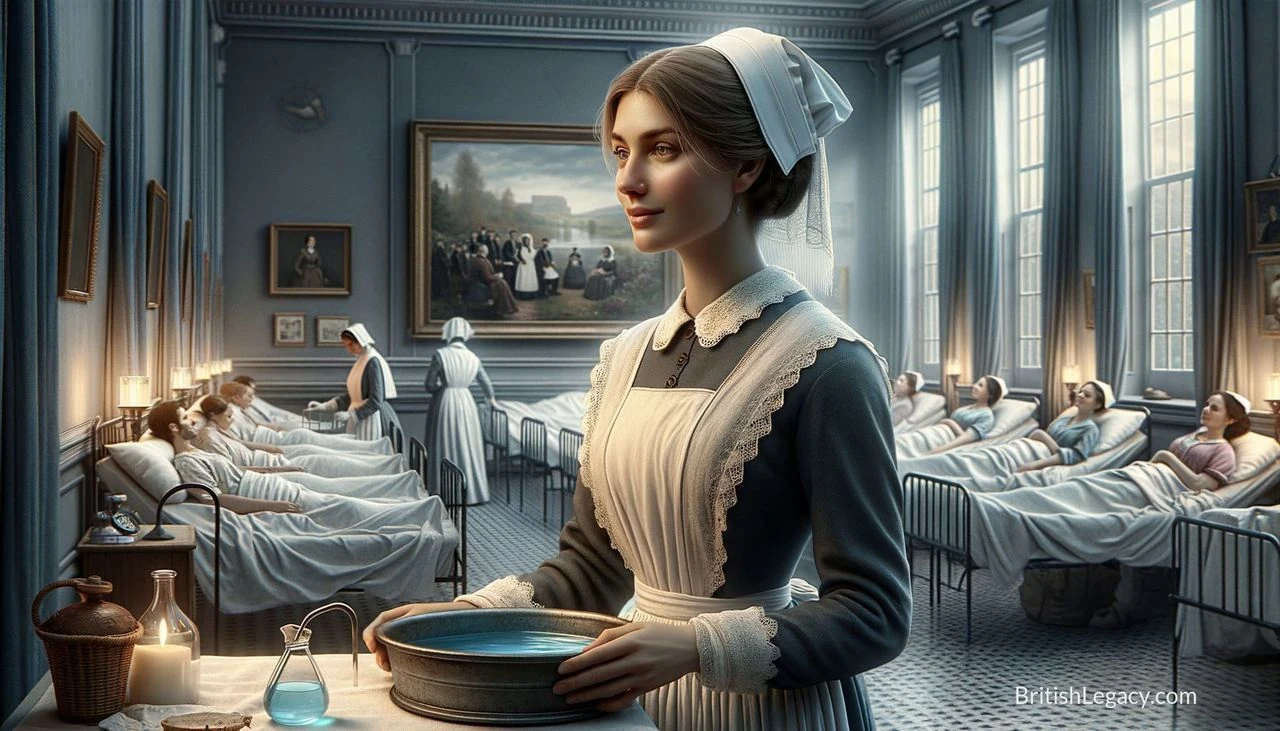
The image of Nightingale making night rounds with a lamp was popularised by a report in The Times and by Henry Wadsworth Longfellow’s poem “Santa Filomena”. The nickname became an enduring shorthand for her wartime service, though it can obscure the less picturesque work of management, evidence-gathering and lobbying. Nightingale’s reputation was already being shaped by public accounts during the war; later writers have debated how far the popular story simplified her achievements.
From training school to public health
After returning to Britain, Nightingale continued to work on military health and nursing. Evidence gathered from the war informed her submissions to the Royal Commission on the Health of the Army. She came to believe that poor living conditions were responsible for much of the disease and death, and she carried that concern into campaigns for sanitary reform in hospitals, army facilities and working-class homes.
In 1859 she published Notes on Nursing: What It Is and What It Is Not. Written to explain nursing principles, the book also reached a general readership. The Nightingale Fund, established in 1855, provided £45,000 for a training school at St Thomas’ Hospital in London. The Nightingale Training School opened in 1860; its first trained nurses began work at Liverpool Workhouse Infirmary in 1865. The school helped make structured training a foundation of professional nursing, and Nightingale continued to promote and organise the profession.
Her work also reached beyond hospitals. From the late 1850s she studied sanitation in India, arguing that drainage, clean water, reduced overcrowding and ventilation affected the health of both soldiers and the wider population. She pressed for official investigations and public-health action. In Britain, she supported stronger requirements for sanitation in private houses and worked with reformers to secure legislation and local powers to enforce it. This was a sustained campaign, not a single intervention: Nightingale used reports, correspondence and political influence to keep conditions of everyday life on the reform agenda.
Making statistics visible
Nightingale’s arguments drew strength from her use of statistics. She presented mortality data in visual form, including the polar area diagram often called the Nightingale rose. The graphic showed seasonal patterns in deaths among soldiers and helped make complex evidence more accessible to MPs and civil servants. The diagram was not an invention unique to her: related forms had been used earlier. Her achievement lay in applying such visual methods to the presentation of public-health evidence and using them to press for action.
In 1859 she became the first woman elected to the Royal Statistical Society; in 1874 she was made an honorary member of the American Statistical Association. Her statistical work and her nursing reforms belonged to the same practical method: gather evidence about outcomes, explain what it shows and use it to improve systems of care. Nightingale also wrote widely, producing books, pamphlets and articles on nursing, public health and other subjects.
Recognition and remembrance
Nightingale received the Royal Red Cross in 1883 and became a Lady of Grace of the Order of St John in 1904. In 1907 she was the first woman awarded the Order of Merit. Her nursing school became part of King’s College London as the Florence Nightingale Faculty of Nursing and Midwifery. International Nurses Day is held on her birthday, 12 May, and the Florence Nightingale Medal was established by the International Committee of the Red Cross in 1912 to recognise exceptional service in nursing.
She died in her sleep in Mayfair, London, on 13 August 1910, aged 90. Her relatives declined an offer of burial in Westminster Abbey; she was buried at St Margaret’s Church, East Wellow, Hampshire. Her familiar lamp remains an emblem of care, but her public legacy also rests on less easily pictured work: training nurses, measuring mortality and challenging institutions to improve the conditions that shaped health.
Why Florence Nightingale deserves a place in British Legacy
Nightingale’s place in British history rests on specific changes to how care was organised and understood. The training school at St Thomas’ Hospital helped establish a model in which nursing required preparation and professional standards. Its influence extended through nurses who went on to work in hospitals in Britain and abroad. Her book Notes on Nursing carried practical ideas beyond the hospital and helped make nursing knowledge available to a wider readership. These contributions give substance to the familiar image of the Lady with the Lamp: her work was not only the bedside act of care, but also the creation of systems that could sustain it.
She also showed how evidence could serve public life. Her diagrams made mortality patterns easier for officials to grasp, while her investigations and advocacy connected sanitation with the health of soldiers, hospital patients and the wider population. Nightingale’s British legacy is therefore not a claim that one person transformed healthcare alone. It is the record of a reformer who used nursing administration, statistics and political engagement to press for practical improvements. That combination remains relevant to the history of British healthcare: better care depends both on skilled people and on institutions willing to act on what evidence reveals.
Sources
Florence Nightingale — revision 1375983362
Adapted in part from Florence Nightingale by Wikipedia contributors, under CC BY-SA 4.0. Text has been edited and combined with the existing article; this adapted text is shared under the same licence. Contributor history.
.jpg)