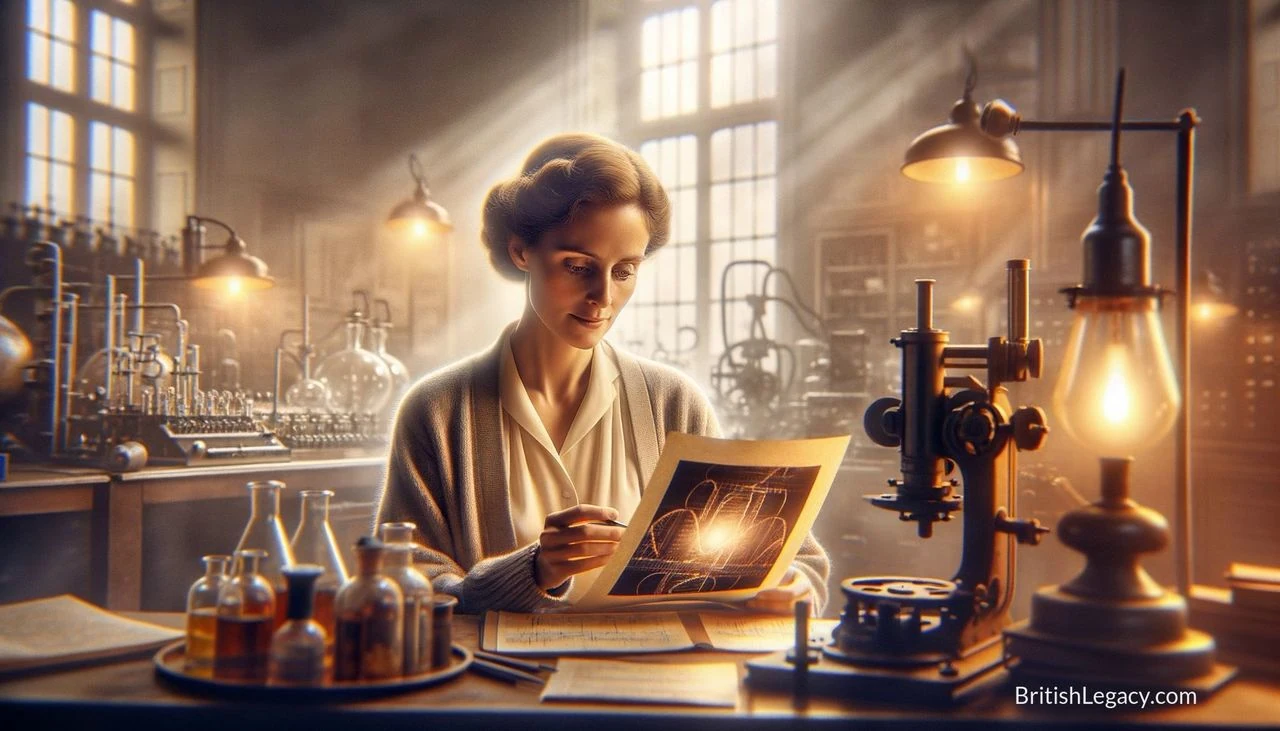
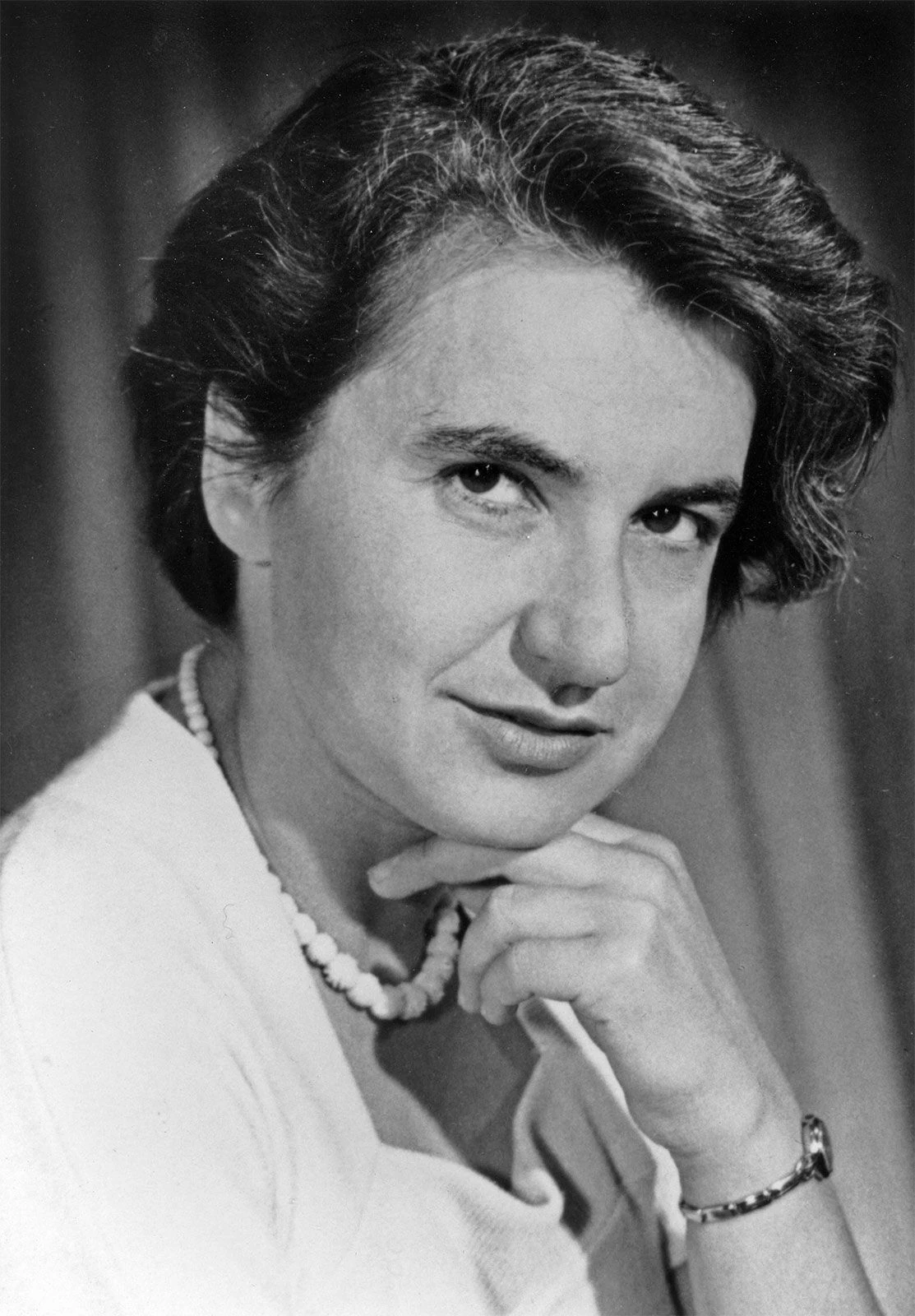
Rosalind Franklin’s research helped establish the evidence on which the DNA double-helix model was built. At King’s College London, she and her student Raymond Gosling produced and analysed X-ray diffraction images of DNA fibres, including the celebrated Photo 51. But DNA was one part of a wider scientific career: Franklin had studied coal and graphite, and at Birkbeck College she led research into viruses. Her work is best understood not as a single image or discovery, but as a sustained contribution to experimental science whose recognition has been debated ever since.
A London education and research on coal
Franklin was born in Notting Hill, London, on 25 July 1920, into a British Jewish family. She attended St Paul’s Girls’ School, where she excelled in science, Latin and sport, then studied chemistry within the Natural Sciences Tripos at Newnham College, Cambridge. She completed her examinations in 1941. Cambridge did not award women titular degrees at that time; her qualification was accepted as a bachelor’s degree for employment. She later received a PhD from Cambridge in 1945.
In 1942, during the Second World War, Franklin took a research post at the British Coal Utilisation Research Association. She investigated coal’s porosity and fine structure, using measurements to examine how its pores affected permeability and performance. Her work connected the size of molecules released as coal was heated with the structure of its pores. This helped classify coals and predict their suitability for fuel and wartime uses, including gas masks. The research formed the basis of her doctoral thesis.
After the war, Franklin moved to Paris to work with Jacques Mering at the Laboratoire Central des Services Chimiques de l’État. There she became an accomplished X-ray crystallographer, applying diffraction techniques to coal and other carbonaceous materials. Her research examined changes in the arrangement of atoms as carbon was converted to graphite. She also introduced the terms “graphitising” and “non-graphitising” carbon, which became part of the scientific vocabulary of the field.
DNA at King’s College London
In 1951, Franklin joined the Medical Research Council’s Biophysics Unit at King’s College London as a research associate. Her work was redirected to DNA fibres. She began experiments with Raymond Gosling, a graduate student who had previously worked with Maurice Wilkins. Franklin brought expertise in X-ray diffraction and refined the apparatus, including by controlling the humidity around the samples. This was important because DNA fibres changed with their water content: she distinguished a “wet” form from a “crystalline” one and investigated each separately.
Franklin’s measurements revealed important features of DNA’s structure. She found evidence for a helical arrangement and concluded that phosphate groups lay on the outside of the molecule. Photo 51, the famous X-ray diffraction image of the B form of DNA, was taken by Gosling while he was working with Franklin. Its distinctive pattern supplied crucial evidence for a helical structure, but it was part of a broader body of experimental work, not a discovery in isolation. Franklin and Gosling also analysed the two DNA forms and prepared research papers of their own.
In early 1953, Wilkins showed Photo 51 to James Watson without Franklin’s knowledge. Francis Crick and Watson also saw a Medical Research Council report containing findings from the King’s research, which Max Perutz gave to Crick. These data helped the Cambridge researchers develop their model. In April 1953, Nature published Crick and Watson’s proposed double helix alongside papers by Wilkins and by Franklin and Gosling. The model drew on experimental results produced at King’s as well as the Cambridge team’s theoretical work. The circumstances in which information reached Watson and Crick, and the adequacy of the recognition given to Franklin, have remained subjects of historical discussion.
Franklin’s own conclusions developed as evidence accumulated. She had recognised helical features in DNA and, by 1953, had drafted work indicating a double-helical structure. Her research was meticulous, but she had not completed the full model proposed by Watson and Crick: the arrangement of the strands and the significance of complementary base pairing were not all resolved in her work. Keeping these distinctions clear recognises her substantial experimental contribution while accounting for the different roles of the researchers involved.
A new research group at Birkbeck
Franklin moved to Birkbeck College in 1953, where she established a research group under crystallographer John Desmond Bernal. The move had been planned. At Birkbeck she continued work on nucleic acids and extended her research into viruses. She also helped Gosling complete their work on DNA; their paper on the A form appeared in Nature in 1953.
Franklin and her team studied tobacco mosaic virus (TMV), an RNA virus. She showed that its particles had a consistent length and, with colleagues, investigated the arrangement of its protein coat and RNA. Work by Franklin and Kenneth Holmes identified the helical arrangement of the virus’s protein subunits. Later research with Donald Caspar showed that the RNA ran along the inner surface of the hollow particle. The group also examined other plant viruses, including turnip yellow mosaic virus. This work made Franklin’s final years a substantial period of research in their own right, rather than an epilogue to her DNA work.
After a visit to the United States in 1956, Franklin’s group began investigating polio virus. She secured funding and planned X-ray studies of the virus in crystalline form, with arrangements made for safe handling of the live virus. Her health deteriorated before she could complete the project. Franklin died in Chelsea, London, on 16 April 1958, aged 37, from ovarian cancer. The Brussels world’s fair opened the following day with a large model of tobacco mosaic virus that she had helped design.
Scientific recognition and historical debate
Franklin’s virus research was recognised during her lifetime, while public understanding of her role in DNA research developed later. The 1962 Nobel Prize in Physiology or Medicine for work on nucleic acids went to Crick, Watson and Wilkins. Franklin had died four years earlier. She was therefore not eligible for a posthumous award. The award and the separate contributions of the researchers do not, by themselves, settle how credit for the DNA model should be understood.
Accounts of the episode differ over what Franklin knew and how information was shared between King’s and Cambridge. The evidence includes Photo 51, the committee report and the research papers published in 1953. Watson and Crick’s article acknowledged that they had been stimulated by knowledge of unpublished work from King’s, but the extent and form of that acknowledgement have since been criticised. Franklin’s contribution was not simply an image passed between laboratories: it included the experiments, measurements and analysis that made the image intelligible.
British institutions have commemorated Franklin’s work in several ways. King’s College London has a Franklin-Wilkins Building; Newnham College named a graduate residence for her; and the Royal Society established the Rosalind Franklin Award and Lecture in 2003. A plaque at King’s commemorates the DNA diffraction work of Franklin, Gosling, Wilkins and their colleagues. The Rosalind Franklin Institute, a UK medical research centre supported by a partnership of universities and UK Research and Innovation, was launched at the Harwell Science and Innovation Campus in 2018.
Why Rosalind Franklin deserves a place in British Legacy
Rosalind Franklin deserves a place in British Legacy because her career demonstrates the range and rigour of scientific research conducted in Britain. At the British Coal Utilisation Research Association, she connected coal’s microscopic structure with its practical behaviour, work that supported its classification and the prediction of its performance. In Paris she developed expertise in applying X-ray diffraction to difficult materials and advanced understanding of carbon and graphite. At King’s College London, she brought that experimental skill to DNA, generating evidence that helped establish the molecule’s helical form and informed the work that produced the double-helix model.
Her legacy extends beyond DNA. At Birkbeck, Franklin led a research group whose work on tobacco mosaic virus and other viruses advanced knowledge of their structures; colleagues continued parts of that research after her death. British universities and scientific organisations commemorate her through named buildings, a research institute, an award and lecture, and plaques marking her work. Such recognition does not replace the need for a careful account of how the DNA research was conducted. It gives Franklin’s achievements a visible place alongside those of her colleagues and makes clear the importance of experimental evidence, sound attribution and women’s participation in science. Franklin belongs in British Legacy for the specific knowledge she helped create and the scientific work she led across several fields.
Sources
Adapted in part from Rosalind Franklin by Wikipedia contributors, under CC BY-SA 4.0. Text has been edited and combined with the existing article; this adapted text is shared under the same licence. Contributor history.