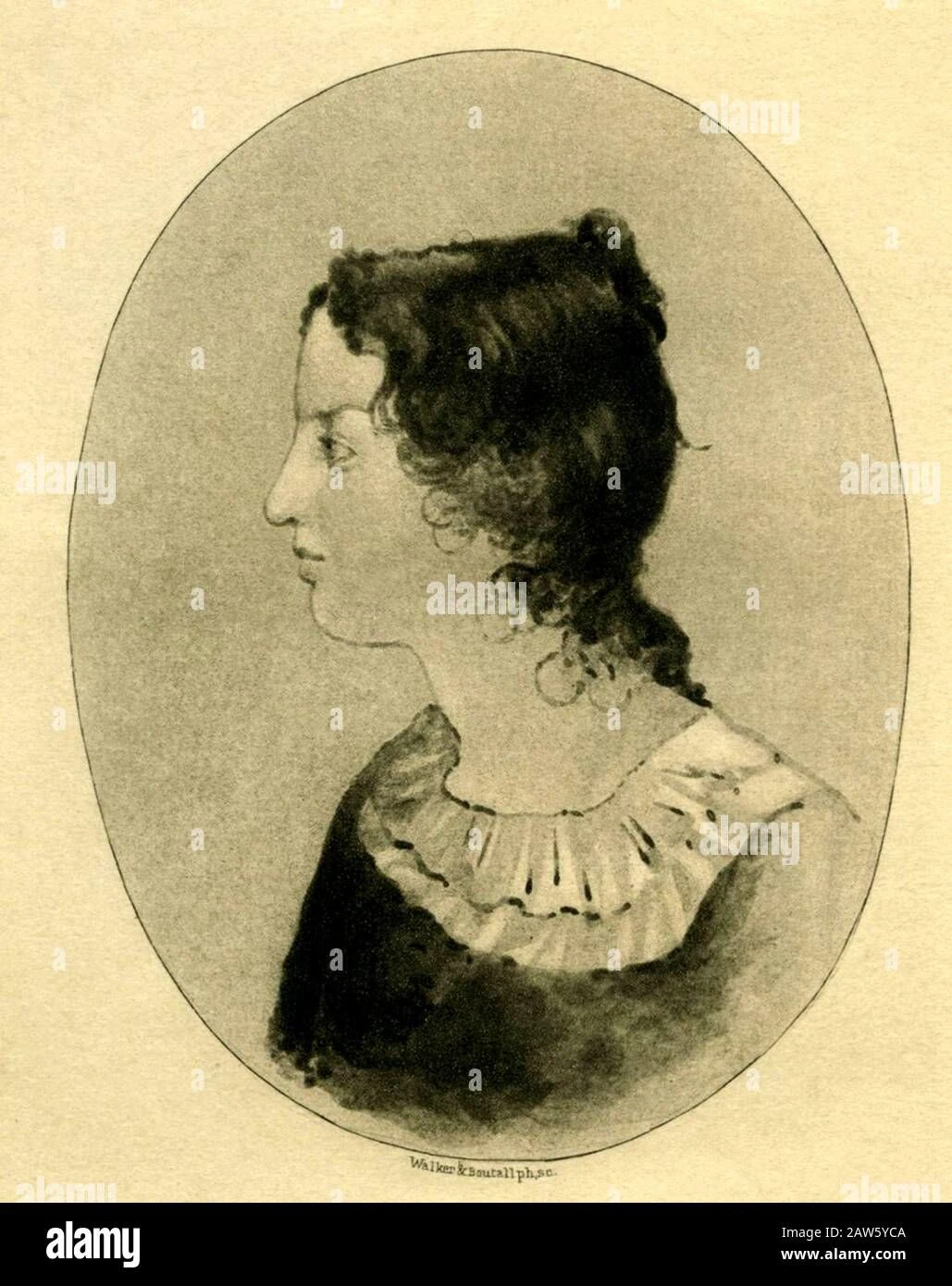
Emily Brontë’s only novel, Wuthering Heights, is a story of love, cruelty and revenge whose fierce passions unsettled many of its first readers. Its intricate design and Yorkshire setting are inseparable from the work of a writer who spent much of her life in Haworth, but whose literary imagination extended into the private worlds she created with her siblings. Brontë also wrote poetry, taught for a time and published under the name Ellis Bell. She died in 1848, less than a year after her novel appeared.
Childhood in Thornton and Haworth
Emily Jane Brontë was born in Thornton, Yorkshire, on 30 July 1818, the fifth of six children of Maria Branwell and Patrick Brontë, a curate. The family moved to Haworth in 1820, after Patrick took up a post there. Emily was three when her mother died in 1821. Her aunt Elizabeth Branwell joined the household and helped care for the children.
In 1824, Emily and her three older sisters went to the Clergy Daughters’ School at Cowan Bridge. After an outbreak of illness, Maria and Elizabeth were sent home and died within months of one another. Emily and Charlotte were then brought back to Haworth. For most of her childhood, Emily was educated at home by her father and aunt, alongside her siblings and the family’s servant, Tabby Ackroyd.
The children made stories around imaginary places, first Glass Town and Angria, and later Gondal. Emily and her younger sister Anne developed Gondal together and continued to write about it as adults. Much of their Gondal writing has not survived, but Emily’s poems preserve traces of this imaginative world. The siblings’ reading ranged widely, and the household encouraged their interest in writing, drawing, music and other studies. Emily became a skilled pianist and taught herself German from books.
Work, travel and poetry
Emily’s adult life included attempts to earn a living as a teacher. She attended Roe Head School as a teenager, where Charlotte taught, but left after a few months. In 1838 she took a teaching post at Law Hill School in Halifax. The long working day affected her health, and she returned to Haworth in April 1839. There she helped with household work and continued to write.
In 1842 she travelled with Charlotte to Brussels to study at the Heger Pensionnat. Emily found the school’s social life difficult, although she pursued her studies and became a capable pianist. The sisters returned to Haworth after their aunt Elizabeth Branwell died. Charlotte later went back to Brussels alone; Emily remained at home and took on more responsibility for the household.
Emily and her sisters first published their poetry together in 1846, paying for the volume themselves. Poems by Currer, Ellis, and Acton Bell appeared under pseudonyms that kept their initials while concealing their identities: Charlotte was Currer Bell, Emily Ellis Bell and Anne Acton Bell. Each sister contributed 21 poems. The book sold few copies, though reviewers noted the power of Ellis Bell’s work. Emily continued writing poetry, including “No coward soul is mine”, while turning much of her creative attention to prose.
Writing and publishing Wuthering Heights
Wuthering Heights was published in December 1847 under the name Ellis Bell. It appeared as the first two volumes of a three-volume set, alongside Anne Brontë’s Agnes Grey. Emily’s name was not printed as the novel’s author until after her death. The story follows generations of people connected with the farmhouse of the title, among them Catherine Earnshaw and Heathcliff. Its subject matter includes love, hatred, revenge and the supernatural.
The book’s narrative structure, violence and emotional intensity confounded many early reviewers. Some described its characters as coarse or immoral; one reviewer called the novel wild and confused. Its unusual form differed sharply from the more familiar pattern of a coming-of-age story, and its strength of feeling led some contemporary readers to think a man had written it. After Emily’s death, Charlotte identified her as the author, though two of Branwell Brontë’s friends disputed that attribution. The novel is now regarded as a classic of English literature.
Brontë’s writing drew on more than the landscape around Haworth. Her years of writing imaginary histories with Anne, and her reading, formed part of the background to her fiction. Yet the novel’s Yorkshire setting is central to its atmosphere: the place is not merely a backdrop to the characters’ conflicts, but an essential part of the world the book creates.
A short life and a lasting readership
Emily’s health deteriorated after the death of her brother Branwell in September 1848. At his funeral she caught a severe cold, which developed into an inflammation of the lungs. Her condition worsened over the following months. She died at Haworth on 19 December 1848, aged 30, and was buried in the family vault at St Michael and All Angels’ Church.
Her poems and novel outlasted their initially uncertain reception. Wuthering Heights has since reached readers around the world and inspired adaptations for stage, film, television and radio. Brontë’s work has also been a source for later writers. Her life and writing continue to attract attention, while the Brontë Parsonage in Haworth gives visitors a place to encounter the family’s history and their literary world.
Why Emily Brontë deserves a place in British Legacy
Emily Brontë deserves a place in British Legacy because she made a lasting contribution to English literature from a life rooted in Yorkshire. Wuthering Heights took the conventions of the Victorian novel in a striking direction: its layered narration, generational reach and unsparing treatment of obsession and revenge resisted the expectations of many of its first readers. Its continuing readership and repeated adaptation show how a work that was once described as bewildering became a central part of the literary inheritance.
Her achievement was not confined to one novel. Brontë’s poems, including those associated with the invented world of Gondal, show a sustained poetic practice; her shared volume with Charlotte and Anne also records the sisters’ decision to publish despite the barriers facing women writers. They used names that concealed their identities while preserving their initials, and brought their work to readers on their own terms. Brontë’s literary legacy connects a particular place and family history with readers far beyond Haworth. Her writing invites people to return to Yorkshire not only as a setting, but as a force in the imagination of one of England’s most distinctive novelists.
Sources
Emily Brontë — revision 1379852679
Adapted in part from Emily Brontë by Wikipedia contributors, under CC BY-SA 4.0. Text has been edited and combined with the existing article; this adapted text is shared under the same licence. Contributor history.