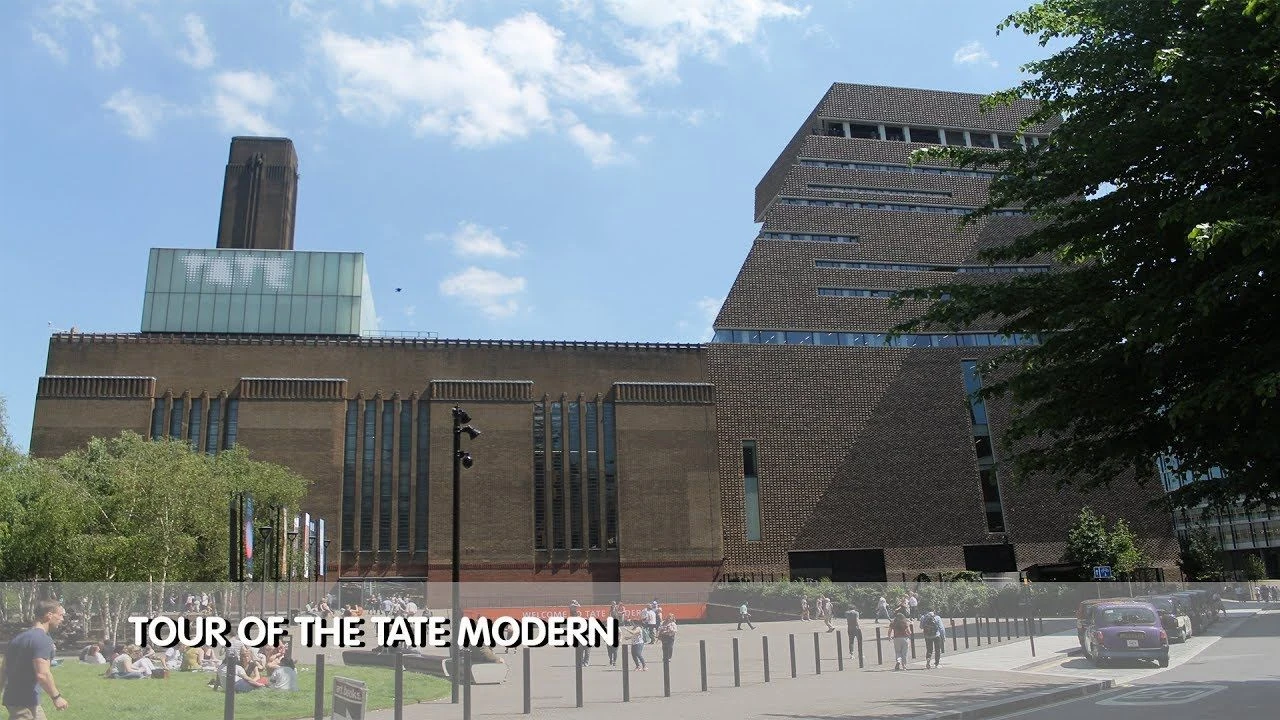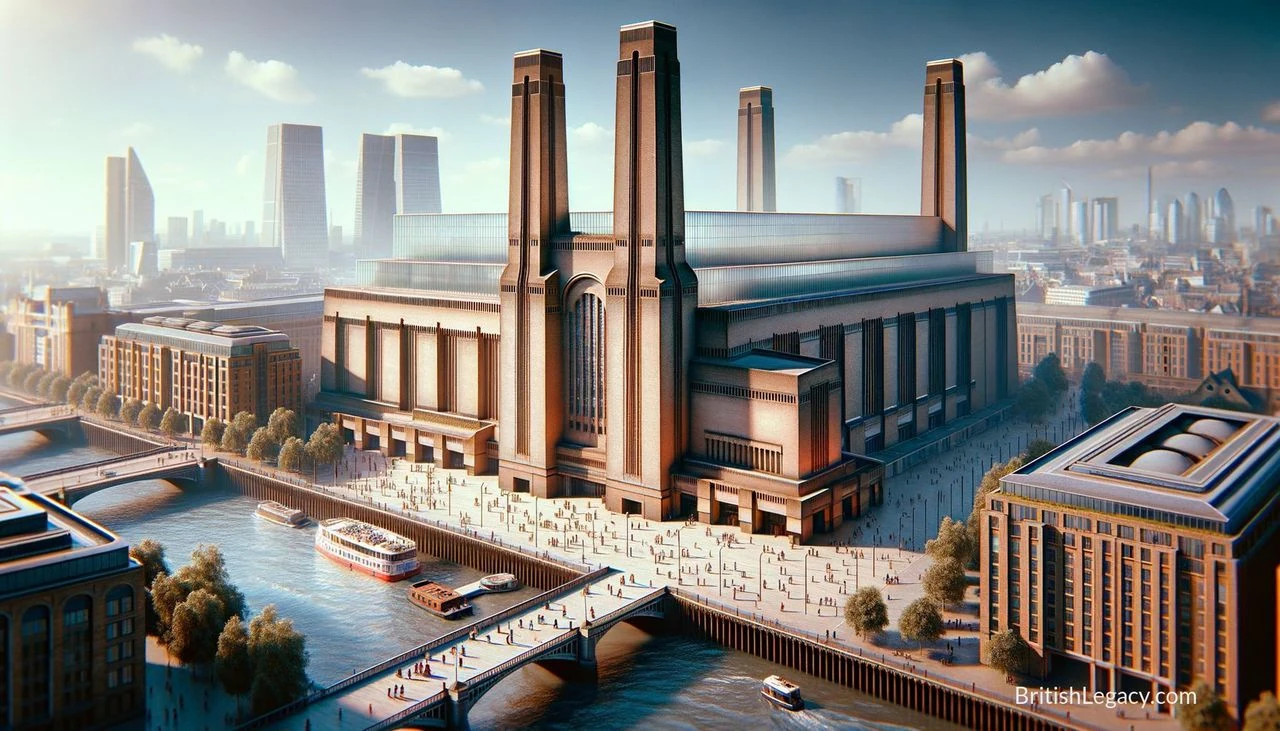
On London’s Bankside, a former power station now gives modern and contemporary art a striking industrial setting. Tate Modern opened in May 2000 in the disused Bankside Power Station, retaining the building’s turbine hall as a vast public space while giving the structure a new cultural purpose. Its story brings together London architecture, an ambitious conversion and a gallery whose collection and programmes engage audiences with art from around the world.
From power station to gallery
The Bankside Power Station was designed by Sir Giles Gilbert Scott and completed in 1963. Its prominent chimney and expansive turbine hall were built for industrial use; by the early 1980s, the station had fallen into disuse. The future of the building was uncertain, but its scale and distinctive spaces offered the prospect of a different public use.
In the late 1990s, the Tate Gallery acquired the disused station and began the project to turn it into a modern art gallery. The conversion was undertaken by the Swiss architects Herzog & de Meuron. Their design retained the building’s industrial character while adapting it for art and visitors. Tate Modern opened in May 2000, making the former power station a prominent cultural destination on the south bank of the Thames.
The change of purpose is central to the building’s appeal. Rather than concealing its earlier life, the gallery makes use of the scale and character inherited from the power station. Its most dramatic example is the Turbine Hall, the large interior space once occupied by the station’s turbines. That industrial volume now accommodates ambitious art commissions and gives visitors an encounter with contemporary work on a scale unusual in conventional galleries.
Art on a monumental scale
Tate Modern holds works spanning the twentieth century to the present. Its collection includes art by Pablo Picasso, Andy Warhol and Henri Matisse, alongside contemporary artists such as Yayoi Kusama and Anish Kapoor. Bringing different periods and practices together gives the gallery scope to present modern and contemporary art to a broad public rather than treating it as the preserve of specialists.
The Turbine Hall has become a defining part of that offer. The space has hosted large-scale, site-specific works commissioned through the Unilever Series, including projects associated with Ai Weiwei, Olafur Eliasson and Louise Bourgeois. These installations make the architecture part of the experience: visitors encounter the work within a hall whose scale and industrial origins are difficult to separate from what is displayed there.
Exhibitions, commissions and public programmes extend the gallery’s activity beyond the permanent collection. The gallery’s international outlook is reflected in its presentation of artists and work from different countries. Digital initiatives also make parts of its collection accessible beyond the Bankside building, extending the reach of a public institution whose audience is not limited to people able to visit in person.
A public institution on Bankside
The gallery’s setting links its artistic purpose to a particular London place. Bankside’s former power station was not designed as a museum, yet its conversion created a large public venue while preserving much of the building’s industrial character. In the Turbine Hall, the former working space has become a place for temporary art and public encounter; elsewhere, the gallery presents works from its collection and stages exhibitions.
The original account describes Tate Modern as attracting more than five million visitors annually and as the world’s most visited modern art gallery. Those superlative comparisons are not necessary to understand its significance. Its importance is evident in the combination of a substantial collection, major commissions, public programming and an internationally minded exhibition programme within a building that remains recognisably tied to London’s industrial history.
That combination has also made the gallery a prominent element of London’s cultural life. Its work is not confined to displaying objects: exhibitions and installations invite visitors to spend time with art, while educational and digital activity can widen access to its collection. The result is a public institution that brings international modern and contemporary art into a setting shaped by the history and architecture of the capital.
Why Tate Modern deserves a place in British Legacy
Tate Modern deserves a place in British Legacy because its history offers a specific example of London’s built environment being adapted for public cultural use. The Bankside Power Station, designed by Sir Giles Gilbert Scott and completed in 1963, did not disappear when its industrial purpose ended. Its conversion by Herzog & de Meuron created a gallery that retained the turbine hall and made the former power station’s scale part of the visitor experience. The transformation connected an important London building with a new role in public life.
The gallery’s legacy also lies in what that space makes possible. Its collection brings together modern and contemporary art, while the Turbine Hall has hosted ambitious commissions by artists including Ai Weiwei, Olafur Eliasson and Louise Bourgeois. Exhibitions, public programmes and digital access extend the institution’s reach beyond the building itself. These are concrete contributions: a major public venue for art, a platform for international artistic voices and opportunities for visitors to encounter work in a distinctive setting. Tate Modern’s British significance comes not from a generic claim to cultural leadership, but from this documented combination of London architecture, public access and an ongoing programme of art.