
Tim Berners-Lee did not invent the internet. He created the World Wide Web: a way to link information across computers so that people could move from one document to another without needing to know which machine or institution held it. The distinction matters. By combining hypertext with internet technologies, he turned a network used by specialists into a shared space for publishing and finding information. His proposal took shape at CERN in 1989; the first website followed in 1990. The web’s subsequent reach owed much not only to the system he built, but also to the decision to make its core software and standards freely usable.
A British family and a practical education
Berners-Lee was born in London on 8 June 1955, the son of mathematicians and computer scientists Mary Lee Woods and Conway Berners-Lee. His parents had worked on the Ferranti Mark 1, the first commercially built computer. Computing was therefore part of his family background, but his early interest also took a hands-on form: he learnt about electronics by tinkering with a model railway.
He attended Sheen Mount Primary School and Emanuel School before studying physics at The Queen’s College, Oxford. He graduated with a first in 1976. While at university he made a computer from an old television set bought from a repair shop. The detail is more than a pleasing origin story: throughout his career, Berners-Lee repeatedly worked by bringing existing parts and ideas together to solve practical problems.
After Oxford, he worked as an engineer at Plessey in Poole, Dorset. In 1978 he joined D. G. Nash in Ferndown, where he helped create typesetting software for printers. The jobs gave him experience in communications, software and the movement of information between systems. They preceded the work for which he would become known, but they also placed him in a British engineering and computing environment before his career turned towards the international research community.
ENQUIRE and the problem at CERN
Berners-Lee first worked at CERN, the European Organisation for Nuclear Research in Geneva, as an independent contractor from June to December 1980. Researchers there needed ways to share and update information, despite working across different projects and systems. He proposed a hypertext-based project and built a prototype called ENQUIRE, which linked information through relationships. It was not the World Wide Web, but it gave him a working way to explore how connected information might be organised.
After leaving CERN, he worked for John Poole’s Image Computer Systems in Bournemouth, where he ran the technical side of the company for three years. A project involving real-time remote procedure calls gave him experience in computer networking. In 1984 he returned to CERN as a fellow. By then, the laboratory was the largest internet node in Europe, but its researchers still faced a basic difficulty: useful information was scattered across computers, formats and teams, and finding one document did not necessarily reveal what it was connected to.
Berners-Lee’s proposal was to join hypertext—the practice of linking one text to another—with the internet’s existing communications technologies. Rather than create another isolated filing system, he envisaged a network in which information could be linked across organisational boundaries. His proposal, dated 12 March 1989, described an information-management system. Manager Mike Sendall’s response, “vague, but exciting”, became a concise record of its early, provisional form. The proposal was redistributed in 1990 and accepted.
Building the World Wide Web
The web needed more than an idea. Its components had to let authors create linked pages, let computers request and deliver them, and give resources addresses that could be used across networks. Berners-Lee developed HTML, the language for structuring web documents; HTTP, the protocol for communication between clients and servers; and a system of identifiers for addressing resources. Together, these elements gave the web a common technical foundation.
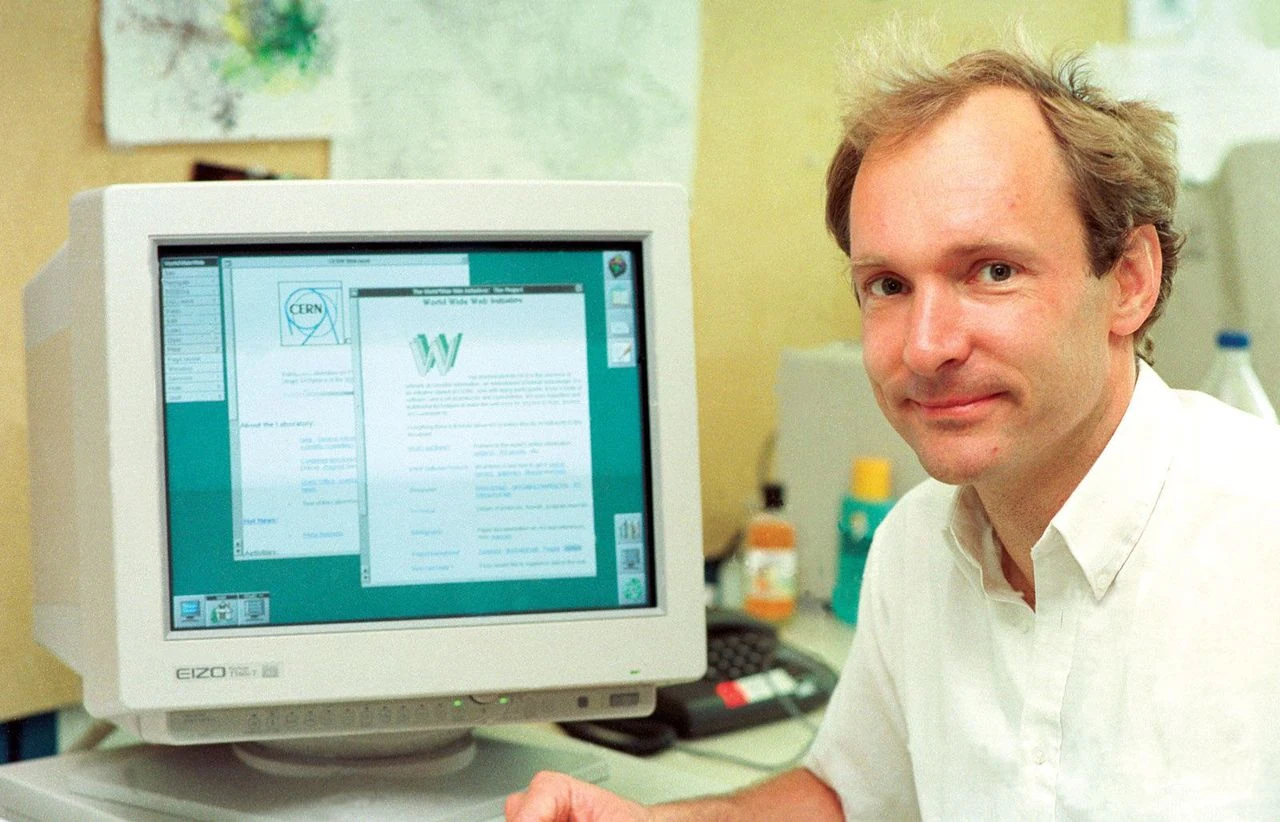
He also built the first web browser, called WorldWideWeb. It could both display and edit documents, making it more than a viewer. The first web server, CERN httpd, ran alongside it. In mid-November 1990, Berners-Lee implemented the first successful communication between an HTTP client and server over the internet. The first website, hosted on his NeXT computer at CERN, was published on 20 December. It explained what the web was and how others could use a browser, set up a server and create a site of their own.
On 6 August 1991, he posted a public invitation to collaborate with the WorldWideWeb project on Usenet. That step opened the work to a wider internet community. The dates distinguish the web’s development from a single launch moment: a proposal came first, then a working browser, server and site, followed by an invitation to others to participate. The internet’s underlying network already existed; Berners-Lee’s contribution was the web layer that made linked information easier to publish and navigate.
From a CERN project to a public resource
The web’s early development was collaborative as well as individual. Robert Cailliau had independently proposed a hypertext project at CERN and joined Berners-Lee in efforts to move the work forward. Berners-Lee devised and built the foundational system, but its adoption also depended on colleagues, institutional support and the participation of developers beyond the laboratory.
A defining institutional decision came in 1993, when CERN made the web’s core software freely available, without patent or royalty barriers. That choice helped make it possible for people and organisations to build browsers, servers and websites without seeking permission from a commercial owner. The web’s technical design mattered; so did the conditions under which others could use and extend it. Its openness allowed a research tool to become a platform for many kinds of publishing, communication and commerce.
In 1994 Berners-Lee founded the World Wide Web Consortium, or W3C, to guide the development of web standards. The consortium brought together organisations working on standards and recommendations. Common standards help a page made in one place remain usable elsewhere, across different browsers and systems. That work is less visible than a new application or device, but it is central to the web’s capacity to connect rather than divide information into incompatible territories.
Stewardship, recognition and a return to Oxford
Berners-Lee’s work continued across universities and institutions. He worked for many years at the Massachusetts Institute of Technology, where he held a senior research role and the 3Com founder’s chair in computer science. In 2004 he accepted a chair in computer science at the University of Southampton, working on the Semantic Web. In 2016 he joined Oxford’s Department of Computer Science as a professorial research fellow and became a fellow of Christ Church. His career thus moved between British education and research, CERN’s international scientific community and American universities.
His contribution received recognition from scientific, engineering and public institutions. He was elected a Fellow of the Royal Society in 2001 and knighted in 2004 for services to the global development of the internet. In 2007 he was appointed to the Order of Merit. He shared the inaugural Queen Elizabeth Prize for Engineering in 2013, and in 2017 received the 2016 ACM A.M. Turing Award for inventing the web, the first browser and the protocols and algorithms that enabled it to scale. Time magazine had included him among its 100 Most Important People of the 20th century.
These honours recognise different parts of the achievement: the invention itself, its engineering foundations and its consequences for computing. They do not mean the web was the work of one person alone. Rather, they mark Berners-Lee’s central role in designing its original system and helping create institutions through which its standards could continue to develop.
Open data and the question of control
Berners-Lee’s public work has continued to focus on access to information. With Nigel Shadbolt, he helped create data.gov.uk, a UK government open-data initiative. The project reflected a practical proposition: information made available in reusable forms can be found, compared and put to work by people outside the organisation that collected it. In 2012, the two also co-founded the Open Data Institute in London, which Berners-Lee led as president. These initiatives carried his interest in open systems into British public policy and civic life.
His later projects address a related but different concern: the amount of control individuals have over their personal information online. Solid is intended to separate applications from personal data stores, giving users greater choice over where their data is held and which applications may use it. Inrupt, an open-source start-up announced in 2018, was formed to support a commercial ecosystem around Solid. These remain projects aimed at changing how online services handle personal data, rather than proof that the problem has been solved.
Berners-Lee has also argued for net neutrality, maintaining that internet service providers should not control or monitor people’s browsing without their consent. In 2019 he and the World Wide Web Foundation launched Contract for the Web, asking governments, companies and citizens to commit to principles intended to prevent misuse of the web. His concerns have shifted from building an open system to considering what happens when powerful platforms, data collection and weak accountability limit the freedom that openness was meant to support.
At the opening ceremony of the London 2012 Olympic Games, Berners-Lee appeared at a NeXT computer and sent the message “This is for everyone”. It was a brief statement of the principle behind the web’s design and its public release. It also linked his work to a moment staged in Britain but addressed to a worldwide audience.
Why Tim Berners-Lee deserves a place in British Legacy
Tim Berners-Lee deserves a place in British Legacy because his achievement was both technically substantial and unusually generous in its consequences. He devised a way to connect information across computers and institutions, then built the first browser and server and the standards needed to make the system work. The web did not replace the internet; it made the internet’s resources easier to link, publish and explore. That distinction helps explain the scale of his contribution: he made networked information useful to people who did not need to understand the machinery beneath it.
The web’s reach cannot be credited to its inventor alone. CERN’s decision to make its core software freely available, the work of collaborators such as Robert Cailliau, and the later development of standards all mattered. Berners-Lee’s role was decisive in setting that open direction and in establishing the W3C to sustain interoperability. Those choices helped create a medium in which researchers, public bodies, businesses and individuals could publish and find material without first securing a proprietary platform’s permission. Openness was not an afterthought to the invention; it was part of the way the invention could serve the public.
His British connection is concrete. He was born in London, educated at Oxford and later returned to the university as a researcher. His parents’ work on the Ferranti Mark 1 links his family history to early computing, while his involvement in data.gov.uk and the Open Data Institute brought his commitment to accessible information into British institutions. His later work on privacy and data control also shows that he has not treated the web as a finished triumph. For British Legacy, his story is therefore not simply one of national pride. It is an account of a British computer scientist whose practical design changed how the world uses information, and whose continuing work asks how that resource can remain open and accountable.
Sources
Adapted in part from Tim Berners-Lee by Wikipedia contributors, under CC BY-SA 4.0. Text has been edited and combined with the existing article; this adapted text is shared under the same licence. Contributor history.

.jpg)