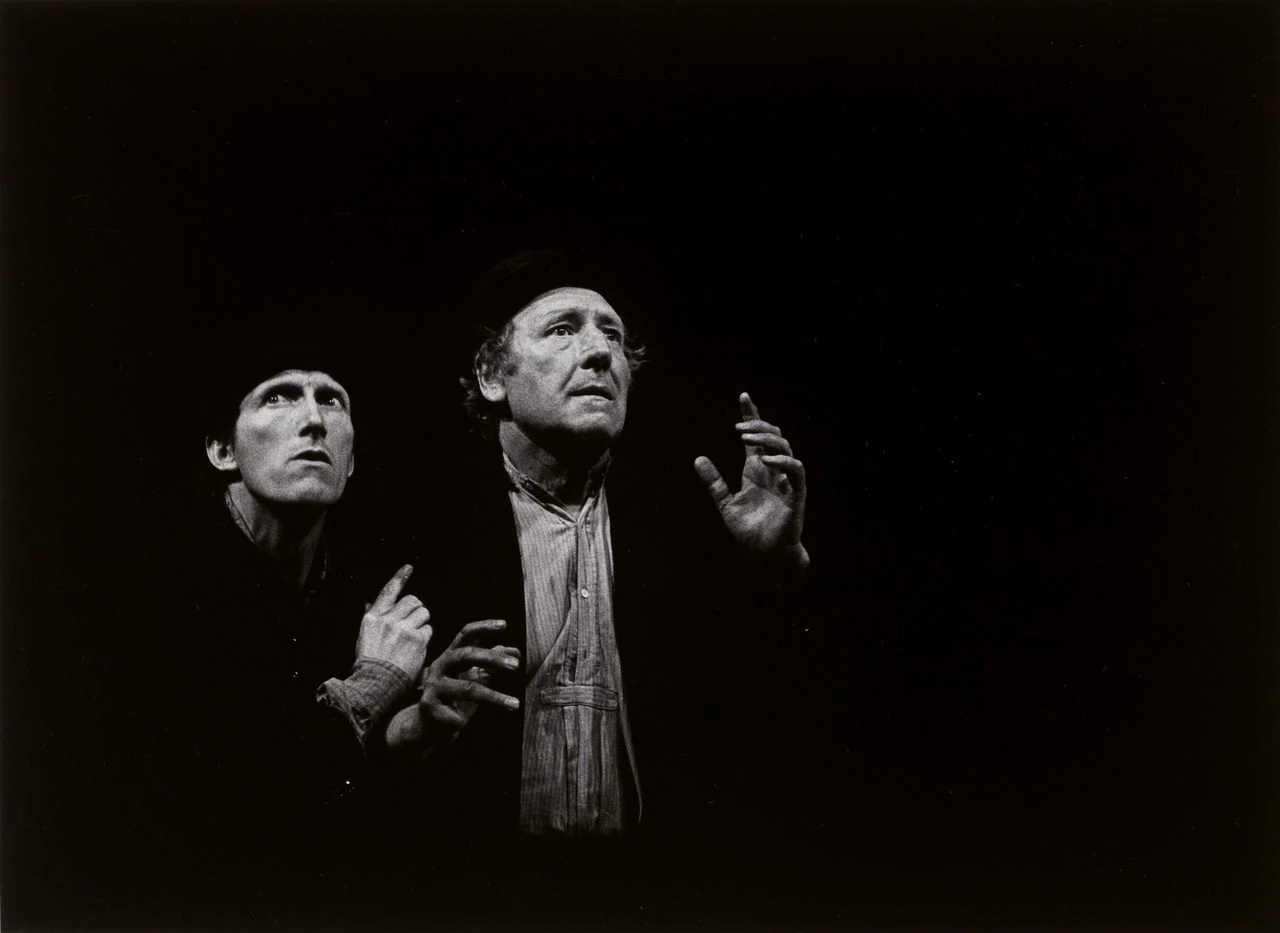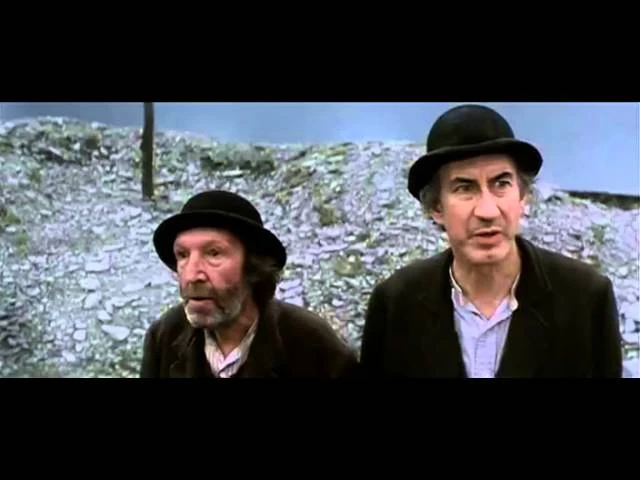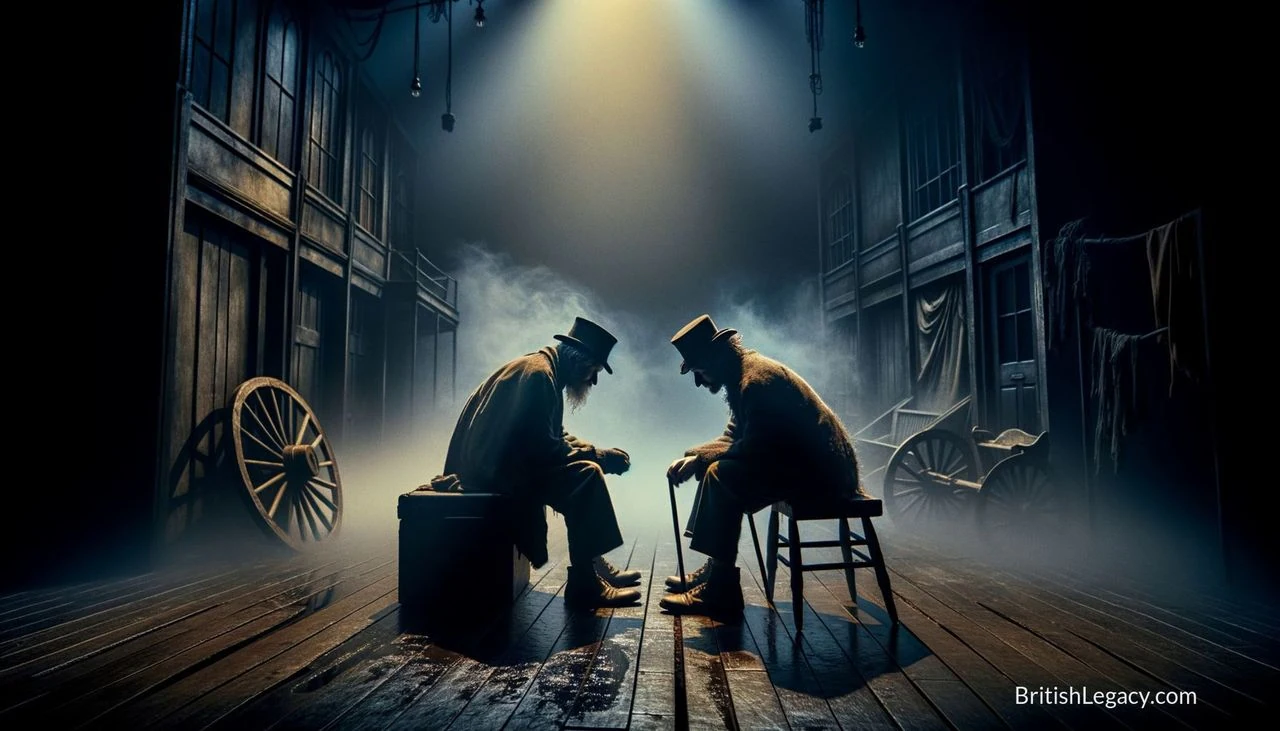
Two figures wait for someone who does not arrive. Around that simple situation, Samuel Beckett built Waiting for Godot, a two-act play of repeated conversations, uncertain purpose and time that seems to circle back on itself. Its first production was in Paris, in French; its English-language premiere followed at London’s Arts Theatre on 3 August 1955, directed by Peter Hall. That staging gave the play a lasting place in British theatrical life.
From Paris to London
Beckett, an Irish playwright born in Dublin in 1906, wrote Waiting for Godot in French as En attendant Godot. The play was first professionally produced at the Théâtre de Babylone in Paris, in a production directed by Roger Blin. London’s Arts Theatre hosted the English-language premiere on 3 August 1955, with Peter Hall directing. The two milestones matter: the play began on a French stage, then entered British theatrical life through Hall’s London production.
The play’s unconventional form did not immediately persuade every critic. Early reactions were mixed, and some critics were bewildered by its departure from familiar narrative expectations. It later gained acclaim for its innovative structure and thematic resonance. Its movement from uncertainty at first reception to subsequent recognition is part of the story of how the work came to occupy a prominent place in Britain.
Two men, one appointment
Vladimir and Estragon, two tramps, spend the play talking as they wait for the mysterious Godot. Over its two acts they encounter Pozzo and his servant Lucky, as well as a boy who brings messages from Godot. The action remains spare: dialogue repeats, and seemingly inconsequential activities interrupt the wait without resolving it.
That structure draws attention to expectation, time and the search for meaning or purpose. The play does not provide a single settled explanation of Godot or the characters’ situation. Instead, its ambiguity leaves room for different interpretations. The repeated conversations and the continuing wait make the form itself part of the experience: what happens on stage does not deliver the conventional progression towards a clear resolution.
A place in British theatre
Hall’s 1955 Arts Theatre production established an important English-language presence for the play in Britain. Its unusual form challenged expectations about dramatic storytelling, relying on repetition and minimal action rather than a steadily unfolding plot. The play became associated with modernist and avant-garde approaches to theatre, and its British reception formed part of a broader engagement with experimental drama.
Waiting for Godot is also performed and studied beyond its early London history. Its continuing presence in British and international theatrical and academic life gives the 1955 production a context beyond the premiere itself. The play’s reach is evident in its place in theatre, literature and philosophical discussion, although its significance need not depend on sweeping claims about a revolution in British drama or influence on unnamed artists.
Why Waiting for Godot deserves a place in British Legacy
Waiting for Godot deserves a place in British Legacy because its history records a specific and consequential meeting between an Irish writer’s play and the London stage. First professionally produced in French in Paris, it reached English-language audiences at the Arts Theatre on 3 August 1955 in a production directed by Peter Hall. This British connection is not a claim that the play originated in Britain; it lies in the London staging and the work’s subsequent place in British theatrical life.
The play also merits attention for what it brought to the stage: two characters waiting, conversations that return on themselves, and an ending that does not resolve the central expectation. Its form challenges an audience to consider time, purpose and uncertainty without dictating a single interpretation. The account of its reception—from mixed initial responses to later acclaim—and its continued performance and study show how an unconventional work can remain part of theatrical discussion. That combination of a clear London milestone and an enduring, open-ended dramatic structure makes its British legacy distinctive.