
Wayne McGregor’s choreography moves between the Royal Ballet and contemporary dance, but also through film, opera, fashion and digital art. His work often brings classical companies into contact with unfamiliar movement and collaborators from other disciplines. Pieces such as Chroma and Infra helped establish that approach at the Royal Ballet; his company and studio have since made space for wider experiments in dance, science and technology.
From Stockport to the London dance scene
McGregor was born in Stockport in 1970. He studied dance at Bretton Hall College, part of the University of Leeds, and in New York. In 1992, he became choreographer-in-residence at The Place in London and founded his own company, initially known as Random Dance. It later became Company Wayne McGregor, within the broader Studio Wayne McGregor.
The early combination of a London base and a touring company gave McGregor a platform for work beyond a single institution. In 2002, the company became the first resident company at the new Sadler’s Wells. McGregor’s work has since reached audiences through a range of formats: live performance, film, television, opera and collaborations with artists and designers. His interests in technology and science have informed this breadth, but the work remains grounded in making movement for performers and audiences.
His appointment in 2006 as resident choreographer of the Royal Ballet marked a significant meeting between contemporary choreography and a major classical institution. McGregor was the company’s first resident choreographer from a contemporary dance background. The role placed his movement language in a setting with a long ballet tradition, while his work for his own company continued alongside it.
Chroma, Infra and the Royal Ballet
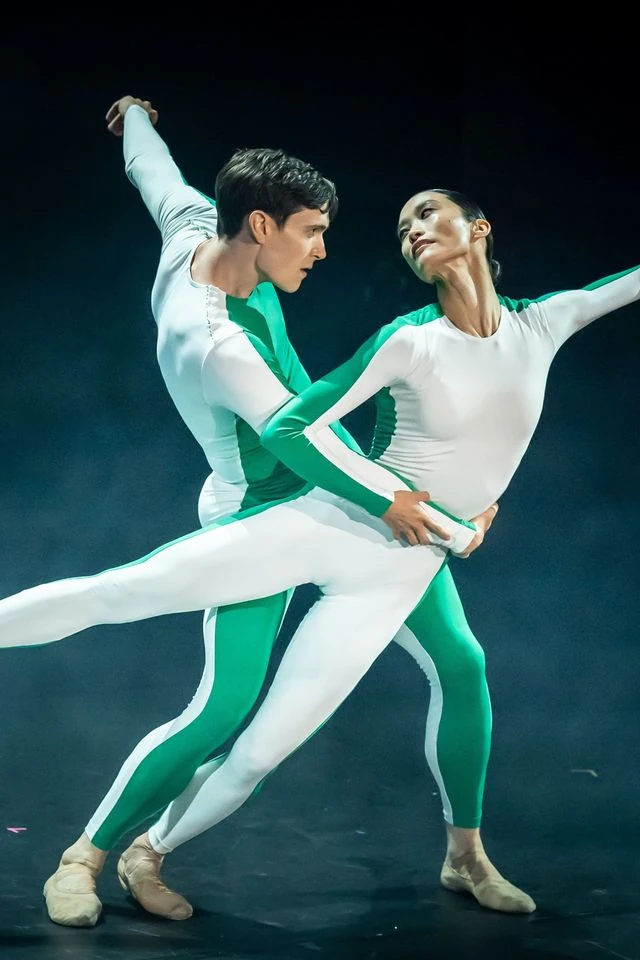
Chroma, created for the Royal Ballet in 2006, is among McGregor’s best-known works. Its score combines music by Joby Talbot with music by Jack White of The White Stripes. The work’s pared-back setting and physically demanding choreography put the dancers’ movement at the centre. It won the 2007 Olivier Award for Best New Dance Production, and McGregor’s choreography was also recognised that year by the Critics’ Circle.
Two years later, Infra brought together McGregor’s choreography, a score by Max Richter and visual design by Julian Opie. It was made for the Royal Ballet and has also entered the repertory of other companies, including the Mariinsky Ballet. The work is one example of McGregor’s continued interest in how movement can meet visual art and music without losing its force as dance. It won the 2009 Prix Benois de la Danse for choreography and the Critics’ Circle award for Best Classical Choreography.
His Royal Ballet work has continued well beyond those two pieces. Among later productions are Woolf Works, Yugen and The Dante Project. The range matters: McGregor has made work for a classical company over many years, not simply supplied a one-off challenge to its conventions. His choreographies have also been taken up internationally, including by the Paris Opera Ballet, New York City Ballet, Bolshoi Ballet and National Ballet of Canada.
A studio for movement, research and collaboration
Studio Wayne McGregor brings together his touring company, other creative work and programmes for learning, artist development and research. The studio’s scope includes dance, film, theatre, opera, fashion, television, science and technology. Its activities include projects with partners in those fields, as well as learning and engagement work in Britain and internationally. One large public project, Big Dance, brought mass participation to Trafalgar Square during the 2012 London Olympics; LightLens was made for Aarhus’s European Capital of Culture programme in 2017.
The studio’s permanent creative space opened at Here East on Queen Elizabeth Olympic Park in 2017. Designed by the architectural practice We Not I, it contains three dance studios and areas for meetings and collaboration. Its location on the former Olympic site gives the organisation a base for making and development in east London, while its facilities allow artists and collaborators to work together beyond the finished performance.
McGregor’s projects show how widely that collaborative practice can travel. He has worked with composers including Max Richter, Joby Talbot, Jlin and Jon Hopkins, and visual artists and designers including Julian Opie, Olafur Eliasson and Tacita Dean. He has directed opera and made choreography for theatre. In 2022, he choreographed ABBA Voyage, a concert built around virtual avatars of the group as they appeared in 1977.
His screen work includes choreography or movement direction for films such as Harry Potter and the Goblet of Fire, Fantastic Beasts and Where to Find Them, The Legend of Tarzan and Mary Queen of Scots. Music-video collaborations include Radiohead’s “Lotus Flower”, Atoms for Peace’s “Ingenue” and The Chemical Brothers’ “Wide Open”. These projects extend his practice into popular culture while drawing on the same central resource: choreographed movement.
Honours and a continuing career
McGregor was appointed a Commander of the Order of the British Empire in 2011 for services to dance. In 2021, the Prix de Lausanne gave him a lifetime achievement award. He was knighted in the 2024 King’s Birthday Honours, also for services to dance. These honours sit alongside awards for individual works, including the Olivier Award for Woolf Works in 2016 and the South Bank Sky Arts Award for The Dante Project in 2022.
His work also includes teaching and public engagement. McGregor is a professor of choreography at Trinity Laban Conservatoire of Music and Dance, and his studio runs learning programmes and supports artist development. The combination of making, teaching and research means his influence is not limited to the works performed by his own company or the Royal Ballet.
In 2021, McGregor was announced as director of dance for the Venice Biennale for the period to 2024. His career has therefore kept a British institutional base while building relationships with companies, artists and festivals elsewhere. International reach and British cultural life are not opposing parts of his story: his work has developed through both.
Why Wayne McGregor deserves a place in British Legacy
McGregor’s place in British Legacy rests first on the sustained effect of his work within British dance. His appointment as the Royal Ballet’s first resident choreographer from a contemporary dance background brought a distinct choreographic practice into one of the country’s defining ballet institutions. Chroma, Infra and later works including Woolf Works and The Dante Project show that this was not a brief experiment: McGregor has continued to make work for the company while retaining his own independent company and practice.
His contribution also lies in the infrastructure around performance. Studio Wayne McGregor provides space for artists to make work, supports learning and artist development, and connects dance with science, technology and other creative disciplines. Its base at Here East gives those ambitions a physical home in London, while projects such as Big Dance brought dance into public space. Work for film, music videos, opera and ABBA Voyage has carried choreography into forms encountered beyond the theatre. Taken together, these achievements show a British choreographer building links between institutions, audiences and fields of practice. They make his legacy more than a list of acclaimed productions: it includes new routes for dance to be made, shared and understood.
Sources
Wayne McGregor — revision 1376573012 · Wayne McGregor
Adapted in part from Wayne McGregor by Wikipedia contributors, under CC BY-SA 4.0. Text has been edited and combined with the existing article; this adapted text is shared under the same licence. Contributor history.
_(2545447164).jpg)