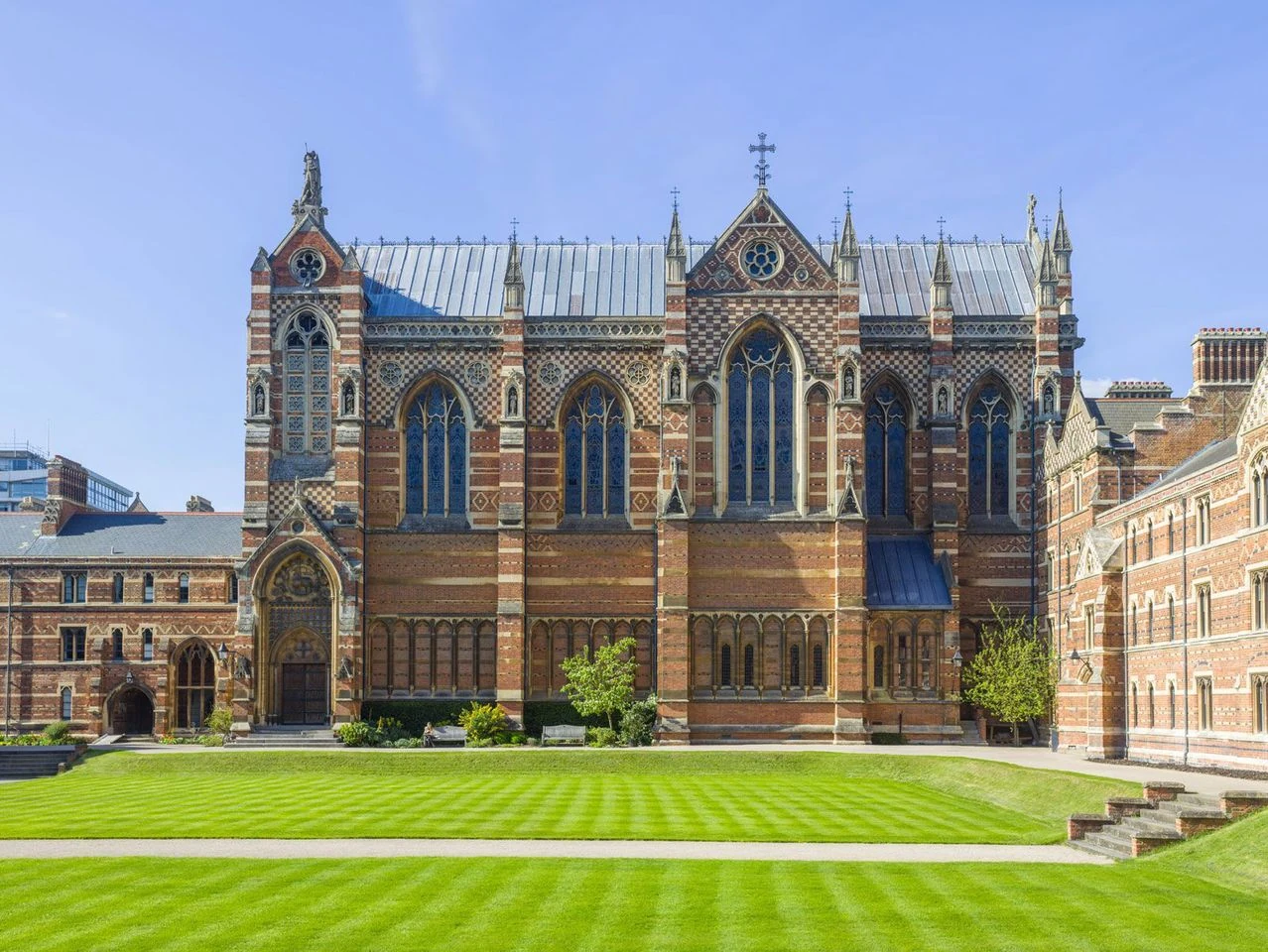
William Butterfield made Gothic Revival architecture unmistakably Victorian. His buildings drew on medieval forms but used colour, material and pattern with a force of their own: red and black brick at All Saints, Margaret Street, and boldly striped walls at Keble College, Oxford. A committed church architect who also designed schools and colleges, he helped give the Gothic Revival an individual language rather than simply reproduce the past.
From London apprentice to architect
Butterfield was born in London on 7 September 1814. His parents ran a chemist’s shop in the Strand and belonged to a strict nonconformist tradition. One of nine children, he attended a local school. At 16, he was apprenticed to the Pimlico builder Thomas Arber, whose business later went bankrupt. He then studied architecture under E. L. Blackburne from 1833 to 1836, and worked as an assistant to Worcester architect Harvey Eginton in 1838–39. Butterfield established his own practice at Lincoln’s Inn Fields in 1840.
This training gives a more specific account of his beginnings than the familiar story of an architect diverted from a family drapery business. His professional path ran through building and architectural offices, and his early work included both church projects and restoration. In 1842 he became involved with the Cambridge Camden Society, later known as the Ecclesiological Society, contributing designs to its journal, The Ecclesiologist. The society’s interest in medieval church architecture helped shape his approach.
Butterfield was also influenced by the Oxford Movement, or Tractarian Movement. Though raised by nonconformist parents, he became high church in his religious outlook. He reinterpreted Gothic architecture in Victorian terms, designing chiefly for religious use but also for educational institutions. His work was not an exercise in archaeological imitation: colour and material became active parts of the design.
All Saints, Margaret Street
All Saints, Margaret Street, London, was designed in 1850 for sponsors who wanted a model church. The complex included a clergy house and a school alongside the church. Its exterior was completed by 1853, and the building was consecrated in 1859. The distinction matters: 1859 marks the consecration, not the completion of all the external work.
Butterfield used red brick patterned with bands of black brick, bringing polychrome brickwork to a London setting where the material had long been out of use. Stone bands accent the spire. Inside, marble and tile marquetry make the decoration richer still. The church combines English details of the fourteenth century with a spire of German character; contemporaries also saw Italian qualities in its appearance.
In 1849, John Ruskin’s Seven Lamps of Architecture had urged architects to study Italian Gothic and use polychromy. That wider interest in colour provides a context for Butterfield’s work, but All Saints is notable for the particular way he joined different traditions and materials. The architectural historian Henry-Russell Hitchcock regarded it as the building that initiated the High Victorian Gothic era.
Oxford, schools and a wider practice
Butterfield’s other best-known commission, Keble College, Oxford, departed sharply from the university’s established architectural traditions. Its walls are striped with differently coloured bricks, making polychromy structural to the building’s appearance rather than a decorative afterthought. The main college buildings were largely constructed between 1868 and 1870. The chapel followed later, built between 1873 and 1876, so the college should not be described as a single project completed in 1870.
Keble was intended for clerical students. Its buildings were on a relatively domestic scale, while the later chapel was more monumental. Butterfield’s use of emphatic colour was even more pronounced in his buildings for Rugby School in 1868–72. Together, these commissions show how he carried his architectural ideas beyond parish churches, adapting them to college and school settings.
His practice extended across Britain and beyond. Among its major projects were St Ninian’s Cathedral in Perth, St Paul’s Cathedral in Melbourne, and St Peter’s Cathedral in Adelaide. The Melbourne cathedral was built from 1880 to 1891, except for its main tower and spire. The Adelaide project began in 1869 and continued after Butterfield’s death. His other work included churches, schools and restorations, a breadth that makes the two celebrated London and Oxford buildings only part of his output.
Recognition and final years
Butterfield received the Royal Institute of British Architects’ Gold Medal in 1884. He died in London on 23 February 1900 and was buried in Tottenham Cemetery, Haringey, in a simple Gothic tomb of his own design. His London home in Bedford Square is marked by a blue plaque.
The design of his own grave offers a quiet point of connection between his professional work and his memory: Gothic form was not only something he specified for churches and institutions, but also the language he chose for his final resting place. His buildings remain the more public record of a career that ranged from distinctive urban churches to educational commissions and cathedrals overseas.
Why William Butterfield deserves a place in British Legacy
Butterfield deserves a place in British Legacy because he made the Gothic Revival more than a return to medieval outlines. At All Saints, Margaret Street, he brought red and black brick, stone, marble and tile into a closely considered whole. At Keble College, he used coloured brick to challenge Oxford’s established architectural character, then gave the college a more monumental focus in its later chapel. These buildings make his approach legible: historical forms could be reinterpreted through contemporary materials and a confident use of colour.
His significance also lies in the range of settings in which he worked. Churches formed the centre of his practice, but schools and colleges were important commissions, and his work extended to cathedrals in Scotland, Australia and elsewhere. That reach connects a London-born architect with places across Britain and with institutions overseas, without diminishing the specificity of his local buildings. Butterfield received the RIBA Gold Medal in 1884, and his grave, designed by himself in a Gothic style, remains in Tottenham Cemetery. The buildings and the recognition together preserve a substantial architectural legacy: one grounded in British Victorian institutions, yet distinctive enough to travel beyond them.
Sources
William Butterfield — Wikipedia, revision 1355063738
Adapted in part from William Butterfield by Wikipedia contributors, under CC BY-SA 4.0. Text has been edited and combined with the existing article; this adapted text is shared under the same licence. Contributor history.