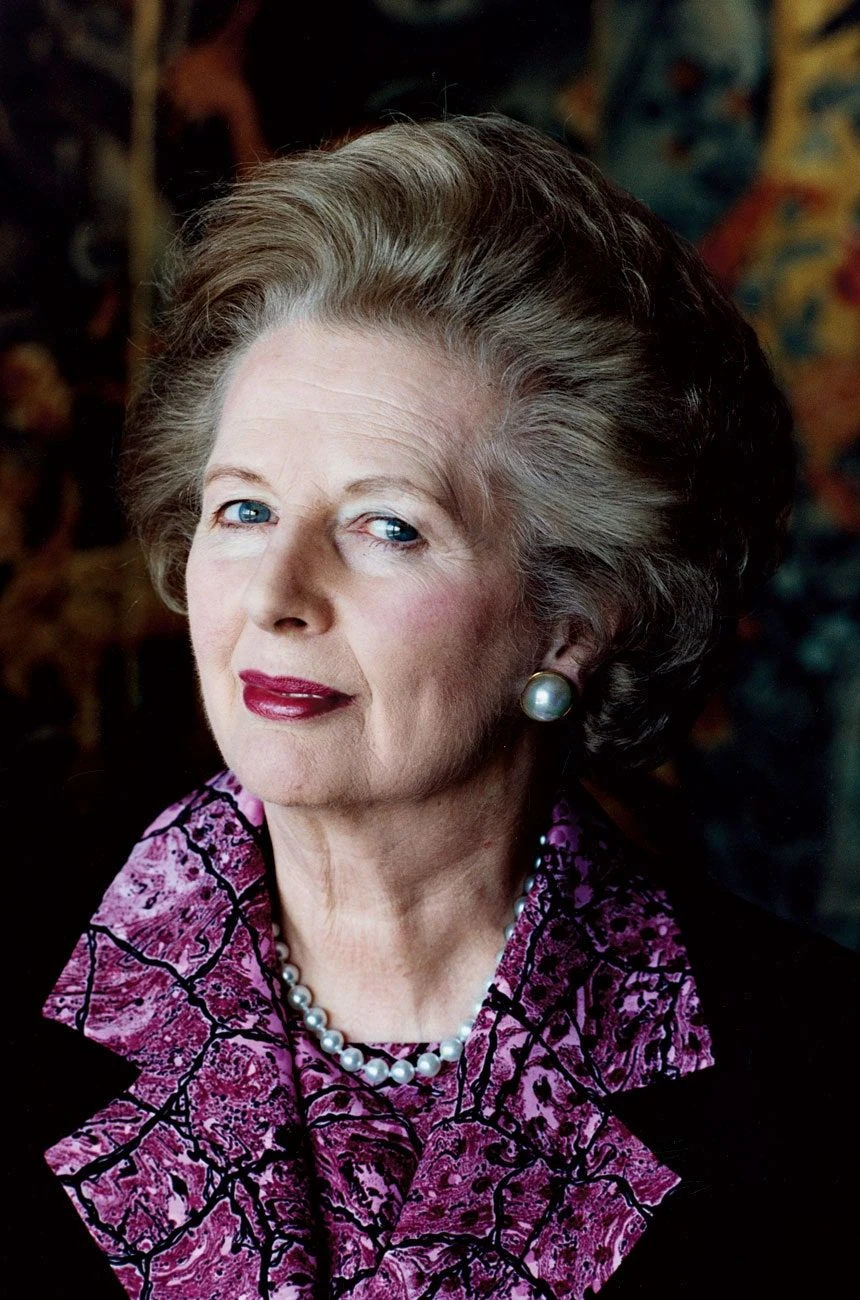
Margaret Thatcher’s premiership changed the argument about what government in Britain should do. She brought state industries into private ownership, confronted trade unions and recast the Conservative Party around a more market-oriented politics. Supporters saw renewal; critics saw social division and lasting damage to industrial communities. Both the scale of change and the continuing disagreement about its costs belong to her story.
Grantham, Oxford and the road into politics
Margaret Hilda Roberts was born in Grantham, Lincolnshire, on 13 October 1925. Her father, Alfred Roberts, ran a grocery and tobacconist’s shop, served as a local alderman and was a Methodist local preacher. She won a scholarship to Kesteven and Grantham Girls’ School and went on to study chemistry at Somerville College, Oxford, graduating in 1947. After university she worked as a research chemist before training as a barrister, specialising in taxation.
Her first attempts at elected office came in Dartford, where she stood unsuccessfully for the Conservatives in the 1950 and 1951 general elections. She married Denis Thatcher in 1951; their twins, Carol and Mark, were born in 1953. In 1959 she was elected MP for Finchley, a seat she represented for more than three decades. In her maiden speech she backed a bill requiring local authorities to hold council meetings in public. It became law in 1960.
Thatcher entered government as Secretary of State for Education and Science in Edward Heath’s administration from 1970 to 1974. Her tenure brought cuts to education spending and the abolition of free milk for most schoolchildren aged seven to eleven. The decision provoked fierce criticism and the nickname “Margaret Thatcher, Milk Snatcher”. She later said she had learnt from the episode how political resentment could be incurred for little political benefit.
After the Conservatives lost power in 1974, Thatcher challenged Heath for the party leadership. She defeated him in 1975 and became the first woman to lead a major British political party. As Leader of the Opposition, she argued for reduced government intervention and presented an alternative to the economic policies associated with the post-war settlement. The strikes and political instability of the Winter of Discontent helped set the scene for the 1979 election, which brought her to Downing Street.
Changing the economic settlement
Thatcher became prime minister on 4 May 1979. Her governments sought to curb inflation and reshape the relationship between the state, business and organised labour. The early years were marked by recession and rising unemployment; the results of the economic programme were disputed even as it became a defining feature of her leadership.
Privatisation was central to that programme. Her governments sold state-owned companies, including British Telecom, British Gas and British Airways, to private owners. The sale of public assets broadened share ownership, while the transfer of essential services raised questions about competition, regulation and the public interest. Some industries performed better after privatisation, but the results were mixed: private ownership did not automatically create competition, and regulators were established to oversee sectors no longer under direct government control.
The 1986 “Big Bang” deregulated London’s financial markets, part of a wider effort to loosen restrictions on capital and business. London’s financial sector grew in importance, but the broader economic record was not a simple story of uninterrupted recovery. Inflation fell from its early-1980s high, and growth strengthened; unemployment, however, passed three million and remained high for much of the decade. Manufacturing employment declined, and the long-term effects of the changes on industry remain contested.
Thatcher also pursued legislation to limit trade-union power. The confrontation became most visible in the miners’ strike of 1984–85, after the National Coal Board proposed pit closures and job cuts. The National Union of Mineworkers called a strike without a national ballot, and the dispute lasted for a year. The union eventually returned to work without securing a deal. The government’s victory weakened the unions’ influence, while the closures and loss of jobs had severe consequences for mining communities. The conflict remains among the most divisive episodes of her premiership.
War, alliances and Britain’s place abroad
The Argentine invasion of the Falkland Islands in April 1982 brought a military crisis that came to define Thatcher’s leadership overseas. She established a small war cabinet and authorised a naval task force to retake the islands. Argentina surrendered in June. The victory strengthened her position at home, although her government had also faced criticism over the islands’ defence before the invasion and over the conduct of the campaign.
Thatcher’s foreign policy combined close ties with the United States and support for NATO’s nuclear deterrent. Her partnership with President Ronald Reagan became a prominent feature of the later Cold War. She also engaged with Soviet leader Mikhail Gorbachev, saying in 1988 that the two sides were in a “new relationship” rather than a Cold War. The nickname “Iron Lady” had first been applied to her by a Soviet newspaper after a speech criticising the Soviet Union; she adopted it in public, and it became inseparable from her political image.
Foreign policy did not bring only successes or easy alliances. Thatcher’s government negotiated the 1984 Sino-British Joint Declaration on Hong Kong, agreeing that sovereignty would pass to China in 1997. In Northern Ireland, she refused to restore political status to republican prisoners during the hunger strikes of 1980 and 1981. In 1984 she narrowly escaped injury in the Provisional IRA bombing of the Conservative Party conference hotel in Brighton; five people were killed. In 1985 she signed the Anglo-Irish Agreement, giving the Irish government an advisory role in Northern Ireland’s governance. The agreement provoked strong opposition from unionists.
Unpopularity, resignation and later years
Thatcher won three successive general elections, but her political authority weakened during her third term. Her government’s Community Charge, commonly called the poll tax, replaced domestic rates with a flat charge on each adult resident. It provoked widespread opposition and a major demonstration in London in March 1990 that ended in riots. Her increasingly sceptical position on European integration also created divisions within her cabinet and party.
In November 1990, Michael Heseltine challenged her for the Conservative leadership. Thatcher led the first ballot but did not win by the margin required to avoid a second. After consulting her cabinet, she withdrew. She resigned as prime minister and Conservative leader on 28 November and was succeeded by John Major. The poll tax was abolished by Major’s government in 1991.
Thatcher left the House of Commons in 1992 and entered the House of Lords as Baroness Thatcher. She published two volumes of memoirs, The Downing Street Years and The Path to Power, and continued to comment on politics and international affairs. After a series of small strokes, she stopped public speaking in 2002 on medical advice. She died in London on 8 April 2013, aged 87, after a stroke. Her funeral at St Paul’s Cathedral was attended by Queen Elizabeth II and the Duke of Edinburgh. Reactions to her death reflected the divisions that had marked her public life.
Why Margaret Thatcher deserves a place in British Legacy
Margaret Thatcher belongs in British Legacy because her premiership altered the country’s political and economic direction on a scale few leaders achieve. Her governments privatised major state-owned industries, deregulated financial markets and restricted trade-union powers. Those decisions changed ownership, employment and the balance between government and markets; later governments, including Labour administrations, operated in a political landscape she had helped remake. Her three successive election victories also made her the first woman to lead a British government and demonstrated a route to power through a political party long led by men.
That place in the story is not an endorsement of every policy or outcome. The miners’ strike and the closure of pits left communities facing profound economic disruption; unemployment remained high for much of her time in office, and the poll tax became a source of mass protest. These are essential parts of the legacy, not footnotes to it. Her handling of the Falklands crisis, her relationship with the United States and her dealings with Gorbachev also show how her leadership shaped Britain’s international role during a period of conflict and change. Remembering Thatcher means examining both the reach of her reforms and the human and political disputes they produced. Her career remains a vivid case study in how a prime minister can change the country—and leave later generations arguing over what that change was worth.
Sources
Margaret Thatcher — Wikipedia revision · Margaret Thatcher — Wikipedia
Adapted in part from Margaret Thatcher by Wikipedia contributors, under CC BY-SA 4.0. Text has been edited and combined with the existing article; this adapted text is shared under the same licence. Contributor history.