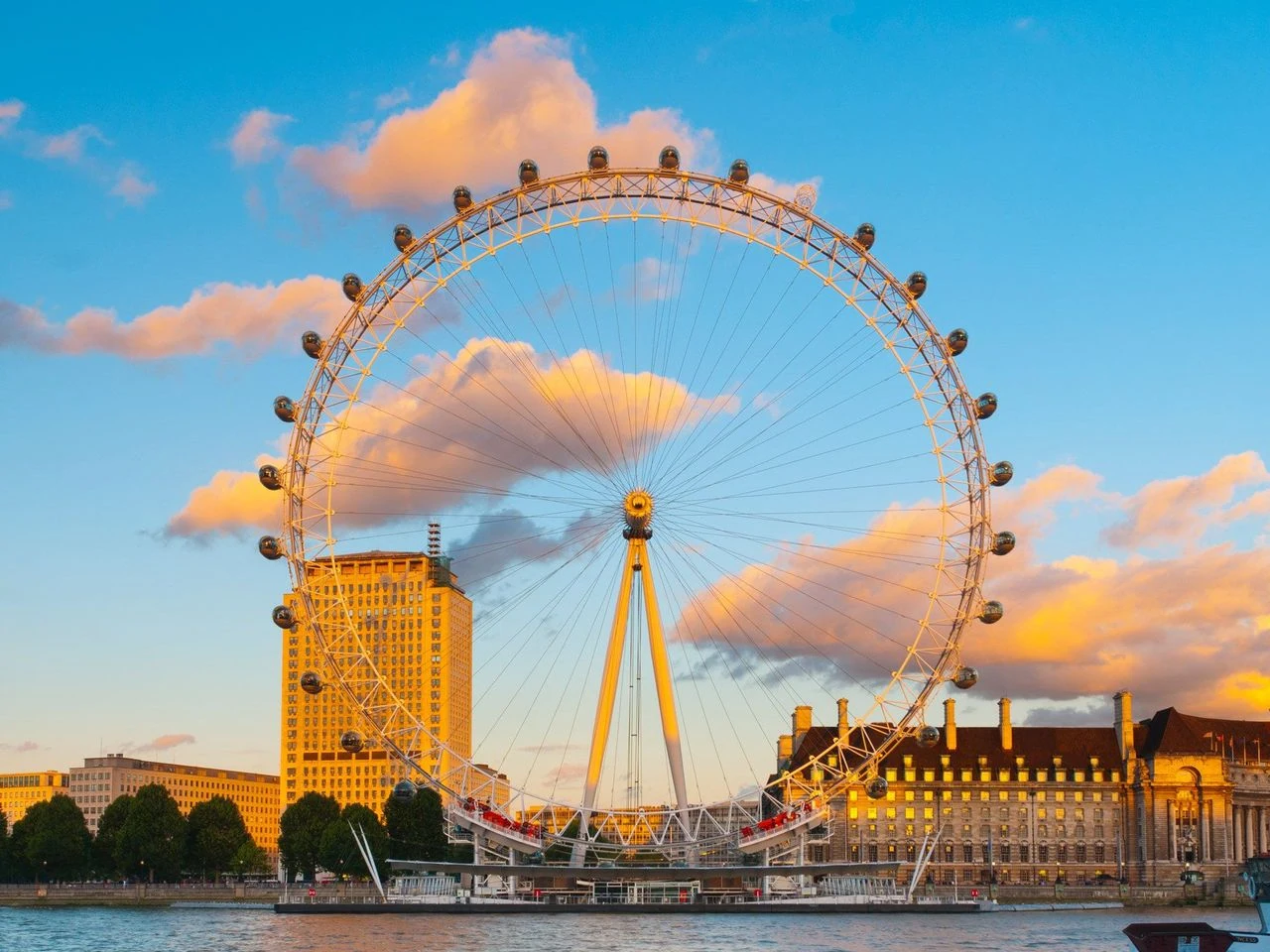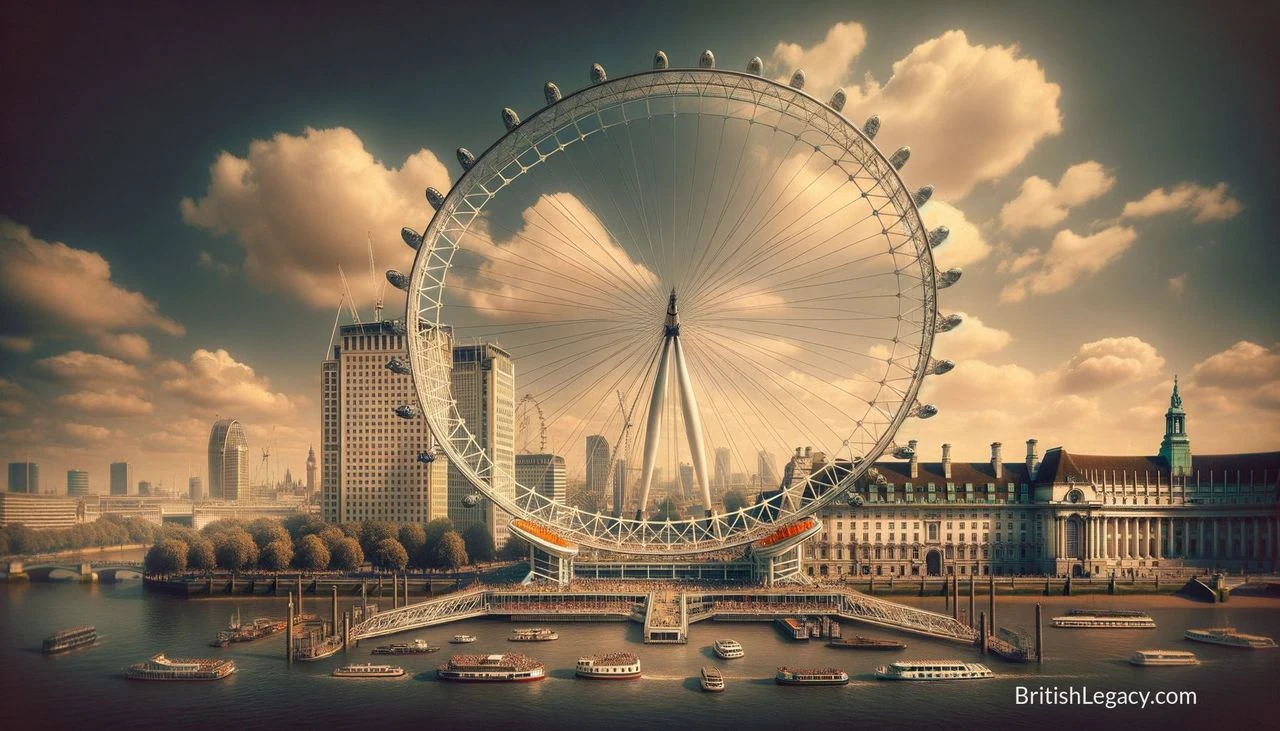
From the South Bank, the London Eye offers more than a striking addition to the skyline. Its great wheel carries visitors above the Thames, giving them time to see the capital as a panorama: landmarks old and new coming into view as the capsule moves around the circle. Conceived for the turn of the millennium, it has become a familiar part of modern London.
A millennium vision on the South Bank
Architects David Marks and Julia Barfield conceived the Eye as a landmark for the turn of the millennium. Its location on the South Bank places it beside the Thames and within a part of London associated with cultural and social activity. The idea was direct: raise visitors above street level and give them a fresh perspective on the capital.
The wheel was completed in March 2000 and stands 135 metres (443 feet) high. Its outline recalls a vast bicycle wheel, with a rim and central spindle joined by tensioned steel cables. Rather than concealing its structure, the design makes the wheel’s form part of its presence in the city. The Eye was once described as the world’s tallest Ferris wheel; that distinction has since passed to taller wheels elsewhere.
Half an hour above the city
Visitors travel in one of 32 capsules, each serving as a viewing platform. The capsules are described as climate-controlled and designed to provide an unobstructed view. A complete rotation takes about 30 minutes, allowing the city to unfold gradually rather than appear as a single framed scene.
From the wheel, the panorama brings together different periods of London’s development. Buckingham Palace and The Shard are among the landmarks identified in views from the Eye. The Thames runs through the wider cityscape, linking the river setting of the attraction with the streets, buildings and familiar silhouettes spread out beyond it. The ride combines the practical experience of a moving viewing platform with the opportunity to look across London from an unusual height.
A public image of modern London
The London Eye has appeared in films and television and is associated with public celebrations, including New Year’s Eve fireworks. Those appearances extend its presence beyond visitors who take a ride: the wheel has become a recurring image of the capital, set beside one of its defining waterways.
It is also a visitor attraction that contributes to tourism and local employment. The scale of those effects is not established here, so the Eye’s significance is clearest in what can be seen and experienced directly: a distinctive landmark on the South Bank, a conspicuous piece of design, and a way for visitors to take in the breadth of London from above.
Why the London Eye deserves a place in British Legacy
The London Eye deserves a place in British Legacy for the way it turns a simple public idea into a lasting piece of the capital’s built environment. Conceived by David Marks and Julia Barfield for the millennium, it gives visitors a broad view of London from a 135-metre wheel whose cables, rim and spindle are visible parts of its design. Its 32 capsules and half-hour rotation make that design accessible as an experience, not merely an object to look at from the riverbank.
Its contribution is specific: the Eye offers a distinctive vantage point on the city, has become a familiar feature of the modern London skyline, and appears in public life through media and New Year’s Eve celebrations. It connects engineering and architecture with a shared visitor experience, allowing people to see the capital’s landmarks and changing cityscape in one slowly unfolding panorama. That combination of design, public access and a strong place in London’s contemporary identity gives the Eye a meaningful place in Britain’s modern heritage.