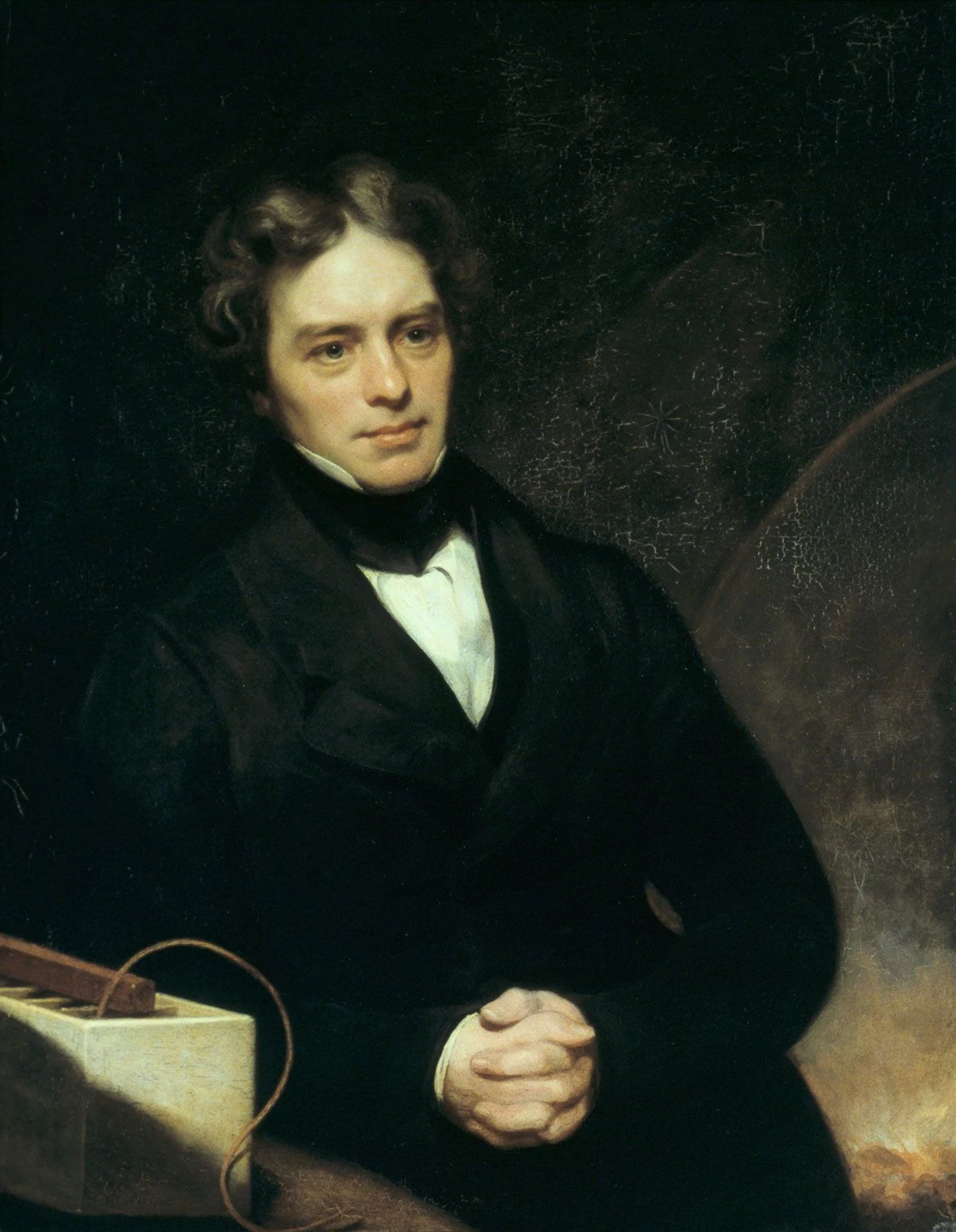
Michael Faraday began his working life in a bookbinder’s shop, with little formal schooling and no university education. He became one of the nineteenth century’s most consequential experimental scientists. His investigations established the principle of electromagnetic induction, clarified the relationship between electricity and chemical change, and gave later physicists a new way to think about forces acting through space. Faraday did not build the electrical systems that followed. He discovered and demonstrated principles that engineers and scientists could develop into them.
A bookbinder’s apprentice in London
Faraday was born on 22 September 1791 at Newington Butts, then in Surrey and now part of the London Borough of Southwark. His family was not well off. His father, James, was a blacksmith and a member of the Glasite Christian sect; his mother was Margaret, née Hastwell. Faraday received only basic schooling and had to educate himself. At 14 he was apprenticed to George Riebau, a bookbinder and bookseller in Blandford Street, London.
The shop gave him a living, but also access to books. During his seven-year apprenticeship he read widely, including Isaac Watts’s The Improvement of the Mind and Jane Marcet’s Conversations on Chemistry. The latter helped kindle an interest in scientific questions that he pursued beyond the shop. He joined the City Philosophical Society, attended lectures and discussed scientific subjects with other members. Faraday’s education was not comprehensive: his mathematical ability remained limited. His strengths lay in patient observation, practical experiment and an unusually visual way of thinking about physical processes.
In 1812, aged 20, Faraday attended lectures by the chemist Humphry Davy at the Royal Institution and by John Tatum at the City Philosophical Society. He took detailed notes at Davy’s lectures, assembled them into a substantial volume and sent it to the lecturer. In March 1813, after a vacancy arose at the Royal Institution, Davy appointed him Chemical Assistant. The appointment brought Faraday into a working scientific environment, where he could learn through handling materials and apparatus as well as through reading.
Faraday’s relationship with the Royal Institution endured for the rest of his working life. He became Director of its Laboratory in 1825 and, in 1833, its first Fullerian Professor of Chemistry, a lifetime position. His progress was remarkable, but it was not simply a story of individual effort: the institution gave him space, equipment and a scientific community in which to develop his abilities. In 1824 he was elected a Fellow of the Royal Society.
Experiments that set electricity in motion
Faraday’s first major investigations were in chemistry, but he turned to the emerging relationship between electricity and magnetism. In 1821, following Hans Christian Ørsted’s discovery that an electric current could affect a magnetic needle, Faraday built devices that produced continuous electromagnetic rotation. In one demonstration a wire carrying current moved around a magnet. This was not a modern industrial motor; it was an experimental demonstration that electrical action could produce continuing motion. The principle became a foundation for motor technology.
The work was accompanied by a dispute over credit. Faraday published his results without acknowledging the contributions of Davy and William Hyde Wollaston, who had also considered the problem. The controversy strained his relationship with Davy and was followed by a period in which Faraday was assigned other work, delaying his further investigations of electromagnetism. The episode complicates any tidy account of scientific progress: discoveries depended on experiments, but also on collaboration, recognition and the rules of scientific institutions.
Faraday returned to the subject in 1831 with a series of experiments that established electromagnetic induction. He wound two insulated coils of wire around an iron ring. When he passed a current through one coil, a momentary current appeared in the other. He also found that moving a magnet through a loop of wire produced a current in the wire; moving the loop over a stationary magnet did so as well. The central result was that a changing magnetic field could generate an electric current.
Faraday’s experiments revealed the principle behind electrical generators and transformers. He used the principles he had discovered to construct early dynamo-like apparatus, demonstrating how motion could be converted into electrical power. These were not the finished machines or power networks that came later. Their significance was that they made a previously unknown physical relationship visible and reproducible. Engineers could build on that knowledge, while James Clerk Maxwell later expressed Faraday’s experimental insights in mathematical form as part of the theory of electromagnetism.
The induction experiments also show Faraday’s characteristic method. He varied the arrangement of coils, magnets and circuits, watched for brief effects and recorded what happened. A current appeared only when the magnetic conditions changed. That distinction helped turn a puzzling observation into a dependable principle. The practical reach of induction would grow over time, but its starting point was a carefully constructed experiment at the Royal Institution.
Chemistry, electrolysis and new terminology
Faraday’s standing as a physicist can obscure the range of his chemical work. He discovered benzene in 1825, which he called bicarburet of hydrogen, studied chlorine compounds and liquefied several gases. He investigated alloys of steel and produced types of glass intended for optical use. One specimen of heavy glass later proved particularly useful in experiments connecting magnetism with light.
His work on electrolysis linked chemical change to the quantity of electricity involved. In the early 1830s, Faraday formulated laws relating the amount of material changed at an electrode to the amount of electric charge passed through an electrolyte. The laws gave researchers a quantitative way to study processes that had previously been difficult to describe consistently. They helped establish electrochemistry as a field in which electrical and chemical effects could be investigated together.
Faraday also helped provide that field with its working vocabulary. Terms including anode, cathode, electrode and ion became established through the electrochemical work of Faraday and his circle; several were proposed by William Whewell. The words made it easier to name parts of an experiment and distinguish the processes taking place within it. Faraday’s contribution was not solely the formulation of laws: clear language helped make scientific results communicable and reusable.
His chemical investigations extended to gases and optical materials. Work on liquefying gases supported the understanding that gases could be treated as vapours of liquids with very low boiling points. His researches into glass created material with properties that could be tested in a magnetic field. He also devised an early form of a laboratory burner later associated with the Bunsen burner. Across these different topics, Faraday relied on experiment to identify properties that could not be inferred from appearance alone.
Fields, light and electrical shielding
Faraday’s idea of lines of force gave scientists a new way to describe what happened around magnets, charged bodies and wires carrying current. Rather than treating forces as unexplained influences that acted across empty space, he regarded the region around an object as physically significant. His account was not expressed in the mathematics later used by Maxwell, and some contemporaries regarded it as insufficiently mathematical. Yet it supplied a powerful conceptual picture: forces operated through a structured field in the space around their sources.
That way of thinking grew from Faraday’s experimental practice. He looked for patterns in the space around magnets and current-carrying conductors, and sought arrangements that made the patterns observable. Maxwell later developed the mathematical treatment of electromagnetism and recognised the fertility of Faraday’s approach. The relationship between them illustrates two different but connected contributions: Faraday’s experimentally grounded conception and Maxwell’s formal mathematical account.
In 1845 Faraday discovered diamagnetism, the weak repulsion of some materials by a magnetic field. That same year, using a specimen of heavy glass, he showed that a magnetic field could rotate the plane of polarised light travelling through a material. This became known as the Faraday effect. The results suggested that light, matter and magnetism were not wholly separate subjects. Faraday had produced experimental evidence of a connection; Maxwell would later place such relationships within a broader mathematical theory.
Faraday also examined static electricity. His ice-pail experiment showed that charge on a charged conductor resided on its exterior and that the interior could be shielded from external electrical effects. In 1836 he demonstrated the effect with an electrified enclosure supported on glass: he entered it and showed that the electrical charge outside did not affect him within. The principle is now associated with the Faraday cage. It remains a clear example of how an experiment can establish a general rule by making an invisible effect testable.
Scientific work beyond the laboratory
Faraday devoted substantial time to work with practical consequences for Britain. He advised Trinity House on lighthouse technology and worked on protecting ships from corrosion. His investigations included industrial pollution at Swansea and air pollution at the Royal Mint. In July 1855 he wrote to The Times about the foul condition of the River Thames. These were not detached interests: they brought scientific observation to questions affecting navigation, industry and life in London.
In 1846 Faraday and the geologist Charles Lyell investigated an explosion at Haswell Colliery in County Durham that killed 95 miners. Their report concluded that coal dust had contributed to the severity of the blast and demonstrated how ventilation could help prevent such danger. The findings connected close observation of an industrial disaster with the protection of working people. They also showed the limits of scientific advice: the report did not lead coal owners to address the risk for many decades.
Faraday’s public work extended to the Great Exhibition of 1851, where he helped plan and judge exhibits, and to the National Gallery, which he advised on cleaning and protecting its collection. He gave evidence to a Public Schools Commission about education in Britain. When asked by the government to advise on chemical weapons for use in the Crimean War, he refused on ethical grounds. Scientific knowledge could serve public needs, but Faraday did not regard every possible application as acceptable.
Lectures for a wider audience
Faraday was also a leading public interpreter of science. He founded the Royal Institution’s Friday Evening Discourses in 1825, giving researchers a forum to present work to members. He became the central figure in the Institution’s Christmas Lecture series for young people and the general public. Between 1827 and 1860 he delivered 19 series. His talks used demonstrations to invite audiences to follow a line of reasoning, not simply to watch an entertaining effect.
The Chemical History of a Candle is among his best-known lecture series. Faraday used the familiar flame as a way into chemistry and physical explanation, showing how ordinary observation could lead to further questions. His approach respected the intelligence of young and non-specialist audiences. The Royal Institution’s continuing Christmas Lectures and the Royal Society’s Michael Faraday Prize for excellence in science communication both keep aspects of this public-facing tradition in view.
Faraday had begun practising his lectures before he became a celebrated speaker. From 1816 to 1818 he delivered chemistry lectures for the City Philosophical Society, the only lectures he gave outside the Royal Institution. He also wrote to his friend Benjamin Abbott about the craft of lecturing, emphasising the need to sustain an audience’s attention. His public work therefore involved preparation and technique as well as scientific knowledge: a demonstration had to be arranged so that people could see what it showed and understand why it mattered.
Belief, recognition and later life
Faraday married Sarah Barnard on 12 June 1821; they had no children. He was a devout Sandemanian Christian and served as a deacon and elder in his church. In 1832 the University of Oxford awarded him an honorary degree. He declined a knighthood, saying that he preferred to remain “plain Mr Faraday”, and twice refused the presidency of the Royal Society. His choices kept public distinction separate from the work he considered important.
Faraday suffered a nervous breakdown in 1839 and later returned to electromagnetic research. In 1848, through representations by the Prince Consort, he was granted a house at Hampton Court, free of expenses and upkeep. He retired there in 1858 and died at the house on 25 August 1867, aged 75. He had declined an offer of burial in Westminster Abbey; he was interred in the non-Anglican section of Highgate Cemetery. A memorial plaque was later placed in the Abbey near Isaac Newton’s tomb.
His name remains attached to scientific units and institutions. The farad, the SI unit of capacitance, commemorates him. In London, a statue stands at Savoy Place and the Faraday Memorial is near his birthplace at Newington Butts. These reminders sit alongside the less visible inheritance of his experimental principles: his influence is present not as a claim that he built every later device, but in the scientific foundations from which many technologies developed.
Why Michael Faraday deserves a place in British Legacy
Faraday merits a place in British Legacy because his discoveries altered what scientists could understand and what engineers could later make. His 1831 experiments established electromagnetic induction, the principle behind generators and transformers; his earlier demonstrations of electromagnetic rotation helped lay the foundation for motor technology. His laws of electrolysis connected electrical charge with measurable chemical change. His lines of force offered a new account of how physical influences could operate through space. These were not ready-made industrial systems, and describing them accurately makes his achievement no smaller. Faraday revealed relationships that others could test, express mathematically and develop into practical technologies.
The British connection is equally specific. Faraday was born in London and spent his scientific career at the Royal Institution, advancing from assistant to laboratory director and Fullerian Professor. There he conducted research and created opportunities for others to encounter science through the Friday Evening Discourses and Christmas Lectures. Beyond that institution, he applied scientific expertise to lighthouses, ships, pollution and mine safety. His work moved between laboratory, public body and audience, linking discovery with practical questions and public understanding. That combination matters to Britain’s scientific history: Faraday helped make electricity intelligible and useful, while showing how experimental knowledge could be communicated and brought to bear on civic needs. His legacy is both a body of foundational science and a durable example of science serving a wider public.
Sources
Adapted in part from Michael Faraday by Wikipedia contributors, under CC BY-SA 4.0. Text has been edited and combined with the existing article; this adapted text is shared under the same licence. Contributor history.