
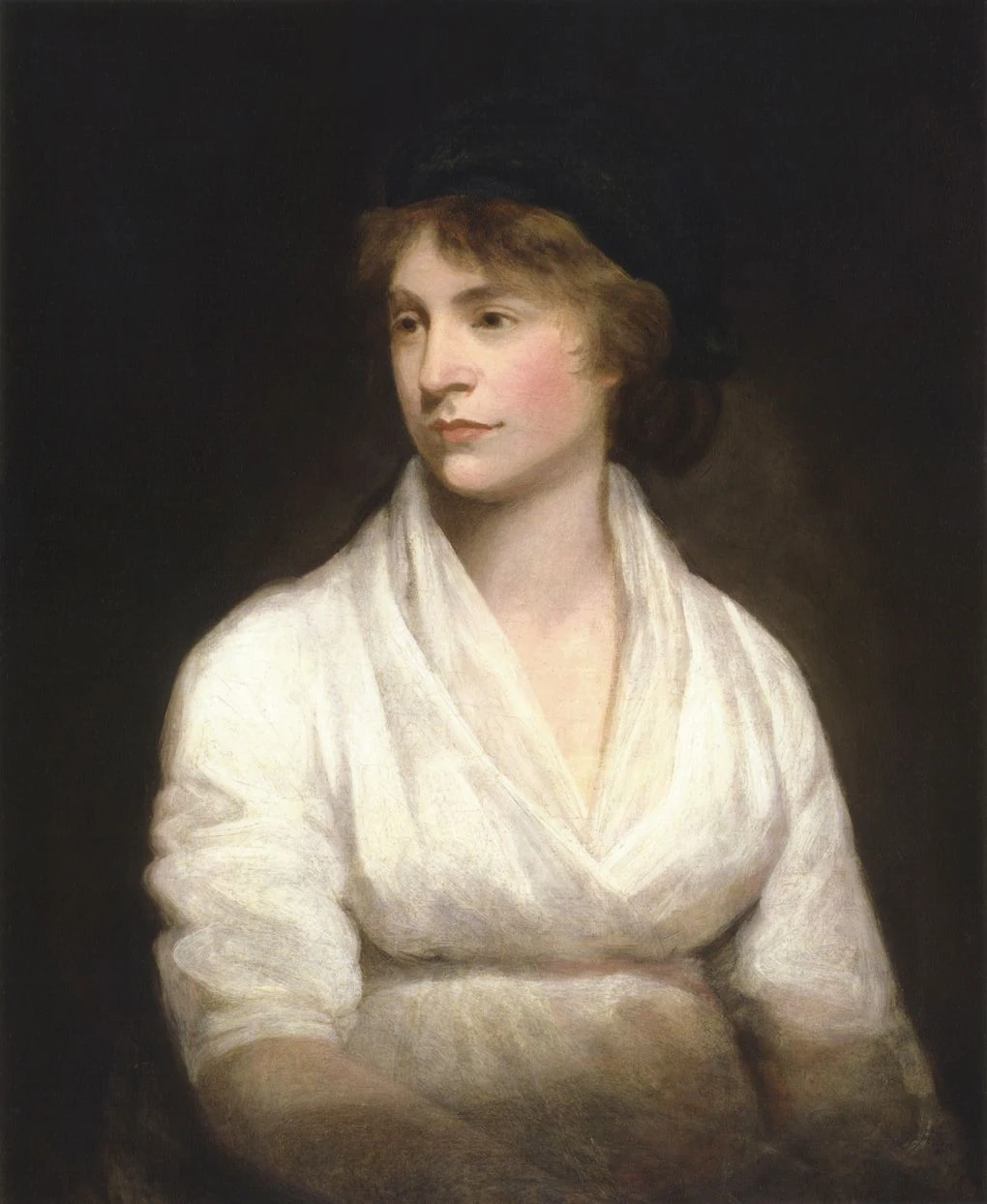
Mary Wollstonecraft made education the centre of a challenge to the limits placed on women. In A Vindication of the Rights of Woman (1792), she argued that women did not seem intellectually inferior because they lacked the capacity to reason, but because they were denied the education that would develop it. Her case joined a demand for women’s intellectual independence to a wider critique of inherited privilege and social convention. The book became her best-known work, but it was one part of a varied career in education, political writing, fiction and travel.
Choosing a life of writing
Wollstonecraft was born in Spitalfields, London, on 27 April 1759, the second of seven children. Her family’s finances became unstable as her father spent money on speculative projects, and the family moved frequently. As a young woman, Wollstonecraft worked as a companion to Sarah Dawson in Bath. She returned to her family when her mother was dying, then lived with her friend Fanny Blood. The two women, joined by Wollstonecraft’s sisters, established a school at Newington Green.
Blood’s death in 1785, after Wollstonecraft had gone to Lisbon to nurse her, helped inspire her first novel, Mary: A Fiction (1788). The school failed after Wollstonecraft left to care for Blood. With few respectable occupations open to a woman without money, she decided to support herself as a writer. In 1787 she moved to London and found work through the publisher Joseph Johnson, translating books and writing reviews, chiefly for the Analytical Review. Her early publications included Thoughts on the Education of Daughters (1787) and the children’s book Original Stories from Real Life (1788).
Those books established education as a continuing subject in her work. Wollstonecraft wrote about teaching children to reason and argued that women’s education mattered beyond the individual: it shaped family life and women’s contribution to society. Johnson’s circle brought her into contact with writers and political thinkers, including Thomas Paine and William Godwin, whom she would later marry. The literary work that paid her way also placed her within the political arguments of her time.
Rights, education and political argument
Wollstonecraft’s first major political intervention was A Vindication of the Rights of Men (1790), a response to Edmund Burke’s criticism of the French Revolution. She attacked aristocracy and hereditary privilege, and challenged the language used to defend them. The pamphlet brought her into public debate and prepared the ground for the argument she developed two years later.
In A Vindication of the Rights of Woman, Wollstonecraft contended that women seemed lesser because they were taught to prize appearance and dependence rather than to cultivate judgement. She argued that they should receive an education suited to their place in society and be treated as rational human beings. Her vision included men and women educated on the same model; women, she maintained, could be companions to their husbands rather than mere ornaments or possessions.
Her argument was social as well as personal. Educated women, she reasoned, could raise children and participate more fully in public life, benefiting the wider community. She challenged conduct books and educational theories that trained women to please men instead of developing their minds. The work’s demand for education was radical in its context, although Wollstonecraft’s account did not amount to a modern programme of equality in every sphere. Its lasting force lies in the question it pressed: whether supposed differences in ability could be separated from the unequal conditions in which women were raised.
She continued to explore women’s restricted choices in fiction. Her novels criticised marriage when economic dependence and social convention left women little freedom. The unfinished The Wrongs of Woman; or, Maria, published posthumously in 1798, centres on a woman confined in an asylum by her husband. These works, alongside her educational books and political pamphlets, show a writer investigating the effects of social arrangements in more than one form.
France, travel and private life
Wollstonecraft travelled to France in December 1792, shortly before Louis XVI was executed. She witnessed the upheaval of the revolution and wrote An Historical and Moral View of the French Revolution, published in London in 1794. The book treated the revolution as a major political event with social and economic causes, while her account also criticised the violence of the period.
In France she became involved with the American Gilbert Imlay. Their daughter, Fanny, was born in 1794. After returning to England in 1795, Wollstonecraft resumed her literary life. Her relationship with Imlay had ended. She and Godwin, who had met her through London’s literary circles, married on 29 March 1797, after she became pregnant. Their daughter Mary was born on 30 August. Wollstonecraft died of septicaemia on 10 September 1797, aged 38, following the birth. Mary later became the writer Mary Shelley, author of Frankenstein.
Wollstonecraft’s travel writing offered another way to examine society and personal experience. In Letters Written in Sweden, Norway, and Denmark (1796), she combined observations of Scandinavia with reflections on nature, feeling and social life. It became her most popular book during the 1790s. Her career thus ranged from practical educational writing to public political controversy, fiction and a personal travel narrative.
Reputation and the return of her work
In 1798, Godwin published Memoirs of the Author of A Vindication of the Rights of Woman. His frank account of Wollstonecraft’s relationships and private life shocked many readers and damaged her reputation for decades. Attention to her life displaced attention to her writing, and later authors used versions of her story as a warning about women who defied convention.
Her work returned to wider prominence as the women’s suffrage movement grew in Britain. The centenary edition of A Vindication of the Rights of Woman in 1892 had an introduction by suffragist Millicent Garrett Fawcett, who presented Wollstonecraft as a precursor to the struggle for the vote. In the twentieth century, feminist readers and scholars again took up her writing, including its arguments about education, political equality and the limits imposed by conventional femininity. Her reputation has therefore changed over time: from posthumous scandal to renewed attention to the intellectual work that scandal had obscured.
Why Mary Wollstonecraft deserves a place in British Legacy
Mary Wollstonecraft deserves a place in British Legacy because she gave a forceful, reasoned account of how women’s opportunities were shaped by education and social convention. In A Vindication of the Rights of Woman, she disputed the assumption that women’s apparent intellectual weakness was natural, arguing instead that it followed from being denied the means to develop their minds. She made education a matter of public consequence, connecting women’s intellectual development to family life and the good of society. That argument remains significant not because it supplies a complete modern programme, but because it challenged a powerful explanation for women’s restricted lives.
Her contribution also lies in the range of her writing. Educational works, a reply to Burke, novels, a history of the French Revolution and a Scandinavian travel narrative gave her different ways to consider how people are formed by material circumstances and social expectations. The history of her reputation adds another dimension: Godwin’s memoir helped make her private life a public controversy, while suffrage-era readers restored attention to her ideas. Wollstonecraft was one writer, not the sole origin of later campaigns for women’s rights. But her insistence that women should be educated as rational beings, and her sustained examination of the structures that denied them that opportunity, form a consequential part of Britain’s intellectual and literary history.
Sources
Mary Wollstonecraft (revision 1379401036)
Adapted in part from Mary Wollstonecraft by Wikipedia contributors, under CC BY-SA 4.0. Text has been edited and combined with the existing article; this adapted text is shared under the same licence. Contributor history.
.jpg)